
Welcome to the Official Website of TianGe Attachments.

Excavator Forks by TGEC

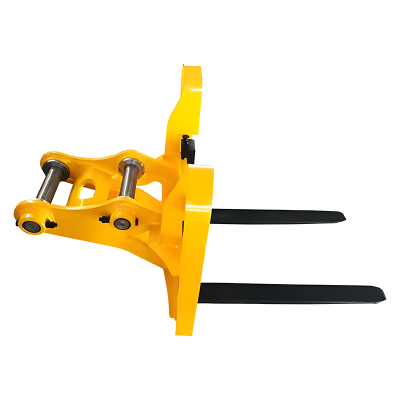
TGEC designs and builds excavator forks for material handling, pallet lifting, load movement, and construction site logistics. Our core offering in this space is the excavator pallet fork attachment—a rugged Q355B steel frame with adjustable tines that lift and transport palletized loads, lumber, pipes, construction materials, and equipment. We offer six models sized for mini and full-size excavators from 1.5 to 20+ tons. As a factory-direct manufacturer, we supply these fork attachments to equipment dealers, construction contractors, material handling firms, and qualified OEM partners with direct production and sourcing support.

Recommended Products

Browse the TGEC excavator fork lineup below. Every model is built around a specific excavator class, fork width, and load capacity. Click through to any product for full specs, compatibility info, and application notes.
A total of 1 pages 1

Machine Compatibility

TGEC excavator forks come in six models for machines from 1.5 tons up to 20+ tons. Final fit depends on the specific model, your excavator's operating weight, lift capacity, pin spacing, pin diameter, and coupler type. Each model has specific weight and dimensional specs that have to line up with your machine's lift capacity and mounting interface.

Head to the product page for detailed machine matching across all six models. Not sure which forks fit your rig? Send us your excavator make, model, operating weight, lift capacity, and mounting dimensions and we'll sort it out. For a detailed selection guide covering load capacity, fork dimensions, and mounting considerations, see our article on how to choose excavator pallet forks.

Application Scenarios

  • Palletized material handling: Lift and transport pallets of building materials, supplies and equipment on construction sites and in yards.

  • Lumber and timber handling: Move bundles of lumber, timber, poles and long building materials on job sites and at distribution yards.

  • Pipe and conduit handling: Lift and position PVC, HDPE, concrete and metal pipes for utility installation and infrastructure projects.

  • Construction site logistics: Move equipment, supplies, prefabricated components and materials around job sites without a forklift.

  • Landscaping and hardscaping: Transport pallets of pavers, stone, soil amendments and plants on landscaping and hardscaping projects.

  • Agricultural and farm use: Move hay bales, feed pallets, fencing materials and farm supplies around agricultural operations.

OEM & Bulk Supply

As a direct manufacturer, TGEC supplies excavator forks to equipment dealers, construction contractors, material handling firms, and OEM partners around the globe. We offer dealer and bulk-supply programs based on model selection, order volume, machine specs, and project needs. OEM and private-label arrangements can also be explored based on partner requirements and production feasibility.

Frequently Asked Questions

What are excavator forks used for?+

Excavator forks are material-handling attachments mounted to an excavator's boom for lifting and transporting palletized and non-palletized loads. They allow contractors to perform material handling with an excavator when a forklift is not available or practical—particularly on uneven terrain, in confined spaces, or at remote job sites. The excavator's boom and arm provide reach and lifting capability, while the fork tines support the load from below, similar to a forklift. This expands the utility of an excavator beyond digging and earthmoving into general material handling and site logistics.

What types of loads can excavator fork attachments handle?+

Excavator fork attachments handle palletized loads as their primary application, along with non-palletized loads such as lumber bundles, pipes, and equipment when the tines are positioned appropriately. The maximum load capacity is determined by the fork model's rated capacity, the excavator's lift capacity at the working reach, and the distribution of the load on the fork tines. Contractors should always verify that the combined weight of the attachment and load is within the excavator's rated lift capacity at the required reach, and that the load is properly positioned and secured before lifting.

How do excavator forks differ from other material-handling attachments?+

Excavator forks use two parallel tines that slide under a load from below, similar to a forklift—ideal for palletized and flat-bottomed materials. Unlike a grapple, which uses jaws to grasp irregular material like rocks and logs, forks are designed for structured loads. Unlike a bucket, which scoops and carries loose material, forks lift without containing the material. And unlike a thumb, which works with a bucket to grasp material, forks are a standalone attachment that replaces the bucket. The key advantage is handling palletized loads with precision while leveraging the excavator's mobility, reach, and all-terrain capability on sites where a conventional forklift cannot operate.

How do you choose an excavator fork attachment for a specific machine?+

Choosing the right excavator fork attachment requires evaluating several factors. First, confirm the excavator's operating weight—each TGEC model is designed for a specific tonnage range from 1.5 to 20+ tons. Second, verify the excavator's lift capacity at the typical working reach using the machine's load chart, accounting for the fork attachment's unit weight plus the expected load weight. Third, check the mounting interface including pin-to-pin spacing, pin diameter, and coupler type (direct pin-on or quick coupler) to ensure compatibility. Fourth, evaluate the required fork width and tine spacing based on typical load dimensions. Custom mounting brackets may be required for specific excavator models. For detailed guidance, see our selection guide on how to choose excavator pallet forks.

Can excavator forks be configured for different excavator sizes and mounting systems?+

Yes. TGEC offers six standard models covering excavators from 1.5 to 20+ tons, each designed for a specific tonnage range with appropriate frame dimensions and fork width. For machines that fall between standard models or have unique requirements, custom configurations can be reviewed based on specific machine specifications. Mounting systems can be configured for direct pin-on mounting or adapted for quick coupler systems for fast attachment changes. Custom mounting brackets can be fabricated to match specific excavator models' pin-to-pin spacing, pin diameter, and coupler geometry. Fork tines can be configured with adjustable spacing to accommodate different pallet sizes, and fixed-position tines are available where consistent spacing is preferred. When requesting a custom configuration, provide the excavator make and model, operating weight, lift capacity, mounting dimensions, coupler type, and typical load requirements, and our team can review feasibility and provide a quotation.

Request a Quote — TGEC Excavator Forks

To get a quote, send us your excavator make and model, operating weight, lift capacity, pin spacing and diameter, coupler type, preferred fork model, and what you'll be moving. We'll check compatibility, recommend the right setup, and send back a factory-direct quote with delivery terms.