Welcome to the Official Website of TianGe Attachments.

Hydraulic Breaker Chisels

Hydraulic Breaker Chisels

TGEC hydraulic breaker chisels are high‑strength alloy steel working tools available in four types – moil point, blunt tool, flat wedge, and conical point – each engineered for specific materials and applications. All chisels are heat‑treated for durability and precision‑machined to fit TGEC breaker models, with tool diameters from 40 to 255 mm depending on breaker model.
Product Name: Hydraulic Breaker Chisels / Breaker Bits / Rock Hammer Moil Points / Breaker Tool Bits / Rock Breaker Working Tools
Type: Parts & Chisels
After-sales Service: Provided
Warranty: 1 Year
Customization: Available
Shipping Cost: Negotiate with us about shipping cost and estimated delivery time.
Get a quote
Overview
FAQ

Product Overview

Breaker chisels – also called bits or working tools – are the replaceable front‑end tools that take the direct hit from the breaker piston and transfer that energy into the material you're breaking. They're the primary wear item on any breaker, taking repeated impact, abrasion, and bending loads, so they need to be swapped out periodically as they wear down or get damaged. Picking the right chisel type for your material and job makes a real difference in productivity and tool life – the wrong one will slow you down, wear out faster, and can even stress the breaker's internal parts. TGEC offers four main chisel types, all made from high‑strength alloy steel with proper heat treatment, to cover the full range of demolition and rock breaking work. Part of the TGEC excavator breaker working tools and spare parts lineup.

TGEC supplies breaker chisels for its side‑type, silenced box‑type, top‑type open‑body, and gas‑free R‑Series, M‑Series, and V‑Series breakers, with tool diameters from 40 mm for compact 0.5‑ton mini excavator breakers up to 255 mm for heavy‑duty 160‑ton quarry rigs. Each chisel type has a specific tip geometry and cross‑section profile optimized for particular materials and breaking actions, and the shank is precision‑machined to match the breaker's tool holder and retaining pin setup. Using a chisel with incorrect dimensions, material properties or heat treatment can lead to accelerated wear, poor fit or premature tool failure. For dealers, rental fleets, quarry operators, and mining companies, TGEC offers volume pricing, custom configurations, and fast shipping to keep downtime to a minimum.

Chisel Types and Applications

TGEC chisels come in four primary types, each with a specific tip geometry for different materials and breaking jobs.

Chisel TypePrimary ApplicationSecondary Applications
Moil PointGeneral demolition and quarry workBreaking slag, demolishing foundations, roadway drivage, mining operations
Blunt ToolCrushing large rocks in quarriesCrushing slag, ground compaction, secondary breaking of oversize boulders
Flat Point (Wedge)General breaking with cutting actionDigging pits in rocky subsoil, separating rock slabs, asphalt cutting
Conical PointPenetrative breaking in medium‑hard materialsGeneral demolition work where initial penetration is required

Chisel specs are for reference only. Actual dimensions and availability may vary by breaker model and application. Contact the TianGe technical team for selection guidance.

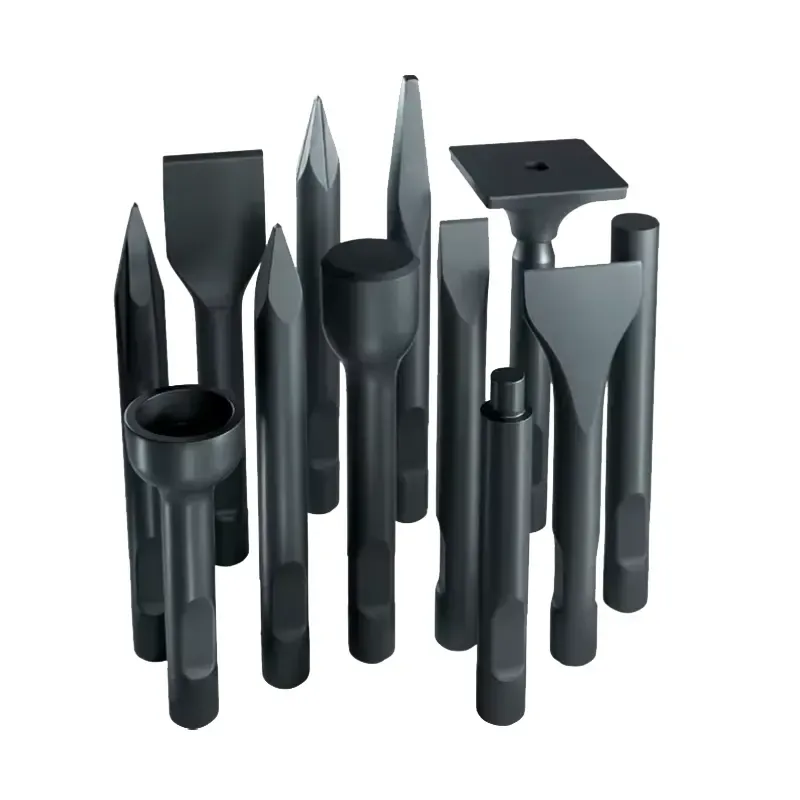
The moil point is the most common and versatile chisel – its pointed tip concentrates impact energy on a small area, making it effective for general demolition, concrete breaking, and quarry rock. It's the default choice for most breaker work and comes standard with new breakers. The blunt tool has a wide, flat working end that spreads impact over a larger area – ideal for crushing applications like secondary quarry breaking, oversized boulder reduction, slag crushing, and ground compaction. The flat wedge has a wide blade tip that delivers a cutting action – great for asphalt cutting, rock slab separation, and digging in rocky subsoil. The conical point has a tapered tip that balances penetration and impact area – effective for medium‑hard materials and general demolition where initial penetration is needed, and it holds a functional point longer as it wears compared to a sharp moil point.
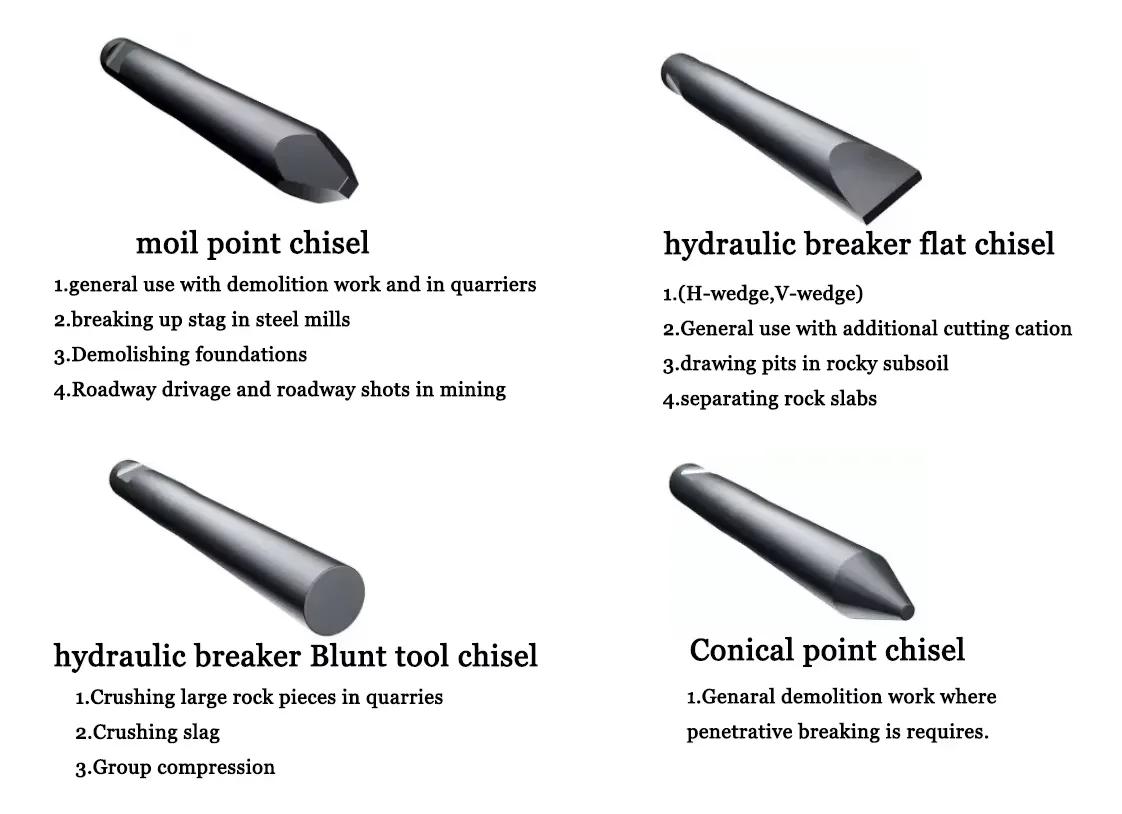
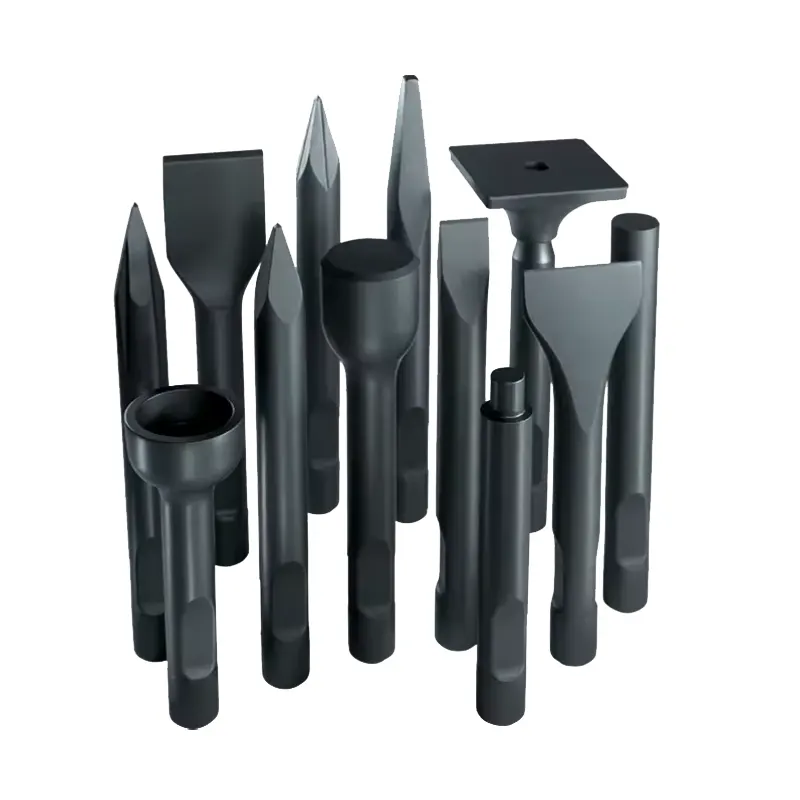
TGEC Hydraulic Breaker Chisels — Moil Point, Blunt Tool, Flat Wedge and Conical Point types for TGEC breaker series

Materials and Manufacturing

TGEC chisels are forged from high‑strength alloy steel with chromium, molybdenum, nickel, and other elements for hardenability, impact toughness, and wear resistance. Precision forging aligns the grain flow with the chisel shape, giving better mechanical properties than machined‑from‑bar tools. After forging, each chisel goes through a multi‑stage heat treatment – austenitizing, quenching, and tempering – to achieve the right balance of hardness and toughness. The working tip receives additional surface hardening for maximum wear resistance, while the shank and retaining pin areas are maintained at a slightly lower hardness for better toughness and crack resistance. After heat treatment, each chisel is CNC‑machined and inspected for dimensions, hardness, and surface condition before shipment. For customers with special needs, TGEC can produce custom chisels with specific tip geometries, dimensions, materials, or surface treatments.

Chisel Selection and Replacement

Choosing the right chisel comes down to your primary material, the breaking action you need, and your breaker model. For general‑purpose demolition, concrete breaking, and rock work, the moil point is generally the most versatile choice. For quarry secondary crushing, boulder reduction, slag crushing, and ground compaction, the blunt tool is generally better suited. For asphalt cutting, rock slab separation, and cutting or splitting work, the flat wedge does the job. For medium‑hard materials where you need both penetration and decent tool life, the conical point is a solid middle ground. Not sure? The moil point is generally the most versatile choice, and our technical team can give you a specific recommendation based on your material, application, and breaker.

Replace the chisel when the tip is worn down to approximately 20–30% of its original length as a general guideline, or when cracks, bending or excessive retaining‑pin‑hole wear are present. Running a worn chisel puts extra stress on the breaker piston, front head, and bushing, which can lead to accelerated wear or damage on those expensive parts. Inspect the chisel daily as part of your routine breaker maintenance – check the tip, the pin hole, and look for cracks or bending. Swapping a chisel is a simple field job – pull the retaining pins, slide out the old one, slide in the new one, and reinstall the pins. While you're at it, check the front head bushing and retaining pins for wear too.

Fleet and Dealer Programs

For dealers, rental fleets, quarry operators, mining companies, and contractors running multiple breakers, TGEC offers fleet and dealer chisel programs with volume pricing based on annual purchasing volume, dedicated account management, and custom chisel kits tailored to specific breaker models and fleet setups. All programs are customized to your needs, breaker models, and applications, and our chisel program team works with you to develop a procurement plan that maximizes uptime and cuts total costs.

Request a Quote — Hydraulic Breaker Chisels

Tell us your breaker model number, the chisel type(s) you need (moil point, blunt tool, flat wedge, or conical point), quantity, and shipping location. Our team will confirm the correct chisel specs for your breaker, check availability and pricing, and send a detailed quote with estimated delivery. For fleet, dealer, or volume inquiries, include your company details, breaker models in your fleet, estimated annual chisel volume, and any specific program needs – we'll put together a customized proposal for your operation.
Frequently Asked Questions

What types of chisels are available for excavator breakers?+

TGEC hydraulic breaker chisels come in four primary types. The moil point features a pointed tip for general demolition, concrete breaking and quarry rock work. The blunt tool has a wide, flat working end for crushing applications including quarry secondary breaking and oversized boulder reduction. The flat wedge has a wide blade tip for asphalt cutting and rock slab separation. The conical point has a tapered tip for penetrative breaking in medium‑hard materials. Four primary chisel types are available across the TGEC breaker range, with type and diameter depending on the breaker model and application.

How do you choose a breaker chisel for rock?+

For general rock breaking in quarry, mining and construction, the moil point is the most common and versatile choice, concentrating impact energy to penetrate rock surfaces and initiate fractures. For secondary crushing of oversized boulders, the blunt tool is preferred because its wide flat end delivers a crushing action. For medium‑hard rock where both penetration and tool life are important, the conical point provides a good balance. For rock slab separation or splitting, the flat wedge can be used.

What breaker bit is suitable for concrete?+

For concrete demolition, the moil point chisel is the standard and most commonly used breaker bit, delivering focused impact energy that efficiently fractures reinforced concrete slabs, foundations and structural elements. For flat concrete slabs or wall sections where a cutting action is preferred, the flat wedge can be used to create clean, even cuts. For asphalt concrete or pavement cutting, the flat wedge is particularly effective. For medium‑hard concrete with high aggregate content, the conical point can be a good alternative.

When should an excavator breaker chisel be replaced?+

A breaker chisel should be replaced when the working tip has worn down to approximately 20 to 30 percent of the original tip length as a general guideline, or when the chisel shows signs of cracking, bending or excessive retaining‑pin‑hole wear. Continuing to operate with an excessively worn chisel can cause increased stress on the breaker piston, front head and bushing. A cracked chisel can fail catastrophically during operation, so any cracked chisel should be replaced immediately. Chisel inspection should be performed daily as part of routine breaker maintenance.

Does chisel selection affect breaker performance?+

Yes, chisel selection significantly affects breaker performance, tool life and operating cost. The chisel directly contacts the material, and its tip geometry determines how impact energy is transferred. Using a moil point for crushing applications can result in the tool getting stuck and placing excessive lateral stress on the breaker. Conversely, using a blunt tool for penetrative breaking in hard rock results in poor penetration and reduced efficiency. Using an incorrectly sized chisel can cause poor tool retention, excessive play and potential damage. Using genuine TGEC chisels manufactured to correct specifications ensures proper fit and optimal performance.

How do I confirm chisel compatibility?+

The most reliable method is to provide the breaker model number to TGEC parts support, because each breaker model has a specific tool diameter, shank length, retaining pin configuration and overall length that must match the chisel dimensions. The breaker model number is typically found on the identification plate, in original documentation or on the breaker housing. Once the model is confirmed, the correct chisel can be identified from the TGEC parts catalog. If the model number is not visible, compatibility can be verified by measuring the existing chisel dimensions and providing these measurements to TGEC for cross‑reference.

Can breaker chisels be supplied as replacement tools?+

Yes, TGEC supplies chisels as replacement tools for its breaker range, with chisel type and tool diameter depending on the breaker model and application. Replacement chisels are manufactured to the same specifications, materials and quality standards as original chisels supplied with new breakers. Customers can order replacement chisels individually or in volume with volume pricing discounts. TGEC maintains ready inventory for common chisel types and sizes, with fast shipping typically within one to three business days for in-stock items. For less common types or custom configurations, chisels may be manufactured to order. When ordering, provide the breaker model number to ensure correct specifications.

Can dealers order breaker chisels in bulk?+

Yes, equipment dealers, rental fleets, quarry operators, mining companies and contractors can order chisels in bulk with volume pricing discounts based on annual purchasing volume. Bulk ordering is available for all chisel types and tool diameters, and customers can order mixed quantities of different types and sizes to match their specific fleet and application requirements. For dealers, bulk ordering allows maintaining chisel inventory for customers. For rental fleets, bulk ordering ensures an adequate supply of replacement chisels is always available. Bulk orders can be supplied with custom packaging and labeling for dealer and OEM customers.

Can OEM tool requirements be supported?+

Yes, TGEC supports OEM tool requirements for equipment manufacturers, attachment distributors and private‑label breaker brands. We can supply chisels with OEM customer branding, packaging and documentation. OEM chisels can be supplied in custom quantities and configurations matched to the customer breaker models and production volumes. For customers integrating TGEC breaker components into their own equipment, we can supply custom chisels with custom dimensions, tip geometries, materials or surface treatments. For larger OEM customers with significant tool volume, dedicated production and inventory programs are available.

What information should be provided when ordering chisels?+

When ordering chisels, provide the following information for accurate identification, pricing and delivery. First, the breaker model number, which is the primary reference for chisel identification. Second, the breaker serial number if available, to verify specific production configuration. Third, the chisel type or types required, specifying moil point, blunt tool, flat wedge or conical point. If unsure, describe the material and application and our technical team can recommend the appropriate type. Fourth, the quantity of each type and size required. Fifth, shipping address and contact information. If the model number is unavailable, provide existing chisel measurements or photographs and our parts technicians can help identify the correct chisel.
Please make sure to include your phone number with the country code (e.g., 86 for China, 1 for USA).