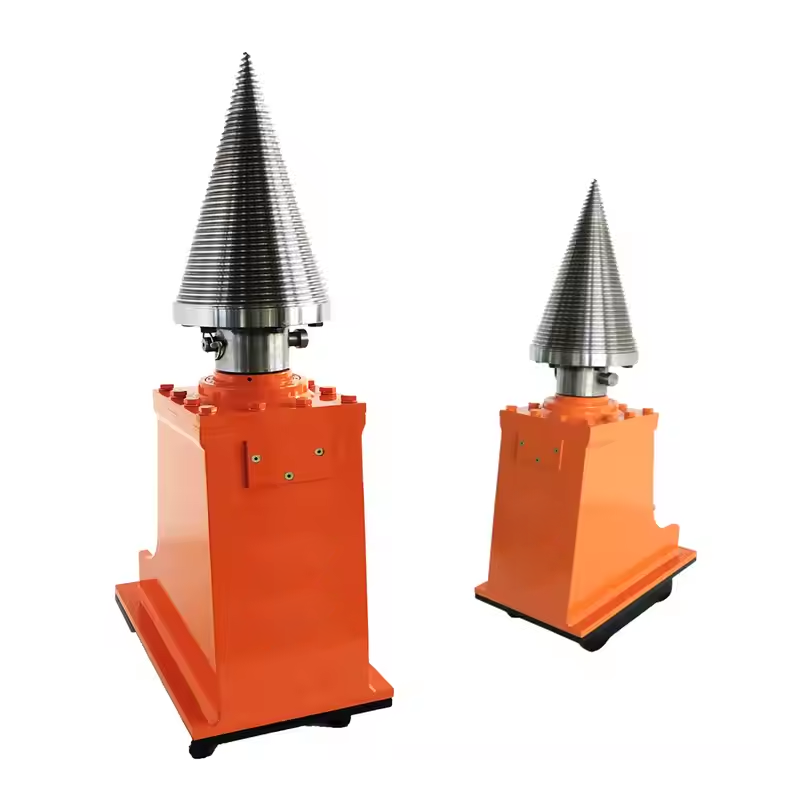
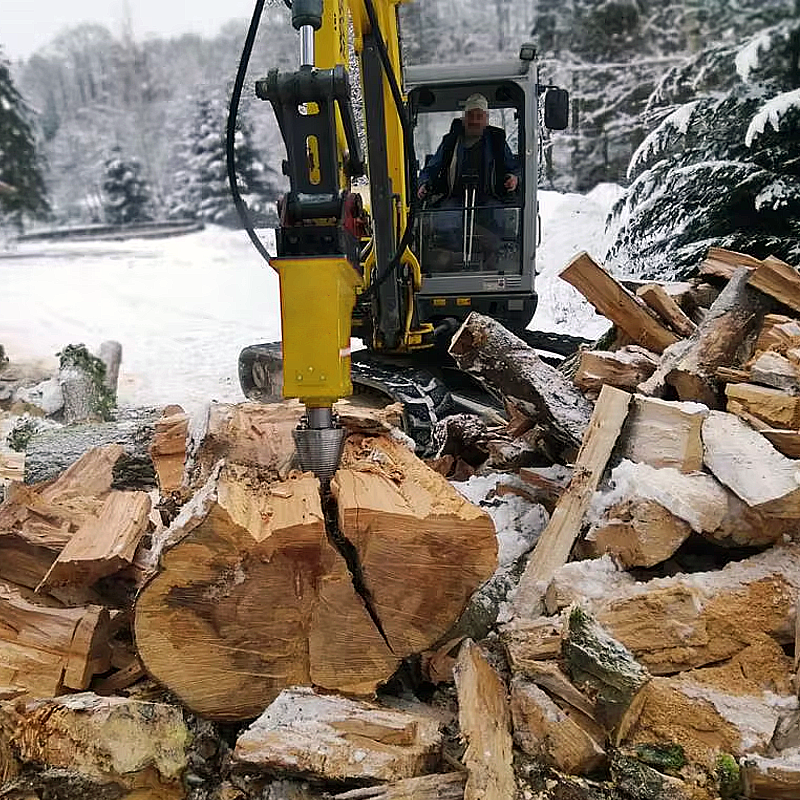
Product Overview
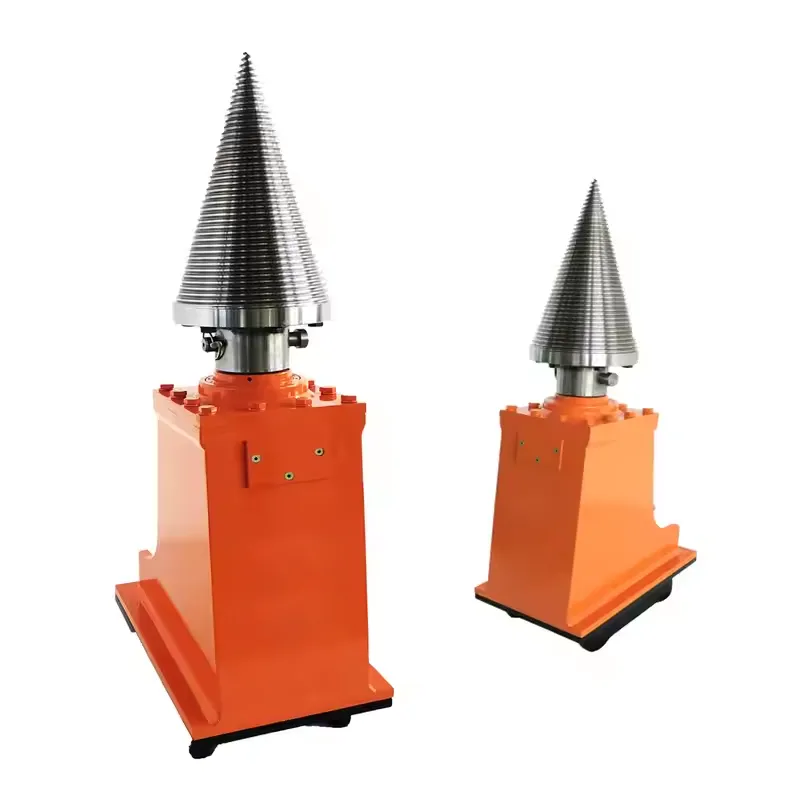
The TGEC excavator cone splitter is a rotating conical screw splitting attachment in the Excavator Log Splitters range, purpose-built for on-site wood processing, large-diameter log splitting, hardwood processing and high-volume forestry operations. It pins onto the excavator boom with standard pin-on or quick coupler brackets and ties into the machine's auxiliary hydraulic circuit, which powers a hydraulic motor that spins the conical screw. As the cone rotates and is pushed into the end of a log, the screw threads bite into the wood and wedge it apart along the grain, generating high torque with less downward force than a conventional wedge-style splitter. Four models are available: the TGEC-WS12 for 2–5 ton excavators with a 150 mm cone, the TGEC-WS40 for 2.5–4.5 ton excavators with a 200 mm cone, the TGEC-WS80 for 5–8 ton excavators with a 300 mm cone, and the TGEC-WS120 for 13–17 ton excavators with a 400 mm cone.
All models are built with high-strength steel, a hardened conical screw with a replaceable cutting tip, a sealed hydraulic motor, and heavy-duty mounting brackets that can take the abuse of forestry and land-clearing work. The hydraulic motor is sized to deliver steady torque across the full operating range, and the cone geometry is designed to bore into logs quickly and split them without binding or stalling. The compact design keeps boom overhang to a minimum and preserves the excavator's lift capacity and stability—especially important when working with large, heavy logs at full reach. The TGEC-WS12 and TGEC-WS40 are a great fit for mini excavators and smaller-scale firewood operations, while the TGEC-WS80 and TGEC-WS120 step up the capacity for big logs and high-volume processing with larger cones, more torque, and greater log capacity. Cone splitters are especially effective on hardwoods and large-diameter logs that would slow down or stall a conventional wedge-style splitter. For clean, uniform firewood splits, check out the conventional Excavator Log Splitter with a Hardox wedge.
Technical Specifications
| Model | TGEC-WS12 | TGEC-WS40 | TGEC-WS80 | TGEC-WS120 |
|---|---|---|---|---|
| Applicable Excavator Weight | 2–5 T | 2.5–4.5 T | 5–8 T | 13–17 T |
| Attachment Weight | 90 kg / 198 lb | 139 kg / 306 lb | 260 kg / 573 lb | 270 kg / 595 lb |
| Dimensions (L × W × H) | 230 × 260 × 845 mm 9.1 × 10.2 × 33.3 in | 400 × 270 × 930 mm 15.7 × 10.6 × 36.6 in | 600 × 420 × 1130 mm 23.6 × 16.5 × 44.5 in | 650 × 470 × 1230 mm 25.6 × 18.5 × 48.4 in |
| Working Pressure | 170 bar / 2466 PSI | 205 bar / 2973 PSI | 205 bar / 2973 PSI | 205 bar / 2973 PSI |
| Maximum Pressure | 170 bar / 2466 PSI | 310 bar / 4496 PSI | 310 bar / 4496 PSI | 310 bar / 4496 PSI |
| Maximum Torque | 1180 Nm / 870 ft-lb | 3760 Nm / 2773 ft-lb | 8240 Nm / 6075 ft-lb | 12300 Nm / 9069 ft-lb |
| Rated Hydraulic Flow | 30–70 L/min / 7.9–18.5 GPM | 150 L/min / 39.6 GPM | 150 L/min / 39.6 GPM | 150 L/min / 39.6 GPM |
| Maximum Hydraulic Flow | 30–70 L/min / 7.9–18.5 GPM | 210 L/min / 55.5 GPM | 225 L/min / 59.4 GPM | 170 L/min / 44.9 GPM |
| Cone Size (Diameter × Length) | Φ150 × 290 mm 5.9 × 11.4 in | Φ200 × 400 mm 7.9 × 15.7 in | Φ300 × 540 mm 11.8 × 21.3 in | Φ400 × 650 mm 15.7 × 25.6 in |
| Maximum Log Length | 1 m / 3.3 ft | 1 m / 3.3 ft | 1.5 m / 4.9 ft | 2 m / 6.6 ft |
| Maximum Log Diameter | 0.4 m / 15.7 in | 0.8 m / 31.5 in | 1 m / 39.4 in | 1 m / 39.4 in |
Specifications may vary by configuration. Contact TGEC for custom mounting brackets and hydraulic flow options.
How It Works
The excavator cone splitter draws power from the machine's auxiliary hydraulic circuit to run a hydraulic motor that spins a hardened conical screw. When the operator engages the auxiliary hydraulic control, pressurized fluid drives the motor, rotating the cone at a controlled speed while the excavator's boom and arm controls press the spinning cone into the end of a log. As the cone's screw threads dig into the wood, the advancing conical shape wedges the log apart along the grain, with rotational torque doing the heavy lifting rather than direct linear pressure. Once the log is split, the operator reverses the hydraulic flow to back the cone out of the log, then moves on to the next split.
Application Scenarios
Large-diameter log splitting: Process logs up to 1000 mm in diameter that would be difficult or slow to split with a conventional wedge-style splitter.
Hardwood processing: Split dense hardwoods such as oak, maple and ash with high rotational torque that requires less downward force than wedge splitters.
High-volume firewood production: Process large quantities of logs quickly with fast cycle times and minimal operator effort, ideal for commercial firewood operations.
Land clearing and site development: Process fallen trees and large brush into manageable pieces for removal, mulching or disposal on construction sites.
Forestry and timber operations: Split logs for further processing, reduce log volume for transport, and process large-diameter thinning material in managed woodlands.
Tree service and arborist work: Process large removed trees on site, reducing hauling costs and enabling on-site firewood or mulch production.
Farm and rural property maintenance: Clear large fallen trees, split firewood for personal use, and maintain woodlots and fence lines on rural properties.
Installation & Mounting
The excavator cone splitter mounts to the boom using standard pin-on or quick coupler brackets, with mounting plates fabricated to match your machine's pin-to-pin spacing, pin diameter, and coupler interface. Hydraulic hoses connect the splitter's motor to the excavator's auxiliary circuit, with routing planned to avoid interference with boom and arm movement and to prevent pinching or abrasion during work. A case drain line is typically required for the hydraulic motor to prevent backpressure and seal damage—install it according to the motor manufacturer's specs and your excavator's auxiliary circuit configuration. Before first use, verify that your machine's auxiliary flow and pressure fall within the attachment's specified range, that all hydraulic connections are secure and leak-free, and that the mounting pins are properly installed and secured with retaining clips or bolts.
Wear & Service
The main wear components are the conical screw and its cutting tip—check them regularly for dullness, chipping, or wear, and replace or re-sharpen them when boring performance drops off. Inspect the hydraulic motor seals for leaks or damage, and service or replace the motor as needed to keep torque consistent and prevent fluid contamination. Check hydraulic hoses and fittings for abrasion, cracking, or leaks—replace damaged hoses immediately to avoid catastrophic failure under pressure. Keep the case drain line clear of blockages or restrictions, as a blocked drain can cause motor seal failure. Grease mounting pins and bushings on schedule and inspect them for excessive wear; replace worn pins or bushings to maintain proper attachment alignment. Also inspect the steel frame and welds periodically for cracks or deformation, especially after heavy use or impact with large logs, and have any structural damage repaired by a qualified welder before putting the splitter back to work.
Dealer & Bulk Orders
TGEC supplies excavator cone splitters to forestry equipment dealers, tree service contractors, land-clearing firms, municipal maintenance departments, and OEM partners worldwide. We offer dealer and bulk-supply programs based on model selection, order volume, machine specs, and project needs. OEM and private-label arrangements can also be explored based on partner requirements and production feasibility.
Request a Quote
To get a quote, send us your excavator make and model, operating weight, auxiliary flow and pressure, pin spacing and diameter, coupler type, preferred model (TGEC-WS12, WS40, WS80, or WS120), typical log diameter and wood type, and what you'll be using it for. We'll check compatibility, recommend the right setup, and send back a factory-direct quote with delivery terms.