When you're picking an excavator-mounted wood splitting attachment, the biggest decision you'll face is whether to go with a conventional hydraulic log splitter or a cone splitter. Both pin onto your excavator and run off the auxiliary hydraulics, but they work in completely different ways—each with its own strengths, limitations, and ideal use cases. This guide breaks down the two methods across key performance areas to help you figure out which one is right for your operation.
Splitting Mechanism: Wedge vs Rotating Cone
The core difference between these two attachments is how they actually split the wood. A conventional excavator log splitter uses a hydraulic ram to drive a hardened Hardox wedge straight into the end of a log with direct linear force. As the wedge pushes forward, it forces the log apart along the grain, giving you clean, controlled splits. The ram extends to split, then retracts to reset—one split per cycle. The wedge's shape determines the split angle and the quality of the pieces: sharper, narrower wedges give cleaner splits but need more force, while wider wedges need less force but produce rougher results.
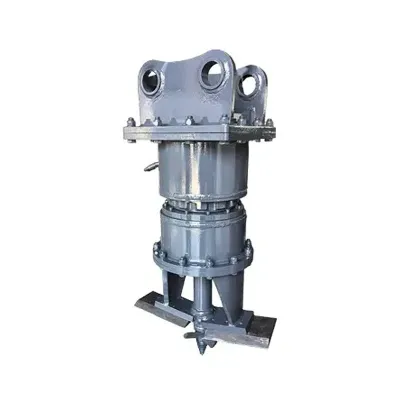
A cone splitter, on the other hand, uses a hydraulic motor to spin a hardened conical screw. You press the rotating cone into the end of a log using the excavator's boom and arm. As it turns, the screw threads bite into the wood, and the advancing conical shape wedges the log apart. The splitting force comes from rotational torque rather than straight-line pressure, and the cone keeps going through the log until it's fully split. Cone splitters can often handle the whole log in a single pass without you having to reposition it. The threaded design also helps pull the attachment into the log, so you don't have to push down as hard with the boom.
Splitting Force and Log Capacity
Conventional log splitters are rated by splitting force in tonnes and split capacity in millimeters. The TGEC SL-WS 470 delivers 21 tonnes of force with a 470 mm capacity, while the SL-WS 610 bumps that up to 25 tonnes and 610 mm. The wedge's linear force is great for splitting along the grain, but all that force is concentrated right at the tip—which can lead to binding or the wedge getting stuck in really big or dense logs. For logs near the max capacity, you might need to make multiple passes or reposition the log to get it fully split.
Cone splitters are rated by maximum torque in Newton-meters and maximum log diameter. The TGEC cone splitter lineup gives you 1180–12300 Nm of torque, with max log diameters from 400 mm all the way up to 1000 mm. The rotational torque is spread across the threaded surface, which lets the cone work through large-diameter and dense logs more effectively than a wedge. The self-feeding design pulls the cone into the log, so you don't need as much downward force and there's less chance of binding. For really big logs (over 600 mm) and tough hardwoods, cone splitters generally outperform wedge splitters in both speed and reliability.
Wood Type and Split Quality
Conventional wedge splitters really shine when it comes to producing clean, uniform splits—ideal for firewood. The linear force follows the grain precisely, giving you predictable piece sizes and smooth split surfaces that are easy to stack and sell. Wedge splitters work great with softwoods like pine, poplar, and spruce, and with medium-density hardwoods like birch and cherry. But if you're dealing with very dense hardwoods like oak, maple, or ash, or logs with knots, twisted grain, or irregular shapes, a wedge can bind, stall, or leave you with uneven splits that need multiple passes.
Cone splitters are more effective for dense hardwoods, large-diameter logs, and tough grain patterns. The rotating cone works through the wood with torque, cutting across grain variations and knots that would stop a wedge cold. The trade-off is that cone splitters generally produce rougher, less uniform splits. The conical shape tears the wood apart rather than cutting cleanly along the grain, so the pieces can be irregular in size and shape—which is fine for land clearing, mulch production, and general processing, but not ideal for commercial firewood where uniformity matters. If you're selling firewood and want consistent piece sizes, go with a wedge splitter. If you're processing big, tough logs and throughput is what counts, a cone splitter is the way to go.
Cycle Speed and Productivity
Conventional log splitters work on an extend-split-retract cycle, with each cycle delivering one split. Cycle time depends on your hydraulic flow, ram stroke length, and how resistant the log is—typically 5–15 seconds per split. For small to medium logs that split easily, wedge splitters can be very productive, with fast cycles and minimal operator effort. But for large or dense logs that need multiple passes or repositioning, productivity drops off fast as you wrestle with the log and make repeated attempts.
Cone splitters generally give you faster cycle times on large and dense logs, since the rotating cone can power through the full log diameter in a single pass without repositioning. The self-feeding design reduces operator input—the cone pulls itself into the log while you just maintain downward pressure with the boom. For high-volume processing of big logs, cone splitters can be significantly more productive than wedge splitters. For small logs that split easily, the difference isn't as dramatic, and wedge splitters might be just as fast or faster because of their simpler ram operation. The productivity advantage of cone splitters really shows up as log diameter and wood density increase.
Hydraulic Requirements and Complexity
Conventional log splitters keep things simple on the hydraulic side—they just need a double-acting auxiliary circuit to extend and retract the ram. They typically run at 207 bar (3000 PSI) with flow rates of 30–100 L/min, depending on the model. No case drain line is required since the ram doesn't have a motor shaft seal that could be damaged by backpressure. That simple design means fewer components to maintain and fewer things that can go wrong.
Cone splitters are more demanding hydraulically. You need a bidirectional auxiliary circuit to drive the hydraulic motor forward and reverse, plus a case drain line to keep backpressure off the motor shaft seal. They typically run at 205–310 bar (2973–4496 PSI) with flow rates of 30–225 L/min, depending on the model. The larger cone splitter models (WS80 and WS120) need high-flow auxiliary circuits (150 L/min rated) to generate enough torque, which not all excavators have. The hydraulic motor adds complexity and potential failure points—motor seals, bearings, and the case drain system all need attention. For detailed hydraulic matching guidance, check out the Excavator Log Splitter Hydraulic Requirements guide.
Maintenance and Wear Parts
Conventional log splitters are pretty straightforward to maintain. The main wear part is the Hardox cutting wedge—inspect it regularly and re-sharpen or replace it when it dulls. Check the hydraulic ram seals for leaks and replace them as needed. Hydraulic hoses, fittings, mounting pins, and bushings need regular inspection and greasing. The simple design means fewer wear parts and lower overall maintenance costs.
Cone splitters come with more maintenance duties because of the hydraulic motor and rotating cone assembly. The conical screw and cutting tip are the primary wear parts—check them often for dullness, chipping, or excessive wear. The hydraulic motor needs regular inspection of seals, bearings, and the case drain system, with service or replacement as needed. The case drain line must stay clear and unrestricted—a blockage can cause motor seal failure. Hydraulic hoses and fittings need the same regular inspection as conventional splitters, with extra attention to the motor supply and drain lines. While cone splitters have more wear parts and higher maintenance requirements, the productivity boost on large and dense logs often makes up for the extra maintenance cost.
Comparison Summary
| Factor | Conventional Log Splitter | Cone Splitter |
|---|---|---|
| Splitting mechanism | Hydraulic ram + Hardox wedge (linear force) | Hydraulic motor + rotating conical screw (torque) |
| Maximum log diameter | 470–610 mm | 400–1000 mm |
| Split quality | Clean, uniform splits (ideal for firewood) | Rougher, less uniform splits (ideal for processing) |
| Wood type | Softwoods, medium hardwoods, small to medium logs | Hardwoods, large-diameter logs, difficult grain |
| Cycle speed | Fast for small/medium logs; slower for large/dense logs | Fast for large/dense logs; comparable for small logs |
| Hydraulic complexity | Simple: double-acting circuit, no case drain | Complex: bidirectional motor circuit + case drain |
| Maintenance | Fewer wear parts, lower maintenance cost | More wear parts, higher maintenance cost |
| Ideal application | Commercial firewood production, small to medium logs | Land clearing, large-diameter processing, high-volume hardwood |
Which Is Right for You?
Go with a conventional log splitter if your main gig is commercial firewood production with small to medium logs (up to 600 mm), you want clean, uniform splits and predictable piece sizes, you mostly work with softwoods or medium-density hardwoods, you prefer a simple, low-maintenance attachment, or your excavator has a standard auxiliary circuit without a case drain. The TGEC Excavator Log Splitter range gives you two models for 2–8 ton excavators with 470–610 mm split capacity and 21–25 tonnes of splitting force.
Go with a cone splitter if you regularly process large-diameter logs (over 600 mm), dense hardwoods, or logs with knots and twisted grain, you care more about throughput and productivity than split appearance, you want a self-feeding attachment that cuts down on operator effort, or your excavator has a high-flow auxiliary circuit with a case drain. The TGEC Excavator Cone Splitter range offers four models for 2–17 ton excavators with 150–400 mm cones, 1180–12300 Nm torque, and 400–1000 mm max log diameter. For guidance on picking the right model and matching hydraulics, check out the How to Choose an Excavator Log Splitter and Hydraulic Requirements guides, or head back to the Excavator Log Splitters hub for the full product lineup.