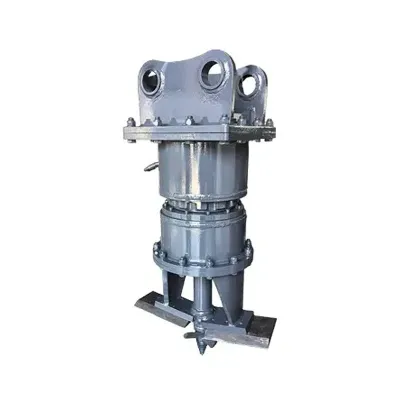
Getting the sizing right is the single most important thing you can do for hydraulic plate compactor performance and durability. Go too big, and you'll overtax your hydraulic system, lose vibration frequency, and create unsafe lift conditions. Go too small, and you're leaving capacity on the table while failing to hit target densities. This guide breaks down the four essential matching criteria—hydraulic flow and pressure, machine weight and lift capacity, mounting dimensions, and plate size—so you can pick the right model for your rig.
Hydraulic Flow and Pressure: The Make-or-Break Factor
Unlike mechanical attachments, a hydraulic plate compactor lives and dies by your excavator's auxiliary hydraulic circuit. Flow rate drives vibration frequency, and pressure provides the torque to keep that frequency up under load. Every plate compactor model comes with a rated flow range and working pressure range, and you need to be inside those numbers. For instance, a compact unit for 1.5–3 ton machines typically wants 30–60 L/min at 100–130 bar, while a big model for 30–40 ton excavators needs 120–170 L/min at 150–200 bar. Run below the minimum flow, and you'll get weak, sluggish vibration that won't compact worth a damn. Push above the max pressure, and you risk blown seals, motor damage, and a voided warranty. Before you even look at models, dig up your machine's auxiliary hydraulic specs from the operator's manual or check with your dealer for confirmed flow and pressure numbers.
Operating Weight and Lift Capacity
Excavator operating weight gives you a rough starting point, but it's not the whole story. Plate compactors are generally grouped by tonnage class—mini (1.5–3 ton), small (4–10 ton), medium (12–16 ton), large (18–24 ton), and heavy (30–40 ton)—and each class lines up with a model that matches in weight, impulse force, and plate dimensions. The more accurate metric is your excavator's lift capacity at the working reach where you'll actually be compacting. A plate compactor for an 18–24 ton machine can weigh 900–1000 kg, and your excavator needs to handle that weight at full boom extension without tipping or overloading the cylinders. Pull the load chart for your machine, not just the operating weight, and confirm that the attachment weight falls safely within limits at your typical reach. If you're often working at long extension or on slopes, you might want to step down to a lighter model even if the tonnage class suggests otherwise.
Mounting Dimensions and Coupler Compatibility
Even if your hydraulics and weight specs line up, wrong mounting dimensions can stop you cold or create dangerous slop in the attachment. The three numbers you need are pin-to-pin spacing (the distance between the upper and lower bucket linkage pin centers), pin diameter, and coupler type. Pin spacing varies by excavator make and model, even within the same tonnage class, so the compactor bracket has to be machined to match. Pin diameter is non-negotiable—too small and you get excessive play and accelerated wear, too large and it simply won't go in. Coupler type dictates the bracket interface: direct pin-on uses the standard bucket pins, while quick couplers (pin-grabber, hydraulic wedge-lock, or proprietary systems) need a bracket designed for that specific coupler. Always specify your coupler type when you order—the bracket geometry is totally different between direct pin-on and quick-coupler setups. Also watch for stick-mounted auxiliary valves or diverter blocks that could interfere with the compactor housing, and note those locations when confirming fit.
Base Plate Size and Application Matching
Plate size affects both productivity and compaction effectiveness. Bigger plates cover more ground per pass but need bigger excavators with enough hydraulic flow and lift capacity to handle them. Plate sizes range from 800 mm by 420 mm on mini-excavator models up to 1500 mm by 1000 mm on heavy-class units. The trick is matching plate size to your typical work area. If you're mostly in narrow trenches or tight spots, a smaller plate that can sit flat is way more effective than a big plate you have to tilt. For open-area road subbase or parking lot compaction, the largest plate your machine can safely handle will maximize your throughput. Soil type also matters: thicker cohesive lifts need more impulse force from a heavier model, while thin granular lifts can be handled effectively by a smaller machine with good vibration frequency. Check the Excavator Hydraulic Plate Compactor product page for full specs on all five models.
Common Sizing Mistakes to Avoid
The biggest trap is picking by tonnage alone and skipping the hydraulic flow and pressure check. Two excavators in the same weight class can have wildly different auxiliary hydraulic outputs—especially between standard-flow and high-flow configurations—so assuming compatibility based on tonnage is a fast track to poor performance. Another common screw-up is underestimating attachment weight and what it does to lift capacity at working reach, which can create tipping hazards or trip the excavator's overload warning. A third mistake is failing to confirm quick-coupler compatibility before ordering, leaving you with a bracket that doesn't fit and requires rework or replacement. And some operators grab the biggest plate their machine class can take without thinking about whether their typical work is in confined areas where a smaller plate would actually be more practical. For more general guidance on attachment selection, check out our article on choosing an excavator compactor.
Summary
To match a hydraulic plate compactor to your excavator, run through four checks in order. First, make sure your auxiliary hydraulic flow and pressure fall within the model's rated range. Second, verify that your excavator's lift capacity at working reach can safely handle the attachment weight. Third, confirm pin-to-pin spacing, pin diameter, and coupler type for bracket compatibility. Fourth, pick a base plate size that fits your typical application and site access. Tonnage class is a decent starting point, but it's no substitute for these detailed verifications. If you're unsure, send your excavator make, model, hydraulic specs, and mounting dimensions to the manufacturer for a confirmed compatibility check. The TGEC excavator compaction attachments team can cross-reference your machine against the full lineup to recommend the right fit.