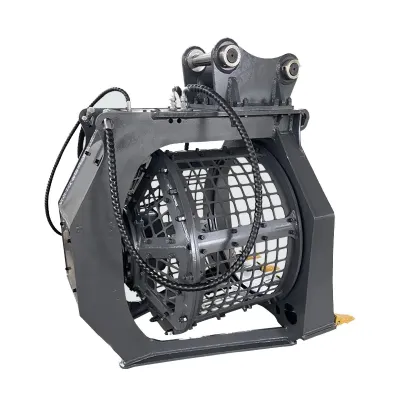
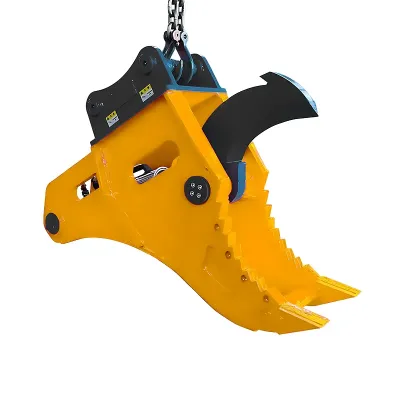
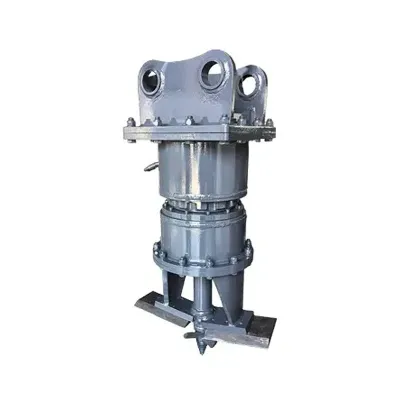
An excavator drum cutter is one of the handiest rock and concrete processing attachments you can have on a jobsite, handling everything from civil construction and quarrying to demolition and utility work. Unlike a hydraulic breaker that just hammers away with percussive force, the drum cutter's continuous rotating action gives you precision milling, profiling, and controlled removal that a breaker simply can't match. Once contractors get one, they often find new uses for it they hadn't thought of—sometimes replacing several specialized tools in the process. This guide runs through the main application areas where drum cutters deliver the most value, the conditions that make them the right choice, and what to consider when deciding if a drum cutter is the right tool for your job.
Rock Excavation and Profiling
Rock excavation and profiling is the biggest single use case for excavator drum cutters, especially in quarry, mining, and heavy civil work. In quarries, drum cutters shape and dimension rock faces, cut bench profiles, and extract rock in controlled sizes that cut down on secondary crushing. In mining, they handle ore extraction in soft to medium-hard deposits, push tunnel faces forward, and develop drifts where controlled cutting beats blasting. In civil construction, they profile rock slopes, shape foundation excavations, and cut dimensionally accurate rock cuts for retaining walls and structural footings. The big advantage over hydraulic breakers is the ability to produce a smooth, uniform rock face with tight dimensional control—critical when the rock will be exposed or when structural elements have to bear against it. Drum cutters also kick up less fly rock and dust than breakers, which improves safety in populated or sensitive areas. How well they work depends on rock hardness—they excel in soft to medium-hard rock like limestone, sandstone, shale, and weathered granite, but very hard massive rock may still call for drilling and blasting.
Concrete Milling and Demolition
Concrete milling and demolition is the second big application area, covering structural demo, road and bridge deck removal, and concrete surface prep. In structural demolition, drum cutters take down concrete columns, beams, slabs, and foundations with controlled cutting that keeps vibration from transferring to adjacent structures—a huge plus in urban demo where nearby buildings need protection from structural damage. On road and bridge jobs, drum cutters mill asphalt and concrete surfaces, strip bridge decks, and cut expansion joints and drainage channels with precision. The continuous cutting action leaves a uniform surface finish that often needs less prep before resurfacing compared to the rough, fractured mess a hydraulic breaker leaves behind. Drum cutters also run significantly quieter than breakers—typically 10–15 dB lower—which makes them a good fit for residential areas, near hospitals and schools, and on night work where noise restrictions apply. When cutting reinforced concrete, the carbide teeth chew through both concrete and steel rebar, though heavy rebar density will slow you down and wear teeth faster. For more on terminology and selection, check out our drum cutter vs rock grinder article.
Precision Trenching in Rock
Precision trenching in rock is a high-value application where drum cutters often beat every other option hands-down. When you have to cut utility, pipeline, or cable trenches through solid rock, a standard bucket is useless, hydraulic breakers leave oversize, irregular trenches, and blasting is often a non-starter in urban areas or near existing utilities. A drum cutter cuts a narrow, dimensionally accurate trench with vertical or near-vertical sidewalls and a flat bottom, minimizing the volume of rock you have to remove and the backfill you'll need. That precision also cuts the risk of damaging existing utilities that might run parallel to or cross your trench line. Drum cutters are especially valuable for trenching in rock under existing roads, in urban rights-of-way, and in environmentally sensitive areas where blast vibration and fly rock won't fly. The trench width is set by the cutting drum width, and multiple passes can widen things up when needed. For deep trenches, you'll need to check your excavator's reach and the attachment's weight at full extension to make sure you're operating safely.
Road-Header-Style Tunneling and Underground Work
Road-header-style tunneling and underground work is a specialized but growing application for excavator drum cutters, particularly in small-diameter tunnels, pedestrian underpasses, utility tunnels, and mining drifts. In this role, the drum cutter works like a miniature road header—the rotating cutting drum advances into the rock or soil face, and the excavator boom provides the forward thrust and articulation to shape the tunnel profile. This approach is ideal for tunnels too small for full-size road header machines, for short tunnel drives where mobilizing dedicated tunneling gear doesn't make economic sense, and for tunnels in urban areas where blasting is restricted. The controlled cutting action produces minimal ground vibration, cutting the risk of settlement damage to surface structures. The spoil from a drum cutter is more manageable than blasted rock, with smaller particle sizes that are easier to muck and haul. Dust suppression is a must in underground work, and many drum cutter setups include water spray systems integrated with the cutting drum to keep dust under control at the source. You'll sometimes hear this referred to as a road header attachment, but it's still an excavator-mounted drum cutter, not a dedicated road header machine.
Foundation Underpinning and Structural Modification
Foundation underpinning and structural modification work demands the highest level of precision and vibration control, which is exactly why drum cutters are the go-to tool on so many of these jobs. When you're underpinning existing foundations—digging beneath or alongside existing footings to install new support elements—the low-vibration cutting action of a drum cutter minimizes the risk of disturbing the existing foundation or causing settlement that could damage the structure above. Drum cutters can remove rock or concrete in tight spaces right next to existing footings, creating precisely dimensioned pockets for new underpinning elements. In structural modification work like basement lowering, seismic retrofitting, and building expansions, drum cutters remove concrete and rock with controlled dimensions and minimal vibration transfer to the remaining structure. That's especially critical in historic buildings, hospitals, data centers, and other structures where even minor vibration or settlement could lead to expensive damage. The ability to cut both rock and concrete with the same attachment makes drum cutters a versatile choice on mixed-material foundation projects. For guidance on matching the right machine size and hydraulics, see our drum cutter machine matching guide.
Controlled Material Removal and Surface Preparation
Controlled material removal and surface preparation covers a range of jobs where the goal is to take off a specific layer or coating without damaging what's underneath. That includes milling asphalt overlays off concrete bridge decks, removing damaged or delaminated concrete from bridge girders and parking structures, stripping coatings and waterproofing membranes from concrete surfaces, and cutting rock or soil to a precise grade for foundation prep. The drum cutter's continuous cutting action lets the operator control cutting depth with precision, removing only the target material while leaving the underlying surface intact. That's way more controllable than a hydraulic breaker, which tends to fracture beyond the intended depth and can damage sound concrete beneath a damaged layer. On bridge deck rehabilitation, that precision reduces the risk of cutting into or damaging the reinforcing steel or the structural concrete below the overlay. In industrial floor prep, drum cutters leave a uniform, textured surface profile that improves adhesion for new coatings or overlays. The Excavator Drum Cutter product page has model specs to help you match the attachment to these applications.
Jobsite Conditions That Favor a Drum Cutter
A few jobsite conditions consistently tip the scales in favor of a drum cutter over hydraulic breakers, blasting, or conventional digging. Noise restrictions are a big one—drum cutters run significantly quieter than breakers, making them essential for work in residential areas, near hospitals and schools, and on night or weekend projects with noise ordinances. Vibration sensitivity is another key factor—in urban areas with nearby structures, buried utilities, or historic buildings, the low-vibration cutting action reduces the risk of settlement, cracking, or utility damage compared to percussive breaking or blasting. Dimensional accuracy requirements favor drum cutters when the finished dimensions, surface quality, or trench profile have to meet tight tolerances that breakers can't deliver. Confined spaces and limited access—like inside buildings, under structures, or in narrow excavations—favor the compact cutting action and precise boom control of a drum cutter. Environmental restrictions on blasting, including proximity to populated areas, protected species habitats, or water sources, often make drum cutters the only viable rock removal method. And when your project involves a mix of rock and concrete, or calls for both rough removal and precision finishing, a drum cutter can handle both with a single attachment, cutting down on equipment changes and boosting productivity.
Summary
Excavator drum cutters are put to work across a wide range of applications—rock excavation and profiling, concrete milling and demolition, precision trenching in rock, road-header-style tunneling, foundation underpinning, controlled material removal, and surface prep. Their key strengths—low noise, low vibration, dimensional accuracy, controlled cutting, and versatility across rock and concrete—make them the preferred tool in urban environments, vibration-sensitive projects, precision work, and confined spaces. How well they perform depends on material hardness, with drum cutters excelling in soft to medium-hard rock, concrete, asphalt, and compacted soil. The TGEC excavator drum cutters line includes eight models covering 0.7 to 70 ton excavators, with torque up to 50495 Nm, so contractors can match the attachment to everything from mini excavator utility trenching to heavy quarry and tunneling operations.