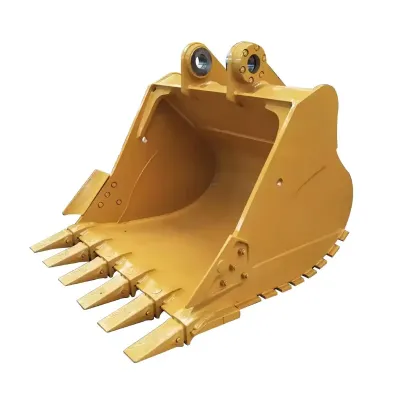
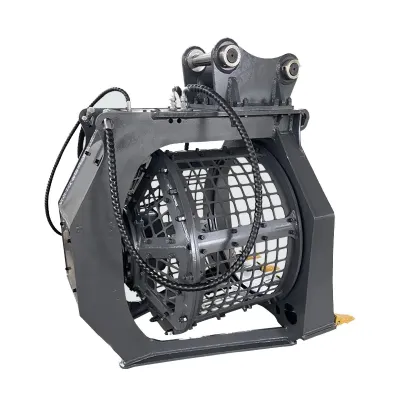
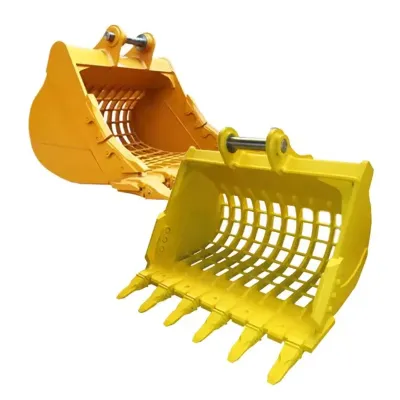
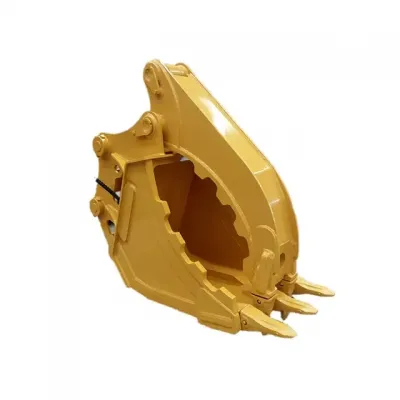
An excavator bucket that doesn't actually fit your machine is just dead weight—literally. Even if you've picked the right type and size for the work you're doing, mismatched pins, incompatible linkage, or not enough hydraulic flow can make the attachment useless or, worse, damage your excavator. This guide walks you through the key compatibility factors, from the mechanical side of mounting to hydraulic requirements, and gives you a checklist to run through before you buy.
Mechanical Mounting Compatibility
Pin Spacing and Pin Diameter
When it comes to getting a bucket to physically fit your machine, two dimensions matter most: pin spacing and pin diameter. Pin spacing (also called pin-to-pin or center-to-center distance) is the measurement between the center of the boom pin hole and the center of the bucket link pin hole on the bucket's mounting bracket. That number has to match the corresponding distance on your excavator's stick and linkage—if it doesn't, the bucket simply won't go on, not without forcing things or modifying parts.
Pin diameter is exactly what it sounds like—the thickness of the pins that hold the bucket to the stick and linkage. The holes in the bucket bracket have to match that diameter, with just enough clearance to slide the pins in and out. If the holes are too small, the pins won't go through. Too big, and you'll have slop, which wears out the pins, bushings, and brackets fast, and can even become a safety issue if a pin works loose while you're working.
Different excavator manufacturers use different pin dimensions, even on machines that weigh about the same. A bucket built for a 14-ton Caterpillar won't swap onto a 14-ton Komatsu unless you use a custom bracket, because the pin spacing and diameter are different. And even within the same brand, dimensions can change between model years or between standard and long-reach configurations. Always get the exact pin dimensions for your specific machine model and year before ordering a bucket.
Linkage Geometry
Pin spacing and diameter aren't the whole story—the linkage geometry has to line up too. That includes the shape and size of the bucket link (sometimes called the dog bone or connecting link), where the bucket cylinder attaches, and how much clearance there is between the bucket and the stick through the full curl and dump cycle. If the geometry is off, the bucket can bind at certain angles, hit the stick or cylinder, or not reach the full curl and dump angles the excavator is designed for.
Some bucket makers design their brackets to match OEM geometry exactly, giving you full motion and proper breakout force. Others use a generic bracket that might fit the pins but won't give you optimal geometry, which means less breakout force, limited range of motion, or interference. When you order a bucket, make sure the bracket is designed for your specific excavator model, not just something that happens to match the pin sizes.
Stick Width and Ear Spacing
You also need to match the width of your excavator stick at the bucket connection point with the ear spacing on the bucket bracket. The bracket has two ears that straddle the stick, with the pin going through both ears and the stick. The space between the inner faces of those ears has to be slightly wider than the stick itself, so the bucket can pivot freely without too much side play.
If the ear spacing is too tight, the bucket will bind and won't go on. If it's too wide, you'll have excessive side play, causing uneven wear on pins and bushings and letting the bucket shift sideways during operation. Shims can sometimes take up the slack, but it's better to order a bucket with the right ear spacing from the start.
Quick Coupler Compatibility
Many excavators are set up with quick couplers (also called quick hitches) that let you swap attachments without leaving the cab. If your machine has one, the bucket has to be compatible with that coupler interface, which may have different pin dimensions or mounting geometry than a direct pin-on setup. Quick couplers come in several flavors—mechanical, hydraulic, and fully automatic—and each has its own interface requirements.
When ordering a bucket for a quick coupler, give the coupler brand and model, not just the excavator model. A bucket made for pin-on mounting might not work with a coupler, even if the pin sizes look close, because the coupler changes the geometry and pin positions. Some bucket manufacturers offer brackets designed for popular coupler models, and others can build a custom bracket based on your coupler's dimensions. Always confirm compatibility with your specific coupler before placing an order.
If you switch between pin-on and coupler use on the same machine, or if you run different coupler types, you might need separate buckets with different brackets, or you might use adapter brackets that let a pin-on bucket work with a coupler. Adapters add weight and can alter the bucket geometry, so they're usually a temporary fix rather than a permanent setup.
Hydraulic Compatibility for Powered Buckets
Auxiliary Hydraulic Circuit
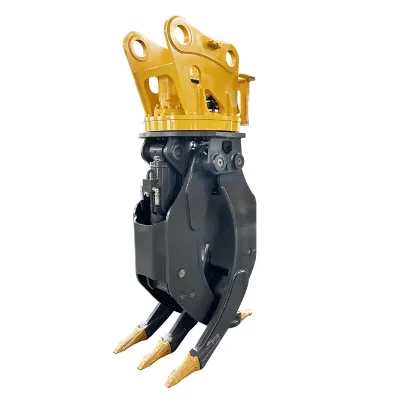
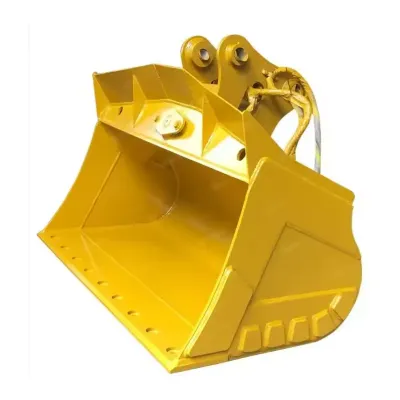
Powered attachments like tilt buckets, grapple buckets, buckets with thumb, rotary screening buckets, and crusher buckets need a double-acting auxiliary hydraulic circuit to run their cylinders or motors. That circuit has to deliver enough flow and pressure to hit the attachment's rated performance, and it needs a third-function valve the operator can control from the cab.
Flow rate is measured in liters per minute (L/min) or gallons per minute (GPM), and it determines how fast the hydraulic function works. A tilt bucket that doesn't get enough flow will tilt too slowly, slowing you down. A screening bucket with low flow won't rotate fast enough to screen properly. A crusher bucket with insufficient flow may not generate enough crushing force. Every powered attachment has a minimum and maximum flow range, and your excavator's auxiliary circuit has to deliver flow within that range for the attachment to work right.
Pressure is measured in bar or psi, and it determines the force the cylinders or motors can put out. Most powered buckets run at system pressures between 150 and 250 bar, depending on the attachment type and size. Too low and you won't get enough force; too high and you risk damaging seals and components. Most excavator auxiliary circuits have a relief valve that limits pressure, and that valve should be set to the attachment maker's recommended pressure.
Case Drain Requirement
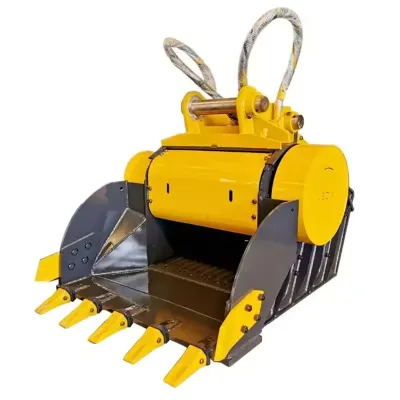
Some hydraulic motors—especially the ones in rotary screening buckets and crusher buckets—need a case drain line to route internal leakage oil from the motor housing back to the tank. Without a case drain, that leakage can build up pressure inside the housing, blow the seals, and cause catastrophic failure. If your excavator doesn't have a case drain circuit, a technician may be able to add one, but that adds cost and may require hydraulic system modifications.
When you're looking at a powered bucket with a hydraulic motor, always check whether it needs a case drain and whether your machine has one. Smaller attachments like tilt buckets and grapple buckets usually use cylinders instead of motors and don't need a case drain. Bigger, higher-power attachments like screening buckets and crusher buckets almost always require one.
Third-Function Control Valve
To run a powered bucket, you need a third-function control valve that lets you activate the auxiliary circuit from the cab. That third function is typically controlled by a thumb switch on the joystick, a foot pedal, or a dedicated lever, depending on the excavator. Some machines come with a factory third-function valve; others need an aftermarket installation.
If your machine doesn't have a third-function valve, a qualified technician can install one by adding a control valve, hydraulic hoses, and a switch or pedal. The cost and complexity depend on the machine and the type of valve you're adding. For simple attachments like tilt buckets and grapple buckets, a basic on-off valve is fine. For attachments that need variable speed, like screening buckets and crusher buckets, you may need a proportional valve that lets you adjust the motor speed.
Weight and Lift Capacity Compatibility
A bucket can fit mechanically and hydraulically but still be the wrong choice if the combined weight of the bucket and material exceeds your machine's lift capacity. Every excavator has a lift chart that shows the maximum weight it can safely lift at various boom and stick positions, and your bucket plus load has to stay within that limit at the reach you typically work at.
The bucket itself counts toward that total, and specialty buckets—heavy-duty rock buckets, screening buckets, crusher buckets—can weigh a lot more than standard buckets. For example, a 20-ton excavator might have a standard digging bucket that weighs 500 kg, but a crusher bucket for the same machine could weigh 2600 kg or more, leaving much less capacity for material. Always figure the total load by adding the bucket weight and the maximum material weight, then check it against the lift capacity at your working reach.
Weight also affects stability. A heavier bucket at the end of the stick increases the load moment, which can make the machine less stable, especially when swinging to the side or working on slopes. If you're working near excavations, on soft ground, or on slopes, a heavy bucket can create unsafe conditions. Always check stability in all operating positions, not just when the bucket is straight in front of the machine.
Compatibility Verification Checklist
Before you order an excavator bucket, run through this checklist to make sure it'll work with your machine. First, confirm your excavator make, model, year, and operating weight—these set the baseline for compatibility. Second, measure or look up in your operator's manual the pin spacing (center-to-center distance between boom pin and link pin), pin diameter, stick width, and ear spacing. Third, if you have a quick coupler, identify the coupler brand and model, because the coupler interface may be different from direct pin-on dimensions. Fourth, for powered attachments, verify your auxiliary hydraulic flow rate, maximum system pressure, case drain availability, and third-function valve type. Fifth, calculate the total weight (bucket plus material) and compare it to your excavator's lift capacity at your typical working reach. Sixth, confirm that the bucket manufacturer can provide a bracket designed for your specific excavator model and coupler type.
If you're not sure, give all this information to the bucket manufacturer or dealer and ask them to confirm compatibility before you order. A reputable manufacturer will check the dimensions against their bracket database and flag any issues. TGEC excavator buckets are available with custom mounting brackets for specific excavator models and quick coupler types, with detailed compatibility verification on every order.