Mini excavators have become a go-to machine for tree service, landscaping, and small-scale land clearing. Slap a tree shear on one, and that compact digger turns into a productive felling and processing rig. The catch is that mini excavators have limited lift capacity, modest auxiliary hydraulic flow, and shorter boom reach—so you've got to match the shear carefully to the machine. This guide breaks down what to look for when picking a tree shear for a 3 to 6 ton mini excavator.
Why Mini Excavator Compatibility Matters
A mini excavator isn't just a scaled-down version of a big machine—the hydraulic system, boom geometry, and lift characteristics are all different, and they affect how well a tree shear performs. Most 3 to 6 ton mini excavators put out auxiliary hydraulic flows between 40 and 100 L/min, which is enough for compact tree shears but won't support larger models. Lift capacity at full reach is also a lot lower than on bigger machines, and the combined weight of the shear plus a cut log can push a mini excavator close to its stability limits.
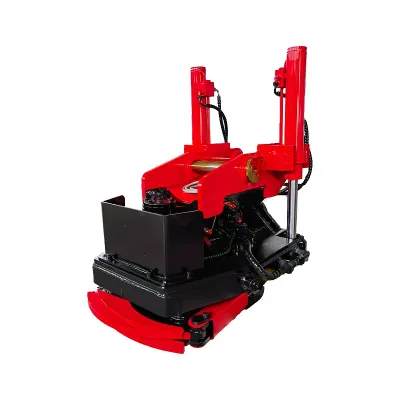
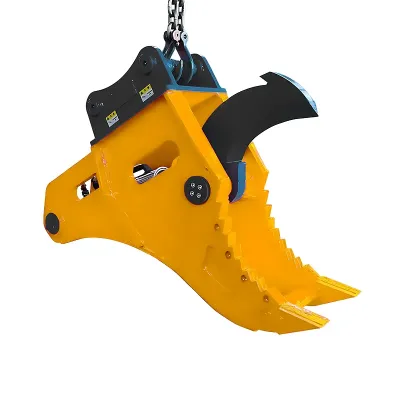
The TG-TS03 is purpose-built for mini excavators in the 3 to 5 ton class, weighing just 180 kg (397 lb) with a max cutting diameter of 150 mm (5.9 in). The TG-TS05 covers the upper end of the mini range and small excavators from 5 to 12 tons, weighing 310 kg (683 lb) and cutting up to 180 mm (7.1 in). Both models are designed to run within the hydraulic flow ranges you'd typically find on mini excavators, so they're the logical starting point for compact carriers.
Cutting Diameter for Mini Excavator Work
For most mini excavator tree service and landscaping jobs, the trees you're dealing with are on the smaller side—saplings, ornamental trees, brush, and modest-diameter trunks. A 150 mm (5.9 in) cutting diameter on the TG-TS03 handles the bulk of that work with ease. If you regularly run into trees in the 150 to 180 mm range, the TG-TS05 with its 180 mm (7.1 in) capacity gives you the extra headroom you need. Just don't push past the rated diameter—doing that can stall the shear, damage the blade, or put unnecessary strain on the mini excavator's boom.
One thing to keep in mind with mini excavators is that you're often working closer to the material and in tighter spots than you would with a larger machine. That means the shear might run into trees with odd shapes, multiple stems, or branches that don't fit neatly into the jaw. A slightly larger cutting diameter gives you more leeway in these situations. If you're frequently in dense brush or multi-stemmed growth, stepping up from the TG-TS03 to the TG-TS05 might be worth the extra weight and cost.
Weight and Stability on Compact Carriers
Stability is a big deal when you're putting a tree shear on a mini excavator. The shear's weight hangs out at the end of the boom, and when the grapple is holding a cut log, the effective load jumps up significantly. A mini excavator that feels solid with an empty bucket can get tippy with a shear and log out at full reach. Always check your excavator's lift capacity chart for your specific boom configuration and working radius, and don't push beyond the rated limits.
The TG-TS03, at 180 kg, is the lightest option and puts the least demand on mini excavator stability. The TG-TS05, at 310 kg, is still manageable for most 5 to 6 ton mini excavators, but you'll want to be more careful—especially on slopes or uneven ground. Adding counterweight (if your excavator supports it) can help with stability. Also, keep the load close to the machine when moving cut material, and avoid swinging the boom fast with a heavy log in the grapple.
Hydraulic Flow and Pressure for Mini Excavators
Mini excavator auxiliary hydraulic systems vary quite a bit from one make and model to another. Some 3-ton machines deliver as little as 40 L/min, while 6-ton models might give you 80 to 100 L/min or more. The TG-TS03 needs 40 to 95 L/min at 60 to 210 bar, which covers the full range of typical mini excavator auxiliary outputs. The TG-TS05 requires 50 to 120 L/min at 120 to 210 bar, which might be more than some smaller 3 to 4 ton mini excavators can provide. Before you settle on a model, check your excavator's auxiliary hydraulic specs in the operator's manual or check with your dealer.
Pressure settings are another detail that often gets overlooked on mini excavators. A lot of compact machines have factory-set auxiliary relief pressures that might be lower than what the shear needs. The TG-TS03 runs at 60 to 210 bar, which is broad enough to work with most mini excavator settings. The TG-TS05 needs 120 to 210 bar, so if your mini excavator's auxiliary relief is set below 120 bar, the shear won't develop its full cutting force. In some cases, you can adjust the relief valve upward, but that should be done by a qualified tech to avoid damaging the excavator's hydraulic system.
Mounting Options for Mini Excavators
Most mini excavators use a pin-on mounting system for attachments, though some are set up with mechanical or hydraulic quick couplers. The tree shear's mounting bracket has to match your excavator's pin-to-pin spacing, pin diameter, and stick width. TGEC supplies custom brackets for all the major mini excavator brands—just provide your excavator make, model, and pin dimensions when you order. If your machine uses a quick coupler, the bracket needs to be configured for that coupler interface rather than a direct pin-on mount.
One nice thing about mini excavators is that many models within a brand or size class share common pin dimensions, which can make bracket selection simpler. Still, it's always best to verify the exact measurements for your specific machine—manufacturers sometimes change mounting geometry between model years or production runs. A properly fitted bracket makes sure the shear sits at the right cutting angle and doesn't put undue stress on the boom and stick.
Configuration Choices: Fixed, Rotating or Grapple
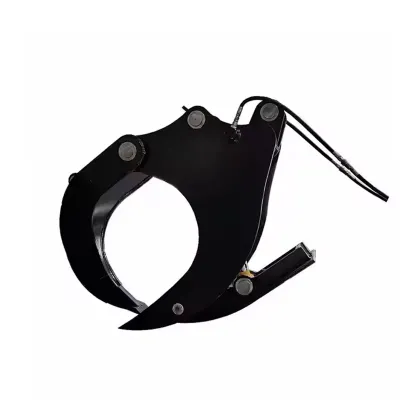
The TG-TS03 for mini excavators comes in fixed standard configuration only, which makes sense for its primary role in light brush and small-tree work where simplicity and low weight are what matter most. The TG-TS05 offers a choice of fixed or rotating mounting, plus standard or grapple jaw configurations, giving operators of 5 to 6 ton mini excavators more flexibility. For most mini excavator applications, a fixed standard shear is plenty and keeps the weight and cost down.
That said, there are situations where the extra features make sense even on a mini excavator. A rotating shear is a big help when you're working in tight backyards or along property lines where repositioning the machine is a pain. A grapple jaw is valuable when you're felling trees near structures or when you need to move and load cut material. The trade-off is that each added feature adds weight, requires an extra auxiliary circuit, and costs more. Mini excavator operators should think carefully about whether the benefits justify the added complexity for the work they typically do.
Making the Right Choice for Your Mini Excavator
The best mini excavator tree shear is the one that matches your carrier's capacity, handles the tree sizes you cut, and fits the way you work. For 3 to 4 ton mini excavators doing light brush and small-tree work, the TG-TS03 is the natural choice. For 5 to 6 ton machines that need more cutting capacity or configuration options, the TG-TS05 is worth a serious look. Either way, verify your hydraulic specs, check your lift capacity, and confirm that a mounting bracket is available for your machine before you pull the trigger.
For full specs on both models, visit the excavator tree shear product page. If you're not sure which model fits your mini excavator, reach out to the TGEC technical team with your machine details, and we'll recommend the right configuration.