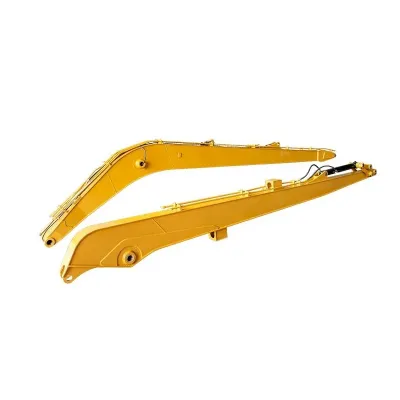
The excavator arm is the section that sits between the boom and the bucket, and it's the part that controls the in-and-out motion of the attachment during digging and lifting. While the boom handles the up-and-down movement, the arm reaches out to the work face and pulls back to drag the bucket through the material. It's a critical link in the digging chain, and its length and geometry directly affect digging reach, breakout force, and where the bucket ends up.
Where the Arm Connects
The arm connects at two points. Its rear end—called the arm pivot or arm eye—attaches to the far end of the boom through a large pivot pin. That connection lets the arm rotate relative to the boom as the arm cylinder extends and retracts. Its front end, referred to as the bucket end or attachment end, connects to the bucket or attachment through a smaller pivot pin, along with the bucket linkage that controls the curl motion. The arm cylinder—sometimes called the dipper cylinder or stick cylinder—is mounted between the boom and the arm, with the base end on the boom and the rod end on a bracket near the rear of the arm.
The arm is typically a box-section steel fabrication, similar in construction to the boom but generally narrower and lighter. It has internal reinforcement plates at the pivot points and cylinder mount, and its cross-section may taper from the rear pivot toward the bucket end. Both the arm pivot and bucket pivot are lined with replaceable bushings, and grease fittings are installed at each pivot for regular lubrication. For a comparison of how the arm relates to the boom and stick terminology, check out Excavator Boom vs. Arm vs. Stick: What Is the Difference?
What Movement the Arm Controls
The arm controls the extension and retraction of the front attachment relative to the boom. When the arm cylinder extends, the arm rotates outward, pushing the bucket away from the machine and increasing reach. When the cylinder retracts, the arm rotates inward, pulling the bucket toward the machine. That retraction motion is the primary digging force in a standard cycle: the bucket bites into the material, then the arm pulls back to drag the bucket through the cut, filling it with soil or rock.
The arm also plays a big role in bucket positioning. By combining arm extension with boom height and bucket curl, the operator can put the bucket just about anywhere within the working envelope. In lifting operations, arm extension determines the horizontal reach at a given boom height, which directly affects lift capacity because the load moment increases as the arm extends. In grading and finishing work, fine arm control lets the operator maintain a consistent cutting depth and angle. Specialized arm configurations, such as sliding dipper sticks and telescopic sticks, extend the arm reach beyond standard limits for deep excavation and dredging.
Why It Is Called a Stick or Dipper
The terminology varies by region and manufacturer. Arm is the most common general term, used widely in international and technical contexts. Stick is the preferred term in North American English, especially among operators and in equipment manuals from U.S.-based manufacturers. Dipper or dipper arm is more common in British English and in the mining and heavy construction industries, where the term dipper originally referred to the bucket-carrying arm on a power shovel. Some manufacturers use dipper stick as a compound term, blending both names.
No matter what you call it, the component is the same: the middle section of the front linkage that connects the boom to the bucket and controls the in-and-out motion. When ordering replacement parts or specifying custom arm configurations, it's helpful to use the manufacturer's terminology from the machine parts manual, since that ensures you're identifying the right component. The distinction between arm, stick, and dipper is purely a matter of naming—not a difference in function or design.
Common Arm Configurations
Standard arms are fixed-length, single-piece fabrications matched to the boom and machine class. Long arms extend the reach for deep excavation, dredging, and slope work, but they reduce breakout force and bucket capacity. Short arms increase breakout force and lifting capacity for heavy digging and rock work, but they cut back on maximum reach. Telescopic arms, including two-stage and three-stage designs, use nested sliding sections to provide variable reach on demand—retracting for transport and general work, and extending for deep or far-reach tasks. Sliding dipper sticks use a similar slide-in design to extend reach while keeping the standard boom.
Each configuration comes with trade-offs. Longer arms give you more reach but reduce lift capacity and breakout force due to the increased load moment. Shorter arms deliver more force but less reach. Telescopic and sliding designs offer versatility but add wear components, maintenance requirements, and cost. The right choice depends on your primary application, the excavator size and hydraulic capacity, and whether the machine will be dedicated to one task or used for general work. For a detailed look at arm types, see Excavator Arm Types: Long, Short, Telescopic and Extendable Configurations.