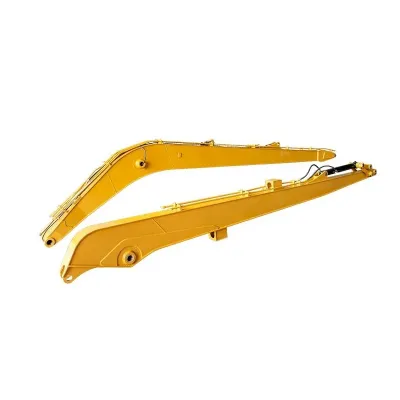
The boom is the large, hinged arm section that ties the excavator's upper structure to the dipper arm. It's the first and longest segment in the excavator's working linkage, and it handles the up-and-down motion of the entire front attachment. Every digging, lifting, and material-handling move starts with the boom, which makes it one of the most structurally critical parts on the machine.
Where the Boom Sits on the Machine
The boom mounts to the excavator's upper carriage at a pivot point called the boom foot or boom swing tower. This connection lets the boom raise and lower through a vertical arc. At the other end, the boom ties into the dipper arm (also called the stick) at a second pivot point, where the arm cylinder attaches to control the arm's extension and retraction. A pair of boom cylinders, mounted between the upper carriage and the boom, supplies the hydraulic muscle to lift the boom, arm, bucket, and whatever load they're carrying.
On most standard excavators, the boom is a single-piece, box-section fabrication cut from high-strength steel. It's packed with internal reinforcement plates and cross-members to handle the bending and twisting forces that come with digging and lifting. The boom foot, pivot points, and cylinder mounting areas see the highest stress, so they get thicker plate and extra gusseting for good measure.
How the Boom Works with the Hydraulic System
The boom is driven by two hydraulic cylinders that extend to raise the boom and retract to lower it. When the operator pushes the boom control lever, hydraulic fluid flows to the cap end of the boom cylinders, extending the rods and pushing the boom upward. To bring the boom down, fluid is routed to the rod end, retracting the cylinders and letting the boom descend under control. The boom circuit usually includes a load-holding valve to keep the boom from dropping unexpectedly if hydraulic pressure is lost.
Since the boom carries the combined weight of the arm, bucket, attachment, and load, the boom cylinders are among the largest and highest-force cylinders on the excavator. The boom also sets the maximum working height and a big chunk of the maximum digging reach. Changing the boom length—say, by installing a long reach or high reach boom assembly—directly changes the machine's working envelope and lift capacity.
Types of Work That Depend on the Boom
Just about every excavator job relies on the boom, but some tasks really put it to the test. Heavy digging and trenching demand high breakout forces while the boom soaks up shock loads from hard ground. Lifting and placing heavy loads—like pipe or precast concrete—depends on the boom's structural integrity and cylinder holding power, especially at extended reach. Demolition work, particularly with high reach demolition booms, throws impact loads and vibration at the boom from breakers and shears working at height. Material handling and scrap sorting lean on the boom for elevated positioning and sustained holding loads.
Specialized boom configurations—including short reach booms for tunnels, piling booms for foundation work, and material handling booms for waste sorting—are built to fine-tune the boom geometry for specific tasks. Understanding how the boom functions and what stresses it faces helps operators and fleet managers pick the right setup and keep it in good shape.
For a closer look at how the boom stacks up against the arm and stick, see Excavator Boom vs. Arm vs. Stick: What Is the Difference?