Operators and equipment buyers often throw around the terms boom, arm, and stick like they're interchangeable, but they actually refer to distinct sections of the excavator's front linkage. Each piece has its own mounting point, hydraulic control, and specific job in the digging cycle. Knowing the difference makes a real difference when you're ordering replacement parts, speccing out custom boom and arm assemblies, or trying to track down a performance issue.
The Boom: First Link from the Machine
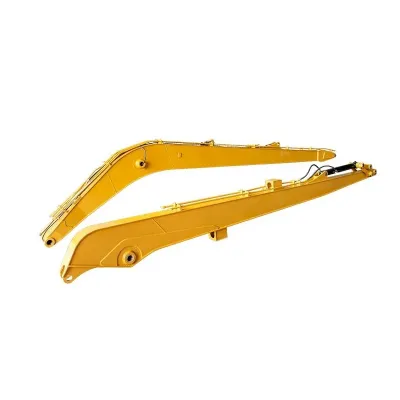
The boom is the section that hooks directly to the excavator's upper carriage at the boom foot pivot. It's the biggest and heaviest of the three front sections, and it's controlled by a pair of boom cylinders that raise and lower the whole front attachment. The boom's primary motion is vertical—it swings up and down through an arc determined by the cylinder stroke and the boom's geometry. Since it carries the combined weight of everything downstream, the boom is built with thick box-section steel and heavy reinforcement at all the pivot points.
The boom's length and shape are the main factors that define the machine's maximum working height and a big chunk of its maximum reach. Standard booms are single-piece mono-boom designs. For specialized work, you've got options like high reach demolition booms with multiple extended sections, short reach booms for low-clearance jobs, and two-piece demolition fronts with an articulated intermediate joint.
The Arm or Stick: Middle Link Between Boom and Bucket
The arm—also called the dipper arm or stick—is the middle section that ties the boom to the bucket or attachment. It mounts to the far end of the boom at the arm pivot and is controlled by a single arm cylinder (sometimes labeled the dipper cylinder or stick cylinder). The arm's primary movement is extension and retraction: pulling the bucket toward the machine for digging, or pushing it away for reaching and dumping. The arm is generally lighter and narrower than the boom, but it still sees plenty of bending and torsional loads during the digging cycle.
The terms arm and stick refer to the exact same component. Stick is more common in North American English, while arm and dipper arm are widely used in international and technical circles. Some manufacturers use dipper or dipper stick in their parts manuals. For a more detailed breakdown of the arm specifically, check out What Is the Arm on an Excavator?
How the Three Sections Work Together
In a typical digging cycle, the boom lowers the front attachment to the ground, the arm extends to position the bucket at the digging face, and the bucket curls to bite into the material. The arm then retracts to pull the loaded bucket through the cut, the boom lifts the full bucket clear of the ground, and the machine swings over to the dumping location. At the dump point, the arm extends and the bucket releases the load. Each section delivers a specific motion, and the coordination of all three determines the machine's digging power, reach, and cycle speed.
The boom and arm dimensions are carefully matched by the manufacturer. A longer boom generally pairs with a proportionally longer arm to keep the working envelope balanced and the lift chart stable. Swapping in a longer arm without adjusting the boom can cut into breakout force, shift the load center outward, and potentially push the machine past its stability limits. Custom configurations like sliding dipper sticks or telescopic sticks extend the arm reach while keeping the boom standard, but they require smaller buckets to compensate for the increased load moment.
Can the Configuration Be Changed?
Yes, but it takes careful engineering. Replacing a standard boom with a high reach, short reach, or piling boom changes the machine's working geometry, weight distribution, and hydraulic demands. Most custom boom and arm assemblies are designed as matched pairs, with the boom and arm engineered together for a specific excavator model and application. The counterweight, bucket size, and sometimes even the hydraulic pump settings may need adjustment to keep things safe and efficient. Always consult the manufacturer or a qualified engineer before modifying the front linkage, and make sure any changes comply with the machine's load chart and safety regulations.