Excavator booms come in more flavors than the standard mono boom most operators are used to seeing every day. Each design changes the machine's working envelope, lift capacity, and breakout force to fit a specific job. Picking the right boom type has a direct impact on productivity, safety, and costs—whether you're working on urban demolition, deep excavation, or forestry work.
The Standard Mono Boom
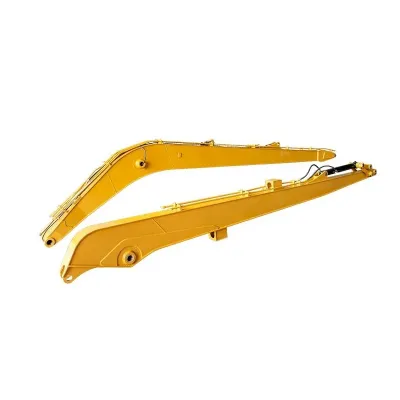
The mono boom is the single-piece, box-section boom that comes as standard equipment on most general-purpose excavators. It delivers a solid balance of digging reach, breakout force, and lift capacity across a broad range of applications. The mono boom is the go-to choice for general construction, earthmoving, grading, and utility work because it offers predictable handling, straightforward transport, and compatibility with the widest variety of buckets and attachments.
Since the mono boom is a fixed-length, single-piece design, it can't be adjusted for specialized reach or height needs. When a project calls for more height, extended reach, or a lower working profile, you'll need to step up to a specialized boom configuration.
High Reach and Demolition Booms
High reach demolition booms use multiple extended sections to achieve working heights well beyond what a standard boom can manage. TGEC high reach demolition booms cover 25 to 45 ton excavators with maximum lift heights from 14.9 to 23.1 meters, making them a solid fit for top-down demolition of mid-rise and high-rise buildings. These booms typically include a counterweight system to balance the extended front and keep the machine stable.
Two-piece demolition fronts use an articulated intermediate joint instead of multiple fixed sections. This variable-angle design provides moderate extended reach—9.1 to 21.6 meters across eight models—with a more compact transport height than a full high reach boom. The two-piece setup is the preferred choice for mid-rise demolition, interior structural work, and sites where transport maneuverability is a concern.
Short Reach and Confined-Space Booms
Short reach booms shrink the working envelope to fit tunnels, basements, under-bridge work, and other low-headroom environments. TGEC short reach models cover 20 to 45 ton excavators with maximum operating heights as low as 4.5 meters, while still maintaining useful digging depth from 8.5 to 11 meters. The shortened boom and arm geometry also reduces the swing radius, making the machine easier to handle in tight quarters.
Application-Specific Boom Configurations
Several boom types are engineered for a single purpose rather than general versatility. Ripper boom assemblies reinforce the boom and arm with thicker plate and an integrated ripper tooth for breaking rock, hardpan, and frozen soil in quarry and mining applications. Long reach piling booms extend the boom and arm to handle 12 to 20 meter piles, with reinforced mounting for hydraulic pile hammers. Material handling booms raise the working height and operator viewpoint for waste sorting, scrap handling, and elevated loading, with maximum lift heights from 10 to 16 meters.
For deep excavation and dredging, sliding dipper sticks and telescopic sticks extend the arm reach without changing the boom. These are sometimes categorized as arm configurations rather than boom types, but they fundamentally change the machine's working envelope and are often chosen alongside a standard or modified boom.
How to Select the Right Boom Type
Selection starts with the primary task. Demolition height determines whether a high reach or two-piece boom is the right call, while confined working height points toward a short reach configuration. Deep excavation or dredging may call for a sliding or telescopic stick rather than a different boom. Piling and material handling each have dedicated boom designs. Once you've narrowed down the configuration type, match the model to your excavator's operating weight, verify pin dimensions and mounting compatibility, and check whether additional counterweight or hydraulic capacity is needed. The TGEC boom and arm assemblies hub page includes a selection guide that maps common tasks to recommended configurations.