When it's time to finish slopes, shape ditches, or put a smooth grade on a surface, excavator operators often have to pick between a tilt bucket and a standard grading bucket. Both are built for finish work, not heavy digging, but they work on completely different principles. A tilt bucket uses hydraulics to angle the cutting edge independently of the boom and stick. A grading bucket relies on its wide, flat shape and the operator's skill to get a smooth finish. Understanding how these two differ is key to picking the right tool for your grading work.
How Each Attachment Works
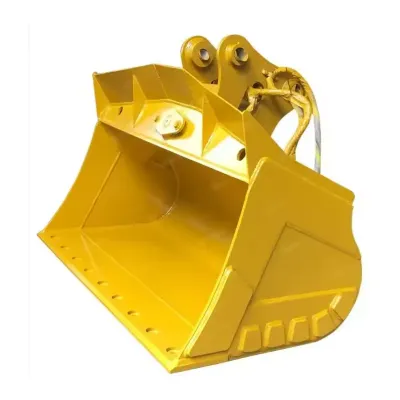
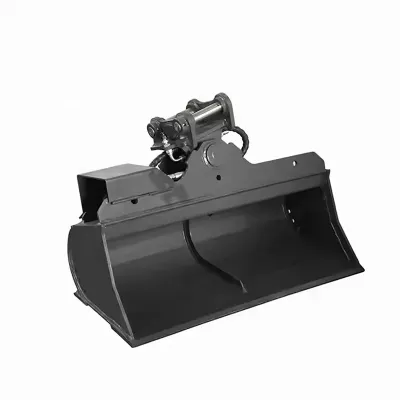
A tilt bucket has a hydraulic rotating cradle between the excavator stick and the bucket shell, letting you angle the cutting edge up to 45 degrees left or right without moving the machine. That means you can set the bucket angle once to match the slope you want, then just use the boom and stick to pull it along the grade while the tilted edge stays in constant contact. The tilt is controlled through the machine's auxiliary circuit with a thumb switch or foot pedal, and a double-acting cylinder gives you positive tilt in both directions.
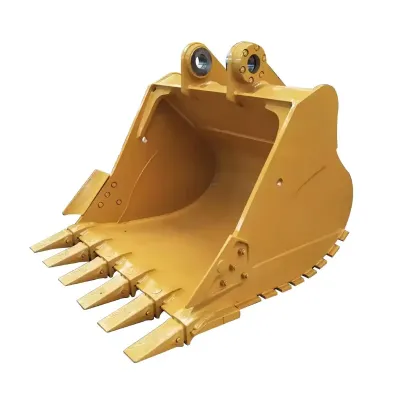
A grading bucket—also called a ditch cleaning bucket or cleanup bucket—has no moving parts beyond the standard bucket curl. It gets its grading ability from a wide, flat bottom and low side walls that give you a large, stable reference surface. The operator uses the boom, stick, and bucket curl together to follow the slope, making constant adjustments to keep the cutting edge angle right. The wide profile covers more ground per pass than a standard digging bucket, and the flat bottom helps knock down high spots and fill low spots as you drag it along.
Precision and Finish Quality
When it comes to precision on slopes, the tilt bucket has a clear edge. Since the cutting edge angle is set hydraulically and stays put as the boom and stick move, you get consistent slopes with minimal tweaking between passes. That's especially useful for road embankments, foundation slopes, and ditch banks where a uniform angle is critical. Even less experienced operators can turn out professional-grade slopes with a tilt bucket that would take serious skill and practice to achieve with a grading bucket.
A grading bucket forces the operator to constantly coordinate boom height, stick extension, and bucket curl to maintain the cutting edge angle on a slope. That takes more skill and concentration, and even seasoned operators can leave slight ridges or uneven spots between passes. On flat or nearly flat ground, though, a grading bucket can produce excellent results because the wide, flat bottom gives you a stable reference that's easy to control. For fine finishing on level ground, many operators prefer a grading bucket because the lack of hydraulic movement in the bucket itself gives you a more rigid, predictable cutting edge.
Versatility and Application Range
The tilt bucket is more adaptable across different slope angles and contour shapes. It can handle everything from gentle road shoulders to steep embankments and irregular contours, just by adjusting the tilt angle. That makes it a great fit for landscape contractors dealing with varied terrain, road builders working on multiple slope profiles, and drainage crews maintaining ditches with different bank angles. The tilt bucket can also do light digging and material handling when the tilt is centered, though it's not built for heavy excavation.
A grading bucket is more limited when it comes to steep or complex slopes because the operator has to juggle all three functions—boom, stick, and curl—at the same time. It shines on flat grading, shallow slopes, ditch cleaning, and material spreading, where the wide profile and low sides give you clear advantages. For contractors who mostly work on flat sites or maintain existing ditches with gentle slopes, a grading bucket may be all you need. For those who regularly deal with varied or steep terrain, the tilt bucket offers more flexibility.
Hydraulic Requirements and Cost
A tilt bucket needs a double-acting auxiliary hydraulic circuit with a third-function control valve to run the tilt cylinder. Most modern compact and mid-size excavators come with auxiliary hydraulics from the factory, but older or basic machines may need an aftermarket installation, which adds cost. The tilt bucket itself is also more expensive than a grading bucket because of the hydraulic cylinder, rotating cradle, hardened pivot pins, and extra machining. Maintenance costs are higher too, since the tilt mechanism has more moving parts that need regular greasing and eventual replacement.
A grading bucket has no hydraulic requirements and runs off the standard bucket curl function, so it's compatible with virtually any excavator in its weight class. It costs less to buy and maintain, with no hydraulic hoses, cylinders, or pivot mechanisms to service. For contractors who already have auxiliary hydraulics on their machine, the extra cost of a tilt bucket may be worth it for the added precision and versatility. For those who would have to install auxiliary hydraulics just for a tilt bucket, the total cost can be a lot higher, and a grading bucket may be the more practical choice.
Productivity and Cycle Time
On sloped terrain, the tilt bucket generally delivers higher productivity because you can complete a grading pass in one smooth motion without constant correction. The fixed tilt angle eliminates the need to adjust bucket curl mid-pass, reducing operator fatigue and letting you move faster along the grade. For long slope sections—highway embankments or large landscape contours—that can add up to significant time savings over a project.
On flat or shallow-slope surfaces, the productivity difference shrinks considerably. A grading bucket with its wider profile may actually cover more area per pass than a similarly sized tilt bucket, because the tilt mechanism adds some width to the cradle assembly that reduces the effective cutting edge width. For flat grading, ditch cleaning, and material spreading, a skilled operator with a grading bucket can work quickly and efficiently, and the lack of hydraulic tilt isn't a major limitation.
Making the Right Choice
Choose a tilt bucket if your work regularly involves slopes steeper than about 5 to 10 degrees, varied contour shapes, or ditch banks with specific angle requirements. The hydraulic tilt will pay for itself in less operator fatigue, better finish quality, and faster slope work. That's especially true if your excavator already has auxiliary hydraulics, since the tilt bucket's extra cost is then the only added investment.
Choose a grading bucket if your work is mostly flat grading, shallow slope finishing, ditch cleaning, material spreading, and general site cleanup. The wide, flat profile and simple mechanical design give you reliable performance at a lower purchase and maintenance cost. If you only run into steeper slopes occasionally, you may be able to handle them with careful technique, or you can rent a tilt bucket for those specific jobs instead of buying one outright.
Many contractors find that the ideal setup includes both attachments—using the grading bucket for flat work and routine ditch maintenance, and switching to the tilt bucket when slope precision matters. TGEC tilt buckets come in nine models for 1- to 28-ton excavators, and TGEC ditch cleaning buckets cover 1- to 40-ton machines in ten models. Both can be built with custom mounting brackets for specific excavator models and quick-coupler setups.