When you need to pull rocks out of soil, sort through demolition debris, or classify aggregate, you've got two main attachment choices: a skeleton bucket and a rotary screening bucket. Both are built to separate material by size, but they go about it in completely different ways and suit very different production levels. A skeleton bucket is a simple, passive tool that relies on gravity and spaced tines. A rotary screening bucket uses active mechanical agitation to deliver faster, more consistent separation. Choosing between them comes down to your material, how much you need to process, your budget, and how precise the separation needs to be.
How Each Attachment Separates Material
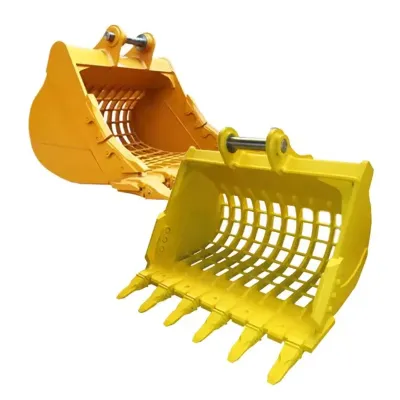
A skeleton bucket swaps out the solid bucket shell for a framework of steel tines that run from the cutting edge to the back of the bucket. The gaps between the tines set the maximum size that can fall through. Load the bucket with mixed material, lift it, and give it a shake—fine particles like soil, sand, and small gravel drop through the gaps, while bigger stuff like rocks, concrete chunks, and wood stay in the bucket. The whole process is passive, driven by gravity and the operator's shaking motion.
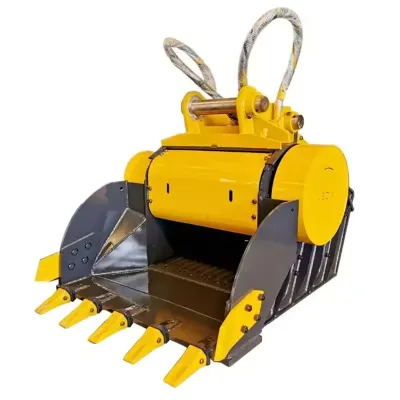
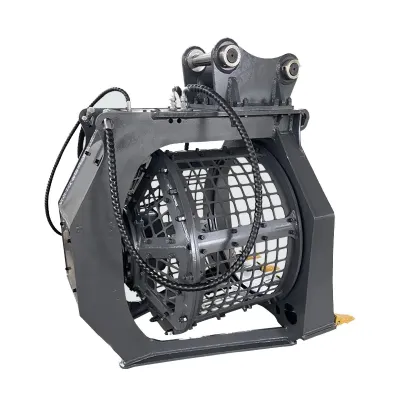
A rotary screening bucket uses a hydraulically driven drum with paddles or star‑shaped elements inside a perforated shell. As the drum spins, it tumbles and agitates the material constantly, breaking up clods, pushing particles across the screen, and separating fines from oversize. That active motion keeps the screen from clogging and gives you more consistent results, even with damp or sticky material that would gum up a skeleton bucket's tines. The screen opening is set by the perforation size, and some models let you swap plates for different output sizes.
Separation Quality and Consistency
The rotary screening bucket generally gives you cleaner, more consistent separation than a skeleton bucket, especially when you're working with finer material. The continuous tumbling action gives every particle multiple chances to pass through the screen openings, so the retained fraction has fewer fines mixed in. That matters for jobs like topsoil processing, where you want clean soil without rocks or debris, or aggregate classification, where you need a specific gradation.
A skeleton bucket relies on the operator shaking the bucket to get material through the gaps, which can lead to inconsistent results. Some fines may stay trapped in the retained material, and larger pieces can occasionally slip through if they line up with the gaps just right. For basic rock removal or coarse debris sorting, that level of consistency is usually fine. But when you need precise classification or a clean end product, the active agitation of a screening bucket gives you better results.
Material Handling Capabilities
Damp, clay‑rich, or sticky material challenges both attachments, but the screening bucket handles it better. The rotating drum continuously breaks up clods and moves material across the screen, preventing wet soil from sticking and clogging the openings. A skeleton bucket with fixed tines can get choked with wet clay, effectively sealing the gaps and killing the separation. Operators working in damp conditions often have to stop and clean the tines, which hurts productivity.
For dry, free‑flowing material like sand, gravel, or dry topsoil, both attachments work well. The skeleton bucket may actually have an edge in very abrasive material because it has no moving parts to wear out. The rotating drum, paddles, and bearings in a screening bucket are subject to wear from abrasive material, and replacing those components adds to the long‑term cost. For extremely abrasive stuff like crushed granite or slag, the simpler skeleton bucket can be the more durable choice, even if its separation efficiency is lower.
Production Rate and Throughput
The rotary screening bucket typically achieves higher throughput for a given bucket size because the active agitation processes material continuously as the drum turns. You can load the bucket, engage the drum while lifting it slightly, and the screening happens in seconds—allowing faster cycle times. For high‑volume work like topsoil processing on a large development site or aggregate classification at a quarry, the screening bucket can move significantly more material per hour than a skeleton bucket.
A skeleton bucket requires the operator to manually shake the bucket to encourage separation, which takes time and may need multiple shakes per load. Throughput also depends on operator skill and willingness to do the shaking. For low‑volume or occasional separation, such as pulling rocks from a small landscaping job, a skeleton bucket is usually enough. For contractors who process material regularly or in large quantities, the higher throughput of a screening bucket justifies the extra cost.
Cost and Maintenance Comparison
The skeleton bucket costs much less to buy and maintain than a rotary screening bucket. It has no hydraulic components, no moving parts beyond the standard bucket curl, and no motors, bearings, or gearboxes to service. The only wear items are the tines themselves, which can be welded up or replaced if they wear down. Maintenance is the same as any standard bucket—grease the pins and linkage. For budget‑conscious contractors or those who only need occasional separation, the skeleton bucket is a low‑cost entry point.
A rotary screening bucket needs a high‑flow auxiliary hydraulic circuit and includes a hydraulic motor, gear reduction, rotating drum, bearings, and screen plates—all of which add to the purchase price. Maintenance includes regular greasing of the drum bearings and gearbox, inspecting and replacing hydraulic hoses, periodic screen plate replacement, and eventually replacing worn paddles or drum elements. The hydraulic motor and gearbox are significant replacement costs if they fail. However, for contractors who use the attachment regularly, the higher productivity and better separation quality can offset the increased purchase and maintenance costs over time.
Hydraulic Requirements
A skeleton bucket has no hydraulic requirements and runs off the standard excavator bucket curl function, so it's compatible with virtually any excavator in its weight class. That's a big advantage for contractors with older or basic machines that lack auxiliary hydraulics, or for those who want to use the attachment across multiple machines without worrying about hydraulic compatibility.
A rotary screening bucket requires a double‑acting auxiliary hydraulic circuit with enough flow and pressure to drive the screening motor. Flow requirements range from 18 to 20 L/min for the smallest compact models to 90 to 100 L/min for mid‑size and large units. A case drain line is recommended for larger models to protect the motor from backpressure and overheating during continuous operation. If your machine doesn't have the needed auxiliary hydraulics or case drain, an aftermarket installation may be required, adding to the total cost. Always verify that your machine's hydraulic system meets the attachment specs before buying a screening bucket.
Choosing the Right Attachment for Your Work
Choose a skeleton bucket if your separation needs are occasional or low‑volume, your material is dry and free‑flowing, your budget is tight, or your excavator lacks auxiliary hydraulics. The skeleton bucket is great for rock removal from topsoil on landscaping projects, coarse debris sorting on small demolition sites, and general material separation where precision isn't critical. Its simplicity, durability, and low cost make it a practical choice for contractors who need separation capability without the investment in a powered attachment.
Choose a rotary screening bucket if you process material regularly or in high volumes, you work with damp or clay‑rich material, you need precise classification or clean output, or your excavator already has the required high‑flow auxiliary hydraulics. The screening bucket is the better choice for topsoil processing on large development sites, aggregate classification at quarries and recycling facilities, demolition debris processing for fill recovery, and compost screening. Its higher throughput, better separation quality, and ability to handle damp material make it the more productive and versatile option for serious material processing work.
Many contractors find that starting with a skeleton bucket and upgrading to a rotary screening bucket as their material processing volume grows is a sensible progression. TGEC skeleton buckets are available in six models covering 1.5 to 30 ton excavators with tine spacing from 50 to 100 mm. TGEC rotary screening buckets cover 3.5 to 38 ton machines in five models with screen diameters from 592 to 1470 mm. Both attachments can be configured with custom mounting brackets for specific excavator models.