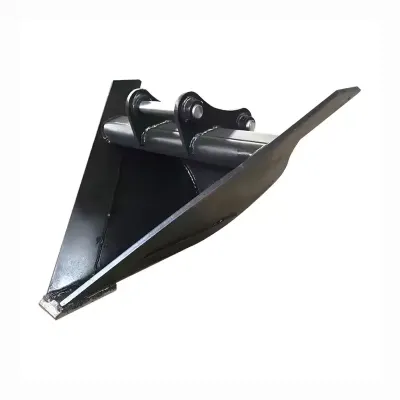
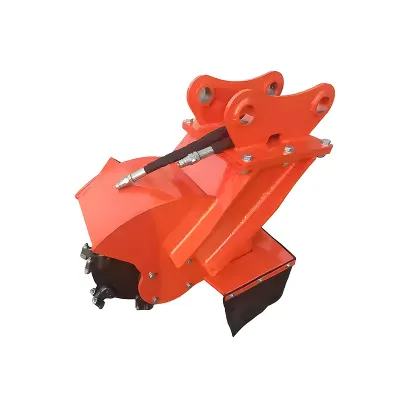
A chain trencher looks simple, but it's a machine that does one job really well. Instead of scooping dirt like a bucket, it uses a rotating loop of cutting teeth to carve out a narrow, consistent-depth trench in a single pass. Understanding how the parts work together helps you figure out if a chain trencher fits your operation, which size makes sense, and what kind of upkeep it needs to stay productive. This guide breaks down the operating principle, key components, performance factors, and selection criteria for an excavator-mounted chain trencher.
Operating Principle
Think of a chain trencher as a chainsaw scaled up for dirt. A hydraulic motor at the top of the boom drives a sprocket that turns a continuous loop of chain fitted with cutting teeth. The chain runs around the boom, over the top sprocket and an idler at the bottom, with the teeth moving downward along the front face of the boom. As the excavator creeps forward, the downward-moving teeth bite into the soil, and the excavated material is carried up the back of the chain and dumped to the side. What's left is a narrow, clean-sided trench with a flat bottom, cut at a rate determined by chain speed and forward travel.
The depth foot—a skid plate at the rear of the boom—rides on the ground and limits how deep the chain can go. Set the depth foot position, and the trencher automatically holds that depth without the operator constantly adjusting the boom. That means consistent trench depth across the whole run, which is critical for utility and drainage work where pipe grade and burial depth have to be exact. The operator just lowers the boom until the depth foot hits the ground, then drives forward at a pace that keeps the chain cutting without stalling.
Key Components
The hydraulic drive motor is what powers the whole thing. It takes hydraulic flow and pressure from the excavator's auxiliary circuit and turns it into rotational torque that drives the sprocket and chain. Motor displacement determines both torque and chain speed at a given flow rate. A bigger displacement motor gives you more torque for hard ground but spins the chain slower, while a smaller displacement motor runs faster but might stall in compacted soil. TGEC trenchers use motors matched to each model and the expected hydraulic output of the target excavator class.
The cutting chain is the business end. It's made up of interconnected links fitted with carbide-tipped teeth that do the actual cutting. The tooth design and carbide grade determine how well they cut and how long they last in different soils. Standard teeth handle soil, clay, and loam just fine, but there are more aggressive patterns for compacted or root-filled ground. The chain runs on a wear bar or slide rail along the boom—that provides a low-friction surface and protects the boom from abrasion. The top sprocket engages the chain links and transfers motor torque, while the bottom idler keeps tension and guides the chain around the end of the boom.
The boom is the structural backbone that holds the chain, sprocket, idler, and depth foot. Its length determines maximum trench depth—longer boom, deeper trench. The boom is made from high-strength steel to handle the cutting forces and bending loads from trenching. The mounting bracket ties the boom assembly to the excavator boom and linkage, and it has to be engineered for your specific excavator model to keep pin alignment and load transfer correct. The depth foot, as mentioned, controls depth and also adds stability by staying in contact with the ground while you work.
Performance Factors
Hydraulic flow is the main factor in chain speed and productivity. The TG-T600 and TG-T900 need 45 to 95 L/min (12 to 25 GPM), the TG-T1200 needs 60 to 120 L/min (16 to 32 GPM), and the TG-T1500 needs 100 to 150 L/min (26 to 40 GPM). Within that range, more flow means faster chain speed and more aggressive cutting, so you can move forward quicker. Below the minimum, the chain moves too slowly to cut efficiently and you have to creep along, killing productivity. Above the maximum, you risk overheating the hydraulics and damaging the motor.
Hydraulic pressure determines how much torque the chain gets. The TG-T600 and TG-T900 run at 150 to 210 bar (2175 to 3045 psi), while the TG-T1200 and TG-T1500 run at 170 to 250 bar (2465 to 3625 psi). Enough pressure keeps the chain spinning under load in compacted soil. Too little, and it stalls when you hit hard ground or roots. The auxiliary relief valve needs to be set to the model's specified working pressure—not the excavator's max system pressure—to protect the motor and hydraulics.
Soil conditions make a big difference. In loose topsoil and loam, the chain cuts freely and you can keep a steady pace. In clay and compacted soil, the chain has to work harder and you need to slow down so the teeth can fully penetrate. In sandy or gravelly soil, the teeth wear faster from abrasion, and the chain may need more frequent tension adjustments as material works into the links. The chain can usually handle small roots, but large ones may stall it, requiring you to clear the obstruction. The trencher is not built for solid rock, concrete, asphalt, or frozen ground—those call for a rock saw or other methods.
Model Selection Considerations
Picking the right model starts with your excavator. The machine's operating weight, auxiliary flow and pressure, and lift capacity at working reach all determine which models are compatible. The TG-T600 fits 2.5 to 5 ton mini excavators, the TG-T900 covers 3 to 7 ton machines, the TG-T1200 fits 5 to 10 ton excavators, and the TG-T1500 covers 8 to 12 ton carriers. In overlapping weight ranges, hydraulic output and required trench depth become the deciding factors rather than weight alone.
Trench depth requirements dictate minimum boom length. The TG-T600 reaches 600 mm (23.6 in), the TG-T900 reaches 900 mm (35.4 in), the TG-T1200 reaches 1200 mm (47.2 in), and the TG-T1500 reaches 1500 mm (59.1 in). Pick a model whose maximum preset depth covers the deepest trench you regularly dig—you can always set the depth foot shallower on any model. Trench width requirements determine the cutting configuration. The TG-T600 and TG-T900 offer widths from 150 to 300 mm (5.9 to 11.8 in), the TG-T1200 offers 150 and 200 mm, and the TG-T1500 is set up for 150 mm. Most utility and irrigation work needs 150 to 200 mm width.
How often you use it and what kind of soil you're in also matter. If you're trenching every day in varied ground, a larger model with more hydraulic power can keep productivity up even in harder soil and reduce the chance of stalling. If you only trench occasionally in good soil, you can go with the smallest model that covers your depth and width needs, saving on cost and carrier load. Dealers and rental companies should stock models that cover the most common excavator sizes and applications in their area to get the most use out of each attachment.
Maintenance and Wear Management
The chain trencher has fewer moving parts than a lot of hydraulic attachments, but proper maintenance is still key to performance and longevity. The cutting teeth are the main consumable—inspect them before each use for wear, chips, or missing carbide tips. Worn teeth cut slower, increase hydraulic load, and can cause the chain to stall. Replacement teeth are available and can be swapped in the field. Check chain tension daily and adjust as needed—usually about 10 to 15 mm (0.4 to 0.6 in) of sag at the midpoint when the trencher is lifted. A loose chain can derail, while an overly tight one wears out bearings and sprockets faster.
Check the drive motor, sprocket, and idler bearings periodically for leaks, excessive play, or unusual noise. Inspect hydraulic hoses and fittings for leaks, especially at connection points that see movement during operation. The boom wear bar or slide rail should be checked for abrasion and replaced when worn to prevent chain damage. Make sure the depth foot and its hardware are secure and not excessively worn. Stick to the manufacturer's maintenance schedule, and keep the chain clean, properly tensioned, and well-lubricated—that'll extend the life of every component and minimize downtime.
Technical Summary
An excavator chain trencher is a specialized tool that uses a hydraulically driven rotating chain to dig narrow, consistent-depth trenches in one pass. The drive motor, sprocket, cutting chain, boom, idler, and depth foot all work together to produce clean, uniform trenches efficiently. Performance comes down to matching the model to your excavator's hydraulic output, picking the right depth and width configuration, and working in soil the chain can handle. With proper setup, maintenance, and technique, the chain trencher is a productive, cost-effective attachment for utility, irrigation, drainage, and landscaping contractors who already own an excavator.
The TGEC excavator chain trencher comes in four models covering 2.5 to 12 ton excavators, with factory-direct pricing, custom mounting brackets, and OEM options for dealers. For a practical comparison of trenching with a chain trencher versus a standard bucket, see our trencher vs excavator guide. For step-by-step selection criteria, see our excavator trencher selection guide.