Getting the hydraulic match right is the single most important thing you can do to keep your excavator log splitter operating safely, productively, and reliably. If the attachment doesn't line up with your machine's hydraulic system, you'll end up with slow cycle times, stalling under load, premature component failures, or even safety issues. This guide covers the key hydraulic and machine-matching factors for both conventional wedge splitters and cone splitters.
Hydraulic Flow: The Primary Performance Factor
Hydraulic flow—measured in liters per minute (L/min) or gallons per minute (GPM)—dictates how fast the splitter operates. On conventional log splitters, flow determines how quickly the hydraulic ram extends and retracts to drive the wedge. On cone splitters, flow controls the rotational speed of the hydraulic motor spinning the conical screw. Every splitter model comes with a specified minimum and maximum flow range. Run below the minimum and you'll get sluggish cycle times and lousy productivity; push above the maximum and you risk excessive speed, overheating, seal damage, and catastrophic component failure.
When matching flow, compare your excavator's auxiliary hydraulic circuit output to the attachment's specified flow range. You'll usually find your machine's flow specs in the operator's manual or from your dealer. If your excavator's flow exceeds the attachment's maximum, you'll need to install a flow regulator or pressure-compensating valve to dial it back. If your flow falls short, consider stepping down to a smaller attachment model or upgrading to a high-flow auxiliary circuit. Cone splitters, in particular, need higher flow to generate adequate torque, so make sure your auxiliary circuit can deliver the rated flow continuously without overheating.
Hydraulic Pressure: Force and Torque
Hydraulic pressure—measured in bar or pounds per square inch (PSI)—determines the force produced by the hydraulic ram in a conventional splitter and the torque produced by the hydraulic motor in a cone splitter. More pressure means more splitting force and torque, but only up to the attachment's maximum pressure rating. Exceed that and you're looking at damaged seals, hoses, fittings, and structural parts. Run below the rated pressure and you'll get reduced splitting force, which can cause the wedge to stall on hardwoods or the cone to stop turning under load.
Most excavator log splitters operate in the 200–310 bar (2900–4500 PSI) range. Conventional splitters are typically rated at 207 bar (3000 PSI), while cone splitters run from 205–310 bar (2973–4496 PSI). Check that your excavator's auxiliary hydraulic relief valve is set within the attachment's pressure range. If your machine's system pressure is higher than the attachment's rating, install a pressure-reducing valve in the auxiliary circuit to protect the attachment. If your system pressure is lower, the attachment will run with reduced force—which might be fine for softwoods but won't cut it for hardwoods or big-diameter logs.
Auxiliary Circuit Configuration
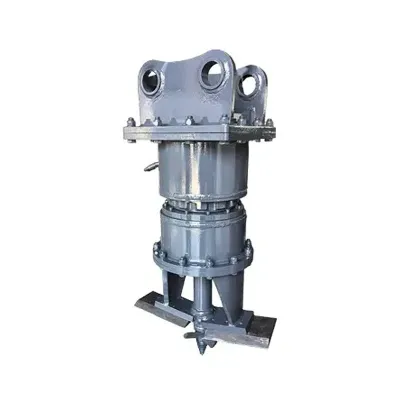
Your excavator's auxiliary hydraulic circuit needs to be set up correctly for the type of splitter you're using. Conventional log splitters require a double-acting auxiliary circuit that can extend and retract the hydraulic ram, typically controlled by a proportional or on/off valve in the cab. Cone splitters need a circuit that can drive a hydraulic motor in both forward and reverse, with enough flow to generate the required torque. Many cone splitters also need a case drain line to keep backpressure off the motor's shaft seal—skip that and you'll be looking at seal failure and oil leaks.
Check that your excavator's auxiliary circuit has the right number of hydraulic lines (typically two pressure lines plus a case drain for motor-driven attachments) and that the control valve in the cab gives you proportional control for smooth operation. Make sure the hydraulic hoses are rated for the system's maximum pressure and flow, and that hose lengths and routing allow full boom and arm movement without pinching, stretching, or abrasion. Your hydraulic reservoir should have enough fluid capacity, and the cooler should be sized for continuous auxiliary circuit operation—especially for high-flow cone splitter applications that generate serious heat.
Machine Size and Lift Capacity
Hydraulics aside, your excavator's physical size and lift capacity have to be matched to the attachment. Every splitter model is designed for a specific excavator tonnage range, but tonnage is just a starting point. The critical number is your excavator's lift capacity at the working reach where you'll actually be using the splitter. The attachment weight plus the weight of the log you're splitting cannot exceed the excavator's rated lift capacity at that reach. Push past that limit and you risk tipping the machine—especially on uneven terrain, slopes, or at full boom extension.
For mini excavators (2–5 tons), compact splitters like the SL-WS 470 or TGEC-WS12 are the way to go—their lighter weight minimizes the hit on lift capacity and stability. For mid-size excavators (5–8 tons), the SL-WS 610, TGEC-WS40, or TGEC-WS80 give you more capacity while staying within the machine's lift limits. For large excavators (13–17 tons), the TGEC-WS120 with its 400 mm cone and 12300 Nm torque is a solid fit, since the machine's lift capacity can handle the attachment and big logs. Always check the excavator's lift chart for your specific working configuration—including boom position, arm position, counterweight, and track setup—rather than just relying on the rated operating weight.
Mounting Compatibility
The attachment's mounting bracket has to play nice with your excavator's boom mounting interface. The key dimensions are pin-to-pin spacing (the distance between the boom mounting ears), pin diameter, and the width of the boom ear gap. Most manufacturers can supply custom mounting brackets for specific excavator models, including both direct pin-on and quick coupler configurations. For quick coupler systems, provide the coupler manufacturer and model number so the bracket matches the coupler's locking mechanism and dimensions.
Before installation, double-check that the mounting pins are the right diameter and length, that retaining clips or bolts are properly installed, and that the attachment pivots freely on the boom without binding. Make sure the hydraulic hoses can be routed from the attachment to the excavator's auxiliary circuit without interference with the boom, arm, bucket cylinder, or cab. Ensure hose lengths allow full boom and arm movement without stretching or pinching, and secure hoses with appropriate clamps or ties to prevent abrasion during operation.
Summary: Hydraulic Matching Checklist
-
Flow: Verify auxiliary hydraulic flow is within the attachment's minimum and maximum range.
-
Pressure: Confirm system pressure is within the attachment's rated pressure range.
-
Circuit: Ensure double-acting circuit for wedge splitters; bidirectional motor circuit with case drain for cone splitters.
-
Cooling: Verify hydraulic reservoir and cooler can handle continuous auxiliary operation.
-
Lift capacity: Check excavator lift chart at working reach for attachment plus log weight.
-
Mounting: Confirm pin-to-pin spacing, pin diameter, coupler type and bracket compatibility.
-
Hoses: Verify hose pressure rating, length, routing and connectors for full boom movement.
For guidance on selecting the right splitter type and model for your application, refer to the How to Choose an Excavator Log Splitter guide. For a detailed comparison of conventional and cone splitting mechanisms, see the Excavator Log Splitter vs Cone Splitter guide. Explore the Excavator Log Splitter and Excavator Cone Splitter product pages for detailed specifications, or return to the Excavator Log Splitters hub for the full range.