When you start shopping for a skid steer rock picker, you'll run into two distinct designs: the box-style hopper picker and the rotary drum picker. Both pull rocks out of the ground, but they work differently, handle material in fundamentally different ways, and fit very different job types. The decision isn't about which one is "better"—it's about which one matches how you work, what your soil looks like, and what you plan to do with the rocks once they're out.
This comparison breaks down the mechanical guts of each design, weighs their strengths and trade-offs, and maps them to real-world jobs. By the end, you'll know which configuration suits your operation—or whether it makes sense to keep both types on hand for mixed sites. For a wider view of what's available, browse our complete range of skid steer rock pickers.
Core Mechanical Design
The box-style rock picker runs on a rotating tine reel mounted at the front of a large enclosed hopper. Hydraulic flow drives a heavy-duty roller chain that turns the reel; as the tines sweep through the soil, they lift rocks and debris up and over the reel, dumping them into the hopper. Soil falls back through the gaps between tines, while rocks stay trapped in the collection chamber. When the hopper fills up, you raise the skid steer arms and open a full-width rear door to dump the entire load in one quick motion.
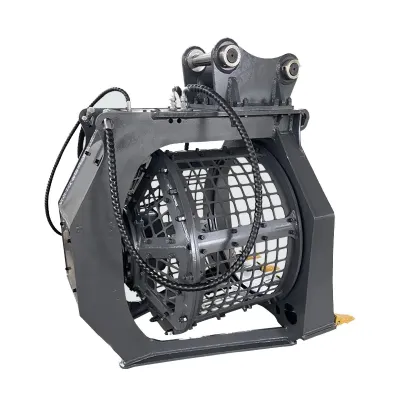
The rotary rock picker trades the tine reel and hopper for a horizontal cylindrical screening drum. Hydraulic power spins the drum around its axis; as the attachment moves forward, the drum's leading edge scoops up soil and rock into the rotating chamber. Centrifugal force pushes material against perforated screen panels lining the drum wall. Fine soil and organic matter pass through the holes and fall back to the ground, while rocks larger than the screen aperture tumble inside and are carried rearward, where they discharge for collection or windrowing.
Material Handling and Soil Retention
The biggest operational difference comes down to what happens to the soil. A box-style rock picker pulls up rocks along with a fair amount of soil, and the whole mix ends up in the hopper. Some soil sifts back through the tine gaps during collection, but the hopper still retains a rock-soil blend that gets hauled away. That's fine when you're clearing a site and everything goes to the dump, but it's a problem in agricultural fields where you want to keep topsoil in place.
A rotary rock picker is built specifically to separate rocks from soil on site. The drum's perforated panels let sand, fine soil, and organic matter fall back to the field while rocks stay trapped and discharge out the back. The soil stays where it belongs, and you haul away much less material. The trade-off is that rotary pickers process ground more slowly per pass, because the drum needs time to tumble and screen each load effectively.
Productivity and Dump Cycles
Box-style pickers generally deliver higher raw throughput for pure rock removal. Their large hoppers hold more material per cycle, so you make fewer trips to the dump pile. A typical 72-inch box-style model with a 1,200 kg safe working load can collect a substantial rock pile before needing to dump, and the full-open rear door empties everything in seconds. That makes the box-style design a strong fit for large-scale site clearance where rocks get hauled away in piles or loaded into trucks, and where fewer dump cycles mean faster acreage coverage.
Rotary pickers work more continuously: rocks discharge steadily as the drum rotates, rather than collecting in a batch hopper. Some rotary models feed rocks into a rear collection area that you empty periodically; others windrow rocks behind the machine for later pickup with a bucket or rake. The continuous discharge means you don't stop and raise the arms to dump as often, but overall throughput is limited by the screening process, which forces you to run at slower ground speeds to let soil separate properly. In fields with moderate rock density, a rotary picker can run steadily for long stretches without interruption, while a box-style picker dumps more often but covers more ground between dumps.
Hydraulic and Machine Requirements
Both designs use standard auxiliary hydraulics, but their specific demands differ. Box-style pickers typically operate at higher pressure—around 21 MPa—with moderate flow around 75 L/min. That reflects the torque needed to turn a heavy tine reel through embedded rocks; the higher pressure helps maintain rotation when tines hit large or deeply set stones. Rotary pickers generally run at lower pressure—about 14 MPa—with similar or slightly higher flow, around 80 L/min. The drum needs consistent rotational speed for effective screening, but it doesn't face the same point-load resistance as a tine reel.
On the machine side, both designs fit standard universal quick-attach plates and work with most standard-flow skid steers. But the box-style picker's higher pressure requirement can be a problem for older or compact-frame machines with lower system pressure, while the rotary picker's flow requirement may challenge very small skid steers with limited auxiliary output. High-flow machines can run either design but should use flow limiters or pressure-reducing valves to avoid overspeeding the mechanism. Always check your machine's auxiliary circuit specs against the attachment's requirements before you buy.
Wear Components and Maintenance
The wear patterns of the two designs reflect their mechanical differences. Box-style pickers see the most wear on the tines, the roller chain and sprockets, and the hopper floor. Tines bend and crack on impact with large rocks; chain stretches with continuous use; the hopper floor abrades as rocks slide across it during dumping. Tines are replaceable, chain can be retensioned or replaced, and the hopper floor may need wear plating or replacement in heavy-use operations. Daily grease points, chain tension checks every 50 hours, and regular tine inspection are the routine tasks.
Rotary pickers concentrate wear on the screen panels, the drum bearings, and the leading edge of the drum. The screen panels are the main consumable—they abrade constantly from tumbling rocks and may need replacement every 200 to 400 hours, depending on soil conditions. The big advantage is that screen panels are individually replaceable, so you can swap worn sections without replacing the entire drum. Drum bearings need daily greasing, and the leading edge should be checked for bending after hitting large boulders. Keep an eye on hydraulic motor seals and hoses, especially where they route across the rotating drum assembly.
Application Mapping
The box-style rock picker is the stronger choice for: construction site cleanup where all debris goes to the dump, large-acreage field clearing where dump piles are acceptable, operations that need to handle a wide range of rock sizes from gravel to boulders, and jobs where fast cycle times and high-volume collection are the priority. It's also better when rocks go straight into trucks or hauling equipment, since the hopper dumps cleanly and quickly.
The rotary rock picker is the stronger choice for: agricultural field cleanup where topsoil must stay in place, operations that need to separate reusable fill from rock debris, pasture and rangeland improvement where soil preservation supports regrowth, and applications where rocks will be windrowed for later pickup rather than immediately hauled. It's also well suited for fine soil conditioning, since the screening action breaks up clods and returns organic matter to the field.
Some operations—especially those that handle both agricultural and construction work—benefit from owning both types. The box-style picker handles demolition and construction debris; the rotary picker manages farm field cleanup. If you work mostly in one sector, choose the design that matches the bulk of your jobs, and you'll get the best return on your investment.
Making the Decision
The final decision between box-style and rotary rock pickers comes down to what happens to the soil and rocks after you pick them up. If you need to remove rocks and haul everything away, the box-style picker's large hopper and fast dumping make it the more productive tool. If you need to keep soil on site and separate rocks for windrowing or later pickup, the rotary picker's screening drum is the better fit. Both designs are durable, reliable, and compatible with standard skid steers, so neither is a compromise on build quality. Look at your typical job sites, your soil type, and your complete workflow—then choose the design that cuts out extra handling steps and maximizes time actually picking rocks, not dumping or reprocessing material.