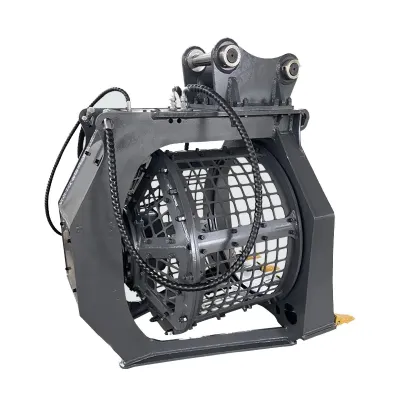
Rotary rock pickers are among the most effective tools for removing rocks while keeping topsoil intact—but their internal operation isn't always obvious at first glance. Unlike box-style pickers that use tines to lift rocks into a hopper, rotary models rely on a continuously rotating cylindrical drum to screen soil from rock as the attachment moves across a field. The process combines mechanical gathering, centrifugal force, and perforated screening to achieve clean separation: soil stays in place, and only rocks and oversized debris are collected.
This article walks through the step-by-step operation of a rotary rock picker, from material intake to rock discharge. Understanding the mechanics helps operators adjust ground speed, drum rotation, and screen panel selection for different soil conditions, and makes it clear why certain maintenance practices are essential for consistent performance. For specifications and model details, see our rotary rock picker product page, or browse the full lineup of rock picker attachments.
The Rotary Drum Assembly
At the core of every rotary rock picker is a horizontally mounted cylindrical drum attached to the skid steer quick-attach frame. The drum is open at the front for material intake and partially enclosed at the rear for rock discharge. Its cylindrical wall isn't solid steel—it's built from individual replaceable screen panels, each perforated with apertures of a specific size. These panels bolt or fasten to the drum's structural frame, making it easy to remove and replace individual panels when they wear out or when a different aperture size is needed.
A hydraulic motor, powered by the skid steer's auxiliary hydraulic circuit, drives the drum. The motor transfers rotation through a drive system—typically a chain or direct-coupled gear arrangement—that turns the drum around its horizontal axis. Most rotary pickers run on about 80 L/min of hydraulic flow at 14 MPa, a combination that delivers a drum rotation speed balancing screening efficiency with material throughput. The drum rotates continuously during operation, and the operator engages it from the cab using the auxiliary hydraulic switch.
Material Intake and Gathering
As the skid steer moves forward with the rotary picker engaged, the leading edge of the rotating drum contacts the soil surface. That forward edge is reinforced with a hardened steel lip or leading bar that cuts through the top layer of soil and funnels material into the rotating chamber. The operator controls the depth of cut via the skid steer's lift arms—shallower passes for light rock removal, deeper ones for heavily infested ground. Because the drum is rotating, material is drawn into the cylinder rather than pushed ahead of the attachment, which reduces soil compaction and allows the picker to work effectively in loose or tilled ground.
Material enters the drum at a steady rate as long as the skid steer keeps moving forward. Optimal ground speed depends on soil type, rock density, and the screening quality you're after. In light, sandy soil with scattered rocks, you can run faster because the drum processes material quickly. In heavy clay or ground with high rock density, slowing down gives the drum more time to tumble and screen each load, resulting in cleaner separation. Operators learn to match ground speed to conditions by watching how much soil stays with the rocks and how quickly the drum fills.
Centrifugal Screening and Separation
Once material is inside the rotating drum, two forces work together to separate it: gravity and centrifugal force. As the drum turns, material lifts along the drum wall then tumbles downward as it passes the top of the rotation cycle. This constant tumbling agitates the material, breaking up soil clods and mixing rocks and soil together. At the same time, centrifugal force from the drum's rotation presses material outward against the perforated screen panels that line the cylinder wall.
The screen panels are the critical separation element. Each panel has a pattern of apertures (holes) of a predetermined size. As material presses against the panels under centrifugal force, any particle smaller than the aperture passes through and falls out of the drum, returning to the ground below. This includes fine soil, sand, silt, small organic matter, and any rock fragments below the size threshold. Particles larger than the aperture—target rocks and oversized debris—stay inside the drum. The tumbling action repeatedly presents all material to the screen panels, maximizing separation efficiency and cutting down on soil retained with the rocks.
The aperture size of the screen panels directly sets the separation threshold. Smaller apertures retain more rocks but can clog in wet or clay-heavy soil; larger apertures speed up screening but may let small rocks pass through. Most rotary pickers come with a standard aperture size suited for general field rock removal, and replacement panels with alternative sizes are available for specialized work. Swapping panels makes the rotary picker adaptable to different jobs without needing a separate attachment.
Rock Retention and Discharge
Rocks too large to pass through the screen panels stay inside the drum and are carried by the rotating motion toward the rear of the cylinder. As the drum spins, retained rocks lift along the upper portion of the drum wall and then fall by gravity into a rear collection area or discharge chute. Some models use internal baffles or flighting inside the drum to actively push rocks rearward; others rely on the natural slope and rotation to move material back. The discharge mechanism releases rocks at a controlled rate, preventing sudden dumps that could damage the attachment or create uneven windrows.
Once rocks reach the rear of the drum, they drop into either a rear collection hopper that must be emptied periodically, or directly onto the ground in a windrow behind the skid steer. Models with a collection area use the skid steer's lift-and-tilt function to raise and empty the collected rocks, much like dumping a bucket. Models that windrow continuously deposit rocks behind the machine, creating a row that can later be picked up with a bucket, rake, or grapple. The windrowing approach lets you work without stopping to dump, but it requires a second pass or separate equipment to collect the windrowed rocks.
Hydraulic Drive and Operator Control
The entire screening process depends on consistent hydraulic power to keep the drum rotating. The skid steer's auxiliary hydraulic pump delivers flow to the picker's hydraulic motor, which converts fluid pressure into rotational torque. The motor is sized to maintain drum speed even under load, when the drum is full of rocks and soil and needs more torque to keep turning. A pressure relief valve in the hydraulic circuit protects the motor and drive system from damage if the drum jams on an oversized rock or foreign object, letting the operator reverse direction or clear the blockage without causing mechanical failure.
Operators control the rotary picker through the skid steer's standard auxiliary hydraulic controls, typically a foot pedal or hand switch that engages and disengages the drum. Some machines offer variable flow control, letting the operator adjust drum speed from the cab. Higher drum speeds increase centrifugal force and can improve screening in dry, loose soil, but may cause excessive wear and potential rock ejection in very rocky conditions. Lower speeds provide gentler tumbling and work better in wet or sticky soil, where material needs more time to separate. Most operators find a moderate, consistent speed gives the best balance of throughput and separation quality across a range of conditions.
Factors That Affect Screening Performance
Several variables affect how well a rotary rock picker separates rocks from soil. Soil moisture is one of the biggest. In dry, loose soil, particles flow freely through the screen apertures, giving clean, fast separation. In wet or clay-heavy soil, particles stick together and to the screen panels, clogging the apertures and reducing effective screening area. Operators working in wet soil should slow ground speed, consider larger aperture panels, and periodically clear the drum by running it at higher speed with the attachment lifted off the ground. Soil with high organic content, like peat or leaf mold, can also clog screens because fibrous material tangles in the apertures.
Rock size and density also play a role. Soil with a high percentage of rocks near the aperture threshold can cause partial blockage, as rocks lodge in the openings and reduce the free area for soil to pass through. Very large boulders can jam the drum, requiring the operator to reverse direction or clear the obstruction manually. Ground speed must come down in high-density rock fields to prevent overloading the drum and allow enough screening time. Drum rotation speed matters too: too fast and rocks are thrown against the panels with excessive force, speeding up wear; too slow and there's not enough centrifugal force, causing soil to stay with the rocks.
Screen panel condition is another critical factor. As panels wear, their apertures enlarge, letting progressively larger rocks pass through and reducing separation accuracy. Panels with bent edges, cracks, or loose fasteners can catch material and create uneven wear patterns. Regular inspection and timely replacement are essential for keeping screening quality consistent. Operators should carry a spare set of panels and the tools to replace them in the field, especially when working in remote locations or during time-sensitive seasonal operations.
Summary of the Rotary Screening Process
A rotary rock picker operates through a continuous sequence of actions: the reinforced leading edge gathers soil and rock into the rotating drum; the drum's rotation creates centrifugal force that presses material against perforated screen panels; fine soil and small particles pass through the apertures and return to the ground; retained rocks are carried rearward by the tumbling motion; and collected rocks discharge into a rear hopper or windrow behind the machine. The entire process runs on the skid steer's auxiliary hydraulics, with the operator controlling ground speed and drum engagement.
The key advantage of this design is its ability to separate rocks from soil on site, preserving topsoil and cutting down on the volume of material to haul away. The replaceable screen panel system adds versatility, letting operators adjust the separation threshold for different jobs. By understanding how each component contributes to the screening process, operators can optimize settings for their specific soil and rock conditions, maximize attachment lifespan through proper maintenance, and achieve consistent, high-quality rock removal across diverse job sites.