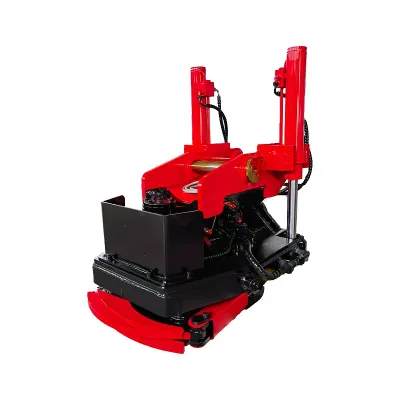
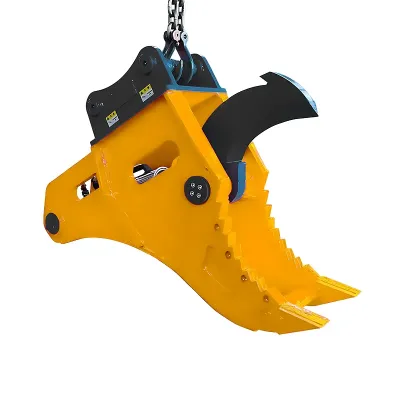
Mini skid steers and compact track loaders have become go-to machines for landscaping, property maintenance, and small-scale vegetation work. Their compact footprint, low ground pressure, and tight turning radius make them ideal for residential yards, tight job sites, and sensitive terrain. But matching a tree shear to a mini skid steer takes more than a universal quick-attach plate and a set of hydraulic hoses. The attachment's weight, hydraulic demand, and cutting forces all need to fall within the machine's safe operating envelope. Get it wrong, and you'll face poor cutting performance, accelerated machine wear, and potentially unsafe conditions.
This guide breaks down what it takes to safely and effectively run a tree shear on a mini skid steer. We'll cover hydraulic flow and pressure requirements, rated operating capacity, attachment weight and dimensions, mounting compatibility, and the real-world performance limits operators should expect. For product specs and configuration details, see our Skid Steer Tree Shear page, or browse the Skid Steer Tree Shears category for manufacturer and supply information.
Understanding Mini Skid Steer Capabilities
Mini skid steers — also called compact utility loaders or stand-on skid steers — typically range from 20 to 50 horsepower with rated operating capacities from 250 to 900 kg (550 to 2,000 lb). They're built for light to medium-duty attachments: buckets, augers, trenchers, and small forks. Some mini skid steers can run tree shears, but the attachment's weight, hydraulic demand, and the dynamic forces of cutting all must stay within the machine's limits. Don't assume a mini machine can handle a full-size tree shear just because it has a quick-attach plate and auxiliary hydraulics.
The most common deal-breaker is hydraulic flow. Mini skid steers typically deliver 30 to 60 L/min of auxiliary flow, compared to 60 to 100 L/min on full-size machines. A tree shear designed for full-size carriers may need more flow than a mini can supply — resulting in slow blade cycling, reduced cutting force, and potential hydraulic overheating. System pressure is less of a concern, since most mini skid steers run at 2,500 to 3,000 PSI, which falls within the operating range of most tree shears. But lower flow directly limits performance. Before you shop, get the exact auxiliary hydraulic flow and pressure specs for your specific mini skid steer model from the operator manual or manufacturer.
Lift Capacity and Attachment Weight
Rated operating capacity (ROC) is the maximum weight a skid steer can safely lift at full height, and it's the primary metric for determining whether a mini skid steer can handle a tree shear. A full-size tree shear typically weighs 340 to 400 kg (750 to 880 lb) — which already approaches or exceeds the ROC of many mini machines. When you raise the attachment for limb cutting or extend it forward on the lift arms, leverage increases the effective load, further reducing the safe working capacity. Exceeding the machine's ROC causes the front wheels or tracks to lift, compromises stability, and creates tip-over hazards, especially on slopes or uneven ground.
To evaluate compatibility, compare the tree shear's weight to your mini skid steer's ROC and build in a safety margin. A good rule of thumb: attachment weight should not exceed 50 to 60 percent of the machine's ROC when working at full lift height or cutting overhead limbs. For ground-level cutting only, a higher percentage may work, but always leave room for the dynamic forces of cutting — when the blade engages a tree, reaction forces transfer through the attachment to the lift arms, adding transient loads beyond the static weight. Machines with ROC near the attachment weight will experience front-end lift or instability during cutting, especially when shearing dense hardwoods at full capacity. If your mini skid steer's ROC is below 700 kg (1,540 lb), a full-size tree shear is likely too heavy, and a smaller, lighter attachment or a different cutting method may be the better call.
Hydraulic Flow and Pressure Matching
Once you've confirmed the weight works, turn to hydraulics. The tree shear's cutting cylinder is designed for a specific flow and pressure range. At a minimum, the machine must deliver enough flow to cycle the blade at a usable speed — flow that's too low means a blade that opens and closes so slowly that productivity tanks. System pressure determines maximum cutting force; most tree shears deliver rated force at 3,000 PSI, and a mini skid steer running at 2,500 PSI will produce about 17 percent less cutting force. That reduced force may still handle softwoods and smaller trees but can cause stalling on dense hardwoods at full cut diameter.
For mini skid steers with auxiliary flow below 50 L/min, think carefully about whether the blade cycle speed will work for your intended use. A tree shear that takes 5 to 8 seconds per cut may be fine for occasional property maintenance but will be painfully slow for commercial land clearing. Also consider the machine's hydraulic cooling capacity. Tree shears are high-demand attachments that generate significant heat, especially during continuous operation. Mini skid steers with small hydraulic reservoirs and limited cooling capacity may overheat during extended use, triggering protection modes or damaging seals and components. If you plan to run the tree shear for extended periods, verify that your mini skid steer's hydraulic cooler is sized for continuous high-demand attachment use, and plan for periodic cool-down breaks if needed.
Attachment Dimensions and Machine Geometry
Weight and hydraulics aren't the whole story — the physical dimensions of the tree shear also need to work with your mini skid steer's geometry. A full-size tree shear may be too tall or wide for a compact machine, blocking the operator's view, contacting the machine's body or lift arms during operation, or shifting the center of gravity in ways that affect stability. Measure the tree shear's height, width, and depth, and compare them to your mini skid steer's attachment clearance specs. Pay special attention to the attachment's height when mounted on the quick-attach plate — a tall tree shear can obstruct the operator's view of the cutting area, especially on stand-on mini skid steers where the operator stands close to the attachment.
Also evaluate the attachment's center of gravity relative to the machine's lift arm pivot point. A tree shear with its weight concentrated far forward of the quick-attach plate increases the effective load more than an attachment with weight closer to the machine. Tree shears with the cutter head extended forward for better reach may exacerbate this effect. Consider whether the cutting position requires the lift arms to be extended forward — which further increases the load moment. For mini skid steers, a more compact tree shear with the cutter head positioned close to the quick-attach plate is generally preferable, as it reduces the load moment and improves stability. Finally, verify that the attachment's width doesn't exceed the machine's track or wheel width by too much — an overly wide attachment makes maneuvering in tight spaces difficult and increases the risk of contacting obstacles.
Rotation and Auxiliary Circuit Considerations
Many full-size tree shears come with ±90° hydraulic rotation, which requires a second auxiliary hydraulic circuit. Most mini skid steers come standard with only one auxiliary circuit, and adding a second may not be possible or could require expensive modifications. With only one circuit, you can run the cutter blade but won't have rotation. For many mini skid steer applications — cutting small trees and brush at ground level — a fixed (non-rotating) tree shear may be adequate. But if you need to cut leaning trees, overhead limbs, or trees at angles, the lack of rotation will significantly limit versatility and force you to reposition the machine for every cut.
If your mini skid steer does have a second auxiliary circuit — or can be fitted with one — verify that both circuits can deliver adequate flow simultaneously. Some mini skid steers split total hydraulic flow between two circuits, so when both are in use, each receives only half the total flow. That can result in slow blade cycling and sluggish rotation when both functions operate together. Also check whether the second circuit has sufficient pressure for the rotation motor — some machines provide lower pressure on secondary circuits. If rotation is essential and your mini skid steer can't support it, consider whether a full-size skid steer or a different attachment type is a better fit for your needs.
Practical Performance Expectations
Even when a mini skid steer can technically run a tree shear, operators should keep expectations realistic. A mini skid steer with a tree shear will cut more slowly, handle smaller trees, and have less continuous runtime before hydraulic overheating than a full-size machine. The effective maximum cut diameter may be smaller than the attachment's rated maximum, because reduced hydraulic flow and pressure limit cutting force on dense hardwoods. Plan to cut trees at the lower end of the attachment's capacity range and avoid pushing the machine to its limit on every cut. Blade cycle times will be longer, so productivity per hour will be lower than with a full-size machine.
Mini skid steers are best suited for tree shear work involving small to medium diameter trees (typically under 200 mm), occasional rather than continuous all-day use, and work in tight spaces where a full-size skid steer can't maneuver. Typical applications include residential property maintenance, fence line clearing, small lot preparation, orchard pruning and removal, and vegetation management in landscaped areas. For commercial land clearing, right-of-way maintenance, or continuous high-volume tree cutting, a full-size skid steer with higher hydraulic capacity and lift capability is generally more appropriate and cost-effective. Operators who push a mini skid steer into heavy-duty commercial tree cutting will face rapid wear, frequent overheating, and poor productivity — ultimately costing more than investing in the right size machine.
Making the Right Match
To determine whether a tree shear works with your mini skid steer, run through this checklist: first, get your machine's exact specs — rated operating capacity, auxiliary hydraulic flow and pressure, number of auxiliary circuits, operating weight, and attachment clearance dimensions. Second, compare the tree shear's weight to the machine's ROC, applying a 50 to 60 percent safety margin for overhead work and a 70 to 80 percent margin for ground-level cutting only. Third, verify that auxiliary flow is at least 40 to 50 L/min for usable blade cycling, and that system pressure is within 10 percent of the attachment's rated pressure. Fourth, confirm that the attachment dimensions fit the machine's geometry and that the operator has adequate visibility of the cutting area. Fifth, determine whether rotation is needed and whether the machine has a second auxiliary circuit that can support it.
If your mini skid steer meets all these criteria, a tree shear can be a productive and valuable attachment for small-scale vegetation work. If any criterion falls short, consider whether a smaller, lighter tree shear model is available, whether your machine can be upgraded (for example, adding a second auxiliary circuit or improving hydraulic cooling), or whether a different cutting method — a chainsaw, reciprocating saw attachment, or brush cutter — is more appropriate for your machine and applications. Taking the time to properly match the attachment to the machine prevents costly damage, unsafe operating conditions, and frustration with poor performance. When in doubt, consult the attachment manufacturer or your equipment dealer with your machine's exact specifications to confirm compatibility before purchasing.