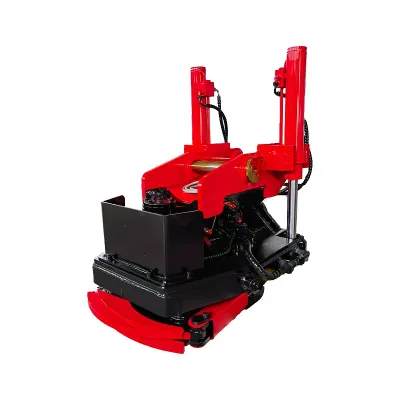
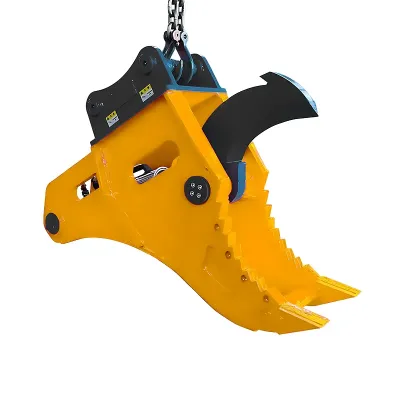
A skid steer tree shear turns a compact loader into a highly efficient felling machine, capable of cutting trees up to 300 mm in diameter in seconds. Compared to chainsaw work, it reduces noise, vibration, and operator fatigue while keeping the operator in the cab. But the wrong attachment for your machine or application leads to slow cutting, hydraulic strain, premature wear, and safety risks. This guide covers the essential factors contractors need to evaluate—cutting capacity, hydraulic requirements, blade quality, rotation, and machine fit—to match the attachment to the job and avoid expensive mismatches. For product specs and configuration details, see our Skid Steer Tree Shear product page, or browse the full Skid Steer Tree Shears category.
Cutting Capacity and Tree Size
Start with maximum cut diameter—the largest trunk the attachment can cleanly shear in one pass. A 300 mm (11.8 in) capacity covers the vast majority of trees in land clearing, right-of-way, and vegetation management, including most hardwoods and softwoods up to medium size. If your work routinely involves trees larger than 300 mm, consider a larger attachment, a felling saw combination, or using plunge-cutting techniques to reduce trunk size before shearing.
Cutting force matters just as much. The attachment needs enough force to shear through dense hardwoods without stalling. A 30-ton rating at standard hydraulic pressure is adequate for most commercial work. Keep in mind that actual cutting force depends on your skid steer's hydraulic system pressure—lower pressure means less force. Evaluate the tree species and sizes on your typical job sites, and select an attachment with capacity that exceeds your average requirement by a comfortable margin. Running an attachment at its limit consistently accelerates wear and risks hydraulic overload.
Hydraulic Requirements and Machine Compatibility
Every tree shear has specific hydraulic needs, and matching these to your skid steer is non-negotiable for safe, efficient operation. System pressure determines cutting force—most tree shears deliver rated force at 3,000 PSI, so machines with lower pressure produce proportionally less cutting power. Auxiliary flow determines blade cycle speed; standard-flow circuits (60 to 80 L/min) handle most work, while high-flow machines cycle faster for high-volume clearing.
Also check whether your skid steer has one or two auxiliary hydraulic circuits. The cutter blade needs one circuit; the ±90° hydraulic rotation function needs a second circuit. With only one circuit, you can still operate the cutter, but the rotation function won't work unless you add a second circuit or use an electronic diverter valve. Verify that your machine's rated operating capacity exceeds the attachment's weight (typically 340 to 400 kg for a full-size tree shear) plus the dynamic forces of cutting—especially when the attachment is raised for limb work. Finally, confirm that the universal quick-attach plate is compatible and that the flat-faced hydraulic couplers match your machine's coupler type.
Blade Quality and Cutting Mechanism
The blade is the consumable heart of any tree shear. Blade quality directly affects cutting performance, maintenance cost, and service life. Look for blades made from AR400 or equivalent heat-treated abrasion-resistant steel—they hold an edge longer and resist cracking under impact. The blade should be replaceable without specialized tools, and replacements should be readily available from the manufacturer. Check whether the attachment uses a single movable blade against a fixed cutting bar, or a dual-blade guillotine mechanism. Both work well, but single-blade systems typically have fewer moving parts and lower maintenance demands.
Blade gap is another critical factor. The gap between the movable blade and the fixed cutting bar determines whether the attachment shears cleanly or pinches and binds. A properly adjusted gap produces clean, square cuts with minimal splintering; excessive gap causes the blade to bend or tear wood fibers rather than shear them. Look for attachments with adjustable blade gap that can be maintained as the blade wears. Also consider whether the blade can be sharpened in the field or must be removed—field-sharpenable designs reduce downtime for remote operations.
Rotation and Positioning Capability
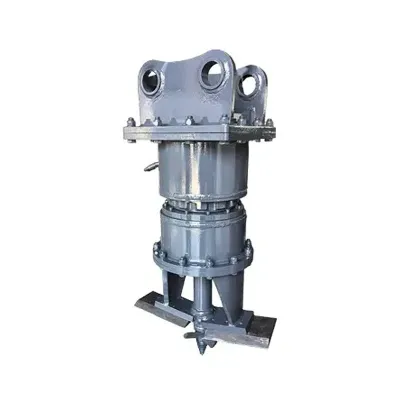
Hydraulic rotation is one of the most valuable features on a modern tree shear. A ±90° rotating cutter head lets the operator angle the blade for cutting leaning trees, reaching overhead limbs, working in tight spaces, and aligning with trees at irregular angles—without repositioning the entire skid steer. This capability significantly boosts productivity in right-of-way work, where trees and limbs grow at every conceivable angle, and in storm cleanup, where fallen and leaning trees require cuts at unusual orientations. Rotation also improves safety by allowing the operator to position the blade and control fall direction without maneuvering the machine into unstable positions.
When evaluating rotation, check the rotation angle (±90° is standard and adequate for most work), the rotation mechanism type (hydraulic motor with gear drive is common and durable), and whether the rotation has a braking or holding function to maintain position under load. Verify that the rotation requires a second auxiliary circuit and that your skid steer can support it. For operations that primarily cut straight, standing trees in open areas, a fixed (non-rotating) tree shear may be sufficient and less expensive, but most commercial operators find that rotation quickly pays for itself in versatility and reduced repositioning time.
Build Quality, Durability, and Serviceability
A tree shear operates under extreme loads and in abrasive conditions, so build quality directly determines service life and total cost of ownership. Look for a heavy-gauge steel cutter frame with reinforced weld joints at high-stress areas—particularly where the cutter arms meet the mounting frame and where the hydraulic cylinder attaches. Sealed pivot points with grease fittings prevent dirt and moisture from entering bushings and bearings, extending their service life. Check that hydraulic hoses are routed away from pinch points and abrasion areas, and that hose lengths accommodate the full range of cutter and rotation motion without binding or stretching.
Serviceability matters just as much. The attachment should allow easy access to the blade for sharpening and replacement, pivot pins for greasing, and hydraulic hoses and fittings for inspection and replacement. Look for standard, readily available fasteners and wear parts rather than proprietary components that require special tools or long lead times. Consider the availability of replacement blades, pivot pins, hydraulic seals, and rotation components from the manufacturer—especially if you operate in remote areas where fast parts delivery is critical. A well-built tree shear with good serviceability will deliver thousands of hours of productive service; a poorly built or hard-to-service attachment will spend more time in the shop than in the field.
Application Matching and Working Conditions
Match the tree shear to your specific applications and working conditions. For general land clearing and lot preparation, a full-size tree shear with 300 mm cut capacity, 30-ton force, and ±90° rotation is the most versatile choice. For right-of-way and utility maintenance—where limb cutting and angled cuts are common—rotation is essential, and a slightly lighter, more maneuverable attachment may be preferable. For orchard and vineyard removal, where tree sizes are uniform and precision cutting matters, blade gap control and clean cutting performance are critical. For storm cleanup, where trees are often broken, leaning, or entangled, rotation and high cutting force are the most valuable features.
Consider the environmental conditions on your job sites. In muddy or soft terrain, a lighter attachment reduces ground pressure and improves flotation. In rocky areas, ensure the blade and cutter frame can handle occasional contact with rock without cracking or chipping. In cold climates, verify that hydraulic components and seals are rated for low-temperature operation. For residential or noise-sensitive areas, remember that hydraulic tree shears are significantly quieter than chainsaws—which can be a selling point for municipal and residential contracts. By carefully evaluating your typical applications and working conditions against the attachment's specifications, you can select a tree shear that delivers reliable performance and a strong return on investment.
Making the Right Selection
Start by defining your maximum tree size and typical species, then select an attachment with cut diameter and cutting force that comfortably exceeds your average requirement. Verify that your skid steer's hydraulic pressure, auxiliary flow, rated operating capacity, and number of auxiliary circuits match the attachment's requirements. Evaluate blade quality, blade gap adjustability, and replacement availability. Determine whether ±90° hydraulic rotation is necessary for your applications, and confirm your machine can support it. Inspect build quality, weld reinforcement, sealed pivot points, and hose routing. Finally, assess serviceability and parts availability to ensure the attachment can be maintained in the field with minimal downtime.
Taking the time to match the tree shear to your machine and applications upfront prevents costly mistakes—buying an attachment that's too large for your skid steer, lacks the rotation you need, or uses proprietary wear parts that are hard to source. A well-matched tree shear will become one of the most productive attachments in your fleet, reducing labor costs, increasing cutting speed, and improving safety compared to manual chainsaw work. Document your machine specifications and typical job requirements, and share them with the manufacturer or dealer to confirm compatibility before finalizing your selection.