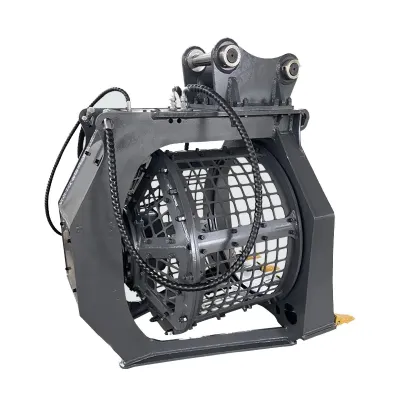
A power rake — also called a Harley rake or soil conditioner — uses a hydraulic-driven rotary drum to cultivate, level, and finish surfaces. While it's primarily a soil tool, it can handle certain gravel and aggregate jobs when set up and run correctly. The trick is matching the attachment to the gravel type, the finish you're after, and what your skid steer can deliver.
This guide covers the gravel jobs where a power rake shines, the specs that matter most, and how it stacks up against a standard landscape rake for aggregate work. For operators putting together a fleet of skid steer rake attachments, these points will help you decide whether a power rake belongs on your gravel projects.
Can a Power Rake Be Used on Gravel?
Yes — but it depends on the gravel size, the depth you're working, and what you're trying to accomplish. A power rake's rotary drum teeth are designed to cut into and loosen material, which works well for leveling and reshaping gravel surfaces that have become uneven, compacted, or mixed with soil. The rotary action moves gravel from high spots to low spots, breaks up compacted layers, and leaves a uniform finish.
That said, a power rake isn't right for every gravel job. On loose, freshly dumped gravel, the rotary drum can dig in too deep, displacing aggregate and leaving an uneven mess. On large, angular stone — think 3-inch riprap or larger — the teeth can catch and throw rocks, creating a safety hazard and damaging the attachment. The sweet spot for a power rake is gravel that's already in place and needs reshaping, leveling, or rejuvenation — like maintaining a gravel driveway, regrading a parking area, or refreshing arena footing. For spreading new gravel, a landscape rake or blade is usually the better call.
Gravel Applications That Suit a Power Rake
Gravel driveway maintenance is one of the most common and effective uses for a power rake on aggregate. Over time, driveways develop ruts, potholes, and uneven spots from traffic, weather, and erosion. A power rake loosens the compacted gravel, redistributes material to fill the low spots, and leaves a smooth, crowned surface that sheds water. The rotary action also breaks up the fine dust and compacted layer that forms on top, restoring permeability and appearance.
Parking lot and access road regrading is another solid application. Gravel lots and access roads that have become compacted or uneven can be rejuvenated with a power rake — loosening the surface, redistributing aggregate, and creating a uniform driving surface. This is often cheaper than adding new gravel since it reuses what's already there. For arena and footing maintenance, a power rake loosens and levels sand, dirt, or synthetic footing, preventing compaction and keeping the riding surface consistent. For operators who need to prep the soil underneath before placing gravel, a Skid Steer Disc Harrow can break up and level the subgrade before the power rake does the final gravel finishing.
Selection Factors for Gravel Work
When picking a power rake for gravel, start with drum width. A wider drum covers more ground per pass, which boosts productivity on large driveways, parking lots, and access roads. But it also needs more hydraulic flow and a bigger, more powerful skid steer to run effectively. For small residential driveways and tight spots, a narrower drum (48–60 inches) is easier to maneuver and needs less hydraulic capacity. For commercial and municipal work, a wider drum (72–84 inches) gets the job done faster.
Hydraulic flow is the second big factor. Most power rakes need between 15 and 30 GPM of auxiliary flow to drive the rotary drum motor. Run one with insufficient flow and you'll get slow drum speed, poor cutting, and extra wear on the motor. Check your skid steer's auxiliary flow rating against the attachment's minimum requirement before buying. Third, look at tooth or blade design — some power rakes use carbide-tipped teeth for aggressive cutting in hard, compacted material, while others use hardened steel blades for general-purpose work. For gravel, a medium-aggressive tooth design strikes a good balance: enough cutting power to break up compaction without displacing too much aggregate.
Depth control is the fourth factor to consider. A power rake with adjustable depth control — either manual or hydraulic — lets the operator set the cultivation depth precisely, which is critical on gravel. Set it too shallow and you won't accomplish much; set it too deep and you'll displace excessive gravel and dig into the subsoil. A rear leveling roller or bar also helps produce a smooth, compacted finish on gravel surfaces. For operators who need a simpler, no-hydraulics option for light gravel spreading and leveling, a Skid Steer Push Stick Rake with its rigid frame and wide working width can move and shape gravel without the complexity of a powered attachment.
Operating Tips for Gravel Surfaces
When running a power rake on gravel, start with a shallow depth setting and make the first pass to see how the gravel responds. If the surface is heavily compacted, gradually increase the depth on subsequent passes rather than trying to loosen everything in one go — this keeps the drum from digging too deep and displacing too much aggregate. Maintain a steady forward speed: too fast and the drum skips across the surface; too slow and the teeth dig in and create trenches. A moderate, consistent pace gives the best results.
Overlap each pass by 2–3 inches to ensure complete coverage and a uniform finish. Work in a pattern that follows the desired crown or slope, using the power rake to move material from high spots to low spots. After the loosening and leveling passes, make a final pass with the drum set very shallow or slightly lifted off the surface, using the rear leveling roller to smooth and compact the finish. This last pass leaves a smooth, uniform gravel surface ready for traffic. Avoid running the power rake on gravel that's wet or saturated — the drum will clog with mud, and the gravel won't flow properly through the attachment.
Power Rake vs. Landscape Rake for Gravel
A power rake and a landscape rake handle gravel differently, and each has its place. A landscape rake is a passive attachment — it drags tines across the gravel surface, spreading and leveling material without digging in. It's great for spreading new gravel, light leveling, and removing debris from gravel surfaces. No moving parts, no hydraulics, simple to run, cheap to maintain, and unlikely to damage the surface. But it can't break up compacted gravel or deeply reshape an uneven surface.
A power rake uses a hydraulic-driven rotary drum to loosen, redistribute, and level gravel. It's far more effective for rejuvenating compacted or uneven surfaces, filling ruts and potholes, and producing a smooth, uniform finish. But it's more complex, more expensive, needs auxiliary hydraulics, and can damage a gravel surface if run too deep or too fast. For most gravel operations, the smart approach is to use a landscape rake for spreading new gravel and light maintenance, and a power rake for periodic deep rejuvenation and regrading of compacted or uneven surfaces.
Summary
A skid steer power rake can be an effective tool for gravel work, particularly for rejuvenating compacted driveways, regrading parking areas, and maintaining arena footing. Choosing the right one means evaluating drum width, hydraulic flow, tooth design, and depth control. Running it on gravel calls for a shallow initial depth, steady forward speed, overlapping passes, and a final finishing pass with the rear leveling roller. While a power rake is more capable than a landscape rake for deep gravel rejuvenation, the landscape rake remains the simpler, more cost-effective choice for spreading new gravel and light surface maintenance. For soil prep beneath gravel surfaces, a disc harrow handles primary tillage before the power rake or landscape rake finishes the job.