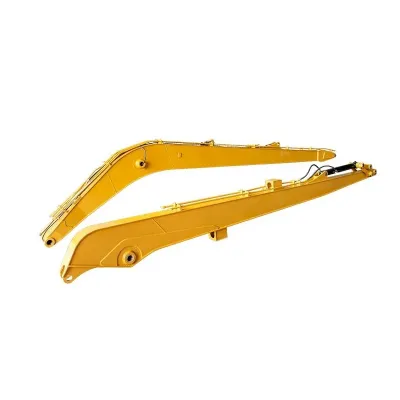
The excavator arm isn't a one-size-fits-all proposition. Different lengths and designs change the machine's working envelope, digging force, lift capacity, and maintenance demands. Choosing the right arm for the job directly impacts productivity and operating costs—because an arm that's too long cuts into breakout force, while one that's too short limits reach. This guide breaks down the most common arm configurations and the applications where each one really shines.
Standard Arm
The standard arm—often called the general-purpose or GP arm—is the factory-supplied length that comes matched to the boom and machine class. It delivers a solid balance of digging reach, breakout force, and lift capacity across a wide spectrum of general construction, earthmoving, and utility work. For contractors who use their machine for multiple tasks and value versatility over specialized performance, the standard arm is the default go-to. It accepts the broadest range of buckets and attachments, and its geometry is dialed in for the manufacturer's intended duty cycle.
On top of that, the standard arm is the easiest and most economical to maintain. Replacement parts, bushings, and pins are readily available, transport dimensions stay within normal limits, and the geometry is familiar to operators and service techs alike. For machines that will handle general excavation, grading, utility work, and everyday material handling, the standard arm is usually the most practical, cost-effective choice.
Long Arm
A long arm stretches reach beyond the standard length, boosting maximum digging depth and horizontal extension. These arms are built for deep excavation, canal and river dredging, slope work, and any situation where the machine can't get close to the work area. The trade-off is that the extended arm increases the load moment, which means safe bucket capacity and lift capacity at full extension take a hit compared to a standard arm. Operators need to downsize the bucket and avoid lifting at maximum reach to stay within safe operating limits.
Long arms come as fixed-length replacements for the standard arm, or as part of a matched long-reach front that includes a longer boom and arm together. A long arm paired with a standard boom gives you moderate reach extension for deep digging, while a full matched long-reach front delivers maximum reach for dredging and far-reach tasks. You may need extra counterweight to keep things stable, and it's worth checking transport dimensions against local regulations before you move the machine.
Short Arm
A short arm is shorter than the standard length, which boosts breakout force and lift capacity by reducing the load moment. These arms are the go-to for heavy digging, rock work, quarry operations, and any application where maximum digging force trumps maximum reach. The shorter arm also shrinks the overall working envelope, making the machine more maneuverable in tight spots like tunnels, basements, and indoor demolition jobs. In these cases, the reduced reach isn't a problem because the work area is right there next to the machine.
Short arms are often paired with heavy-duty buckets and high-capacity hydraulic systems to max out production in hard digging conditions. The extra breakout force can cut cycle times in competent rock or hardpan where a standard arm might struggle to get a bite. On the flip side, the reduced reach means you'll have to reposition the machine more often to cover the same ground, which can slow you down in large, open excavations. Short arms are a specialized tool—great for jobs where force and maneuverability matter more than reach.
Telescopic and Extendable Arms
Telescopic arms use nested sliding sections that extend and retract hydraulically, giving you variable reach on demand. A two-stage telescopic arm has one outer section and one inner sliding section, providing moderate extension with a single slide interface. A three-stage telescopic arm adds a second inner section, delivering greater maximum extension and a more compact retracted length—but with more wear components to keep an eye on. TGEC two-stage telescopic sticks cover 20 to 50 ton excavators with 10 to 18 meters of extended reach, while three-stage sticks cover 30 to 60 ton machines with 14 to 22 meters of reach.
Extendable arms, sometimes called sliding dipper sticks, work on a similar slide-in principle but may be mechanically rather than hydraulically extended, or use a different locking setup. TGEC sliding dipper sticks cover 12 to 45 ton excavators with maximum digging depths from 8 to 16 meters. The big advantage of telescopic and extendable arms is versatility: you can retract the arm for transport and general work, then extend it for deep digging or far-reach tasks. The downside is more wear parts at the slide interfaces—they need regular greasing and periodic bushing replacement—and a reduced bucket capacity at full extension thanks to the increased load moment.
Selecting the Right Arm Type
The right arm type comes down to your primary application, the size and hydraulic capacity of your excavator, and whether the machine will be dedicated to one task or used for general work. For general construction and earthmoving, the standard arm gives you the best blend of reach, force, and versatility. For deep excavation, dredging, and slope work, a long arm or telescopic arm gets you the reach you need. For heavy digging, rock work, and tight spaces, a short arm delivers extra force and maneuverability. If you need both standard and extended reach from the same machine, a telescopic or extendable arm offers the most flexibility—though you'll pay for it with added maintenance and a reduced bucket capacity at full extension.
Before making an arm change, double-check that your excavator's hydraulic system can handle any additional flow requirements, that your counterweight is sufficient for the new arm geometry, and that transport dimensions comply with local regulations. The bucket size needs to be matched to the arm configuration and excavator lift capacity, and operators should get up to speed on the changed working envelope and load limits before hitting the job site.