Setting utility poles has long depended on truck-mounted derricks, but a skid steer with the right attachment often does the job more efficiently — especially in tight rights-of-way, rough terrain, or on jobs where a full-size derrick truck can't reach. This guide covers the workflow from site prep through final backfill, with practical tips on equipment selection and safe handling.
Before any pole goes in the ground, confirm that your carrier, attachment, and crew are matched to the pole size and site conditions. The following sections walk through each stage of the process.
Jobsite Preparation
Start by locating all underground utilities — gas, electric, water, telecom, and fiber — before breaking ground. Mark the hole location per the pole plan, and verify that the hole diameter and depth meet local utility standards and the pole specifications. A common rule of thumb: hole depth equals roughly 10% of the pole length plus two feet, though local codes may differ.
Clear the area around the hole of debris, soft soil, and obstacles that could block the skid steer's approach or the pole's swing arc. Make sure the ground can support the machine under load, especially near the hole edge. On slopes or soft ground, consider a track loader or use mats to distribute weight. Set up traffic control or barricades for roadside or urban work.
Pole Handling and Positioning
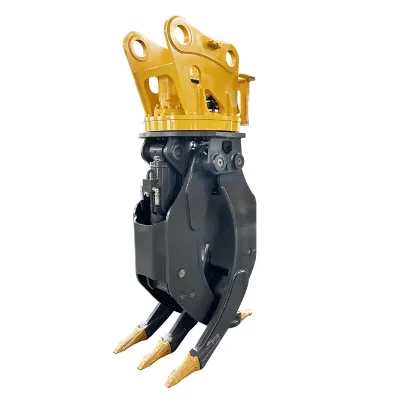
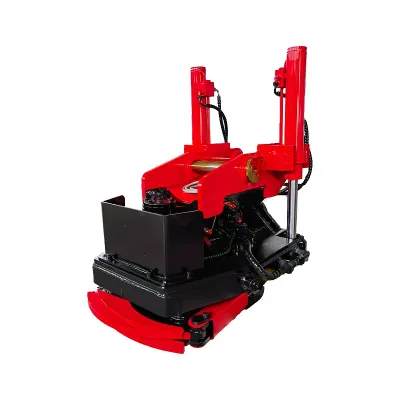
Once the hole is ready, move the pole from the staging area to the hole and lift it into position. A skid steer with a hydraulic pole setter clamps the pole securely, then uses the lift arms and the attachment's rotation to swing the pole from horizontal to vertical. The operator approaches the hole with the pole at a controlled height and lowers it in while ground crew guide the base.
Getting the pole plumb and aligned with the route or structure is critical. The pole setter's hydraulic rotation lets the operator fine-tune orientation without repositioning the skid steer — a real time-saver on multi-pole jobs. Once the pole is in place, backfill in layers, tamping each layer for stable support. Check alignment again after backfill and once more after the pole is fully set.
Attachment Selection
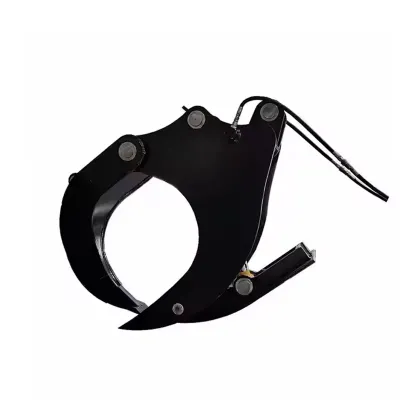
Choosing the right attachment is the biggest equipment decision for skid steer pole setting. A dedicated skid steer pole setter is purpose-built for the job: hydraulic clamping jaws that grip securely, a rotation circuit for precise positioning, and a reinforced frame that stands up to repeated lifting cycles. General-purpose attachments like pallet forks or material grapples can move poles around a yard but lack the controlled clamping and rotation needed for safe vertical placement — they also increase the risk of pole damage or slipping.
When evaluating a pole setter, check that the clamping range covers the diameters you typically handle — wood distribution poles, steel streetlight poles, and concrete poles all have different dimensions. Verify that the attachment's hydraulic flow and pressure match your skid steer's auxiliary circuit, and confirm that the mounting plate fits your machine's quick-attach system. Some models offer extras like extended rotation, remote-controlled clamping, or jaw inserts for delicate pole finishes.
Machine Requirements
The skid steer must have enough lift capacity, hydraulic output, and stability to handle the pole and attachment together. Lifting a long pole creates a significant load moment, especially when the pole is extended horizontally during the lift. Check the machine's load chart to ensure the rated operating capacity covers the pole weight plus attachment weight at the required height and reach. An undersized machine will struggle and may become unstable.
Auxiliary hydraulic flow is equally important. The pole setter's clamping cylinder and rotation motor both draw flow from the auxiliary circuit. Insufficient flow means slow clamping or weak rotation, cutting productivity. Most pole setters require standard or high-flow auxiliary, depending on the model. Also confirm that the machine's hydraulic pressure meets the attachment's rating, and that the correct hose kit and couplers are in place.
Safety Considerations
Pole setting involves heavy loads, overhead work, and close interaction between operator and ground crew — so safety procedures are non-negotiable. Only trained, authorized operators should run the skid steer. All ground crew must wear hard hats, safety glasses, gloves, and high-visibility clothing. Establish clear hand signals or radio communication between operator and crew, and keep everyone clear of the pole's swing radius and out from under suspended loads.
Before each lift, inspect the attachment's clamping jaws, pins, hydraulic hoses, and frame for wear or damage. Never lift a pole that exceeds the attachment's rated capacity or the machine's operating limits. Avoid sudden movements when lifting or rotating, and never allow riders on the attachment or the pole. For roadside jobs, set up traffic control and ensure the skid steer's lights and beacon are visible. After the pole is set and backfilled, clear all tools and equipment from the hole area before moving to the next site.
Final Tips for Efficient Pole Setting
A smooth pole-setting operation moves from one hole to the next without delays. Stage poles near their installation points ahead of time, pre-dig holes in sequence, and keep the skid steer's path clear between locations. For crews that install utility poles regularly, investing in a dedicated pole setter for the skid steer fleet — rather than renting or improvising with general attachments — pays off in faster cycle times, fewer damaged poles, and better jobsite safety. For more on equipment options, see the full lineup of skid steer pole setters available for utility and municipal work.