Picking the right skid steer auger attachment isn't complicated—you just need to match the tool to the job, the machine, and the ground you're drilling in. Get it right, and you'll drill clean, straight holes with minimal strain on your carrier. Get it wrong, and you're looking at slow production, damaged hydraulics, or both. Here's what to consider before you spec out an auger drive, bit diameter, and configuration for your typical work.
Start With Your Drilling Application
Start with what you'll be drilling day in and day out. Fence and sign post work typically calls for smaller diameters—think 150 mm to 230 mm. Deck footings, foundation piers, and utility work often step up to 300 mm to 460 mm. Agricultural jobs like vineyard trellises or orchard planting tend to land somewhere in the middle. If your work covers multiple hole sizes, a dual-stem configuration that accepts two diameters on one drive can save you changeover time and keep costs in check.
Also think about where you're working. Tight residential yards and indoor jobs are better suited to mini skid steers with lighter auger setups, while open construction sites and farm fields can handle full-size machines with bigger bits and heavier drives. TGEC's skid steer auger attachment lineup spans both ends of that spectrum, with configurations ranging from 144 kg to 245 kg.
Match the Bit Diameter to the Job
Bit diameter drives both the hole size you get and the torque you need to make it. A 150 mm bit works well for narrow fence posts and light utility work. Step up to 230 mm and you're covering standard wood and steel fence posts. For larger deck footings or foundation piers, you'll want 300 mm to 460 mm bits—and those require a heavier drive with more grunt. Oversize the bit relative to the drive or carrier, and you'll get slow drilling, stalling, and accelerated wear on the motor and gear reducer.
For a deeper dive into common diameters and what they're good for, check out our guide on skid steer auger bit sizes. That piece covers everything from 6-inch fence-post bits to 36-inch footing bits, along with how to size holes for different posts and concrete footings.
Check Your Skid Steer Hydraulic Flow
Hydraulic flow is the single biggest factor in how well your auger performs. The drive turns the carrier's auxiliary flow into rotational torque, and if the flow doesn't match the drive's rating, you'll either starve it of power or overspeed it—both of which shorten component life. Most compact and mid-size skid steers put out standard auxiliary flow in the 15 to 25 L/min range. High-flow machines can push 30 L/min or more. TGEC's AG23 series is rated for 15 L/min standard flow, which aligns with the majority of compact and mid-size skid steers on the market.
If you're running a high-flow carrier, you can still use a standard-flow auger—just dial the flow down to the drive's rating using the machine's flow control or a pressure-compensated valve. Running unrestricted high flow through a standard-flow drive will overspeed the motor, cut torque, and shorten seal and bearing life. For a more detailed look at flow matching and the flow-torque relationship, see our skid steer auger flow rate guide.
Consider Soil and Ground Conditions
Soil type dictates the tooth configuration and flight thickness you'll need. Loose topsoil, sand, and clay drill just fine with standard cutting teeth and 4 mm flighting. Mixed ground with gravel, roots, or the odd rock calls for heavier-duty teeth and 8 mm flighting to resist bending and cracking. Consistently rocky or fractured ground demands a rock auger bit with carbide-tipped teeth and a reinforced pilot point—and you'll want to run steady, moderate downforce rather than muscling through solid rock.
Many contractors face a mix of soil types across different jobsites, so going with an 8 mm-flight, carbide-tooth configuration can be a smart move even if you mostly drill in normal ground. The extra durability cuts down on downtime from bent flights and broken teeth, and the bit will still drill efficiently in softer material.
Evaluate Drive Type and Torque
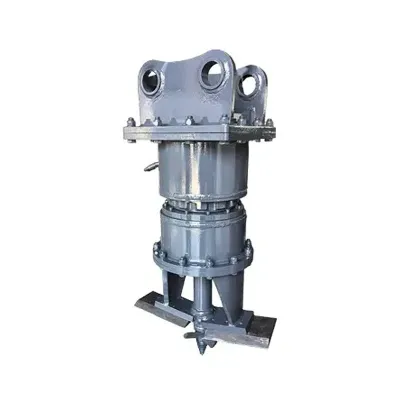
An auger drive pairs a hydraulic motor with a planetary gear reducer. The reducer steps down the motor's high-speed spin to a slower output with multiplied torque—and that torque is what actually does the cutting. Bigger bits and harder ground need more torque. Smaller bits in soft soil can get by with less. When comparing drives, look beyond the flow rating—pay attention to gear reduction ratio, motor displacement, and rated torque output.
Some drives offer a two-speed design that lets operators switch between high-speed/low-torque and low-speed/high-torque modes from the cab. That's handy for contractors who bounce between small-diameter holes in soft ground and larger-diameter holes in harder material. For most standard fencing and landscaping work, though, a single-speed planetary drive with the right flow rating is more than enough and comes at a better price point.
Plan for Depth and Extensions
Standard auger stem lengths—915 mm to 1160 mm—cover most post-hole and footing applications. For deeper holes, you'll need extension shafts. Extensions connect between the drive and bit through matching hex or round interfaces, and you can stack multiple sections to go deeper. Practical depth is limited by the skid steer's lift height, the stiffness of the extended assembly, and the ground itself—the deeper you go, the more torque you need, and the higher the risk of binding or bending the stem.
If deep holes are a regular part of your work, look for a drive with a robust stem connection and consider buying extension shafts upfront. For a full breakdown of maximum drilling depth, extension types, and the real-world limits of deep-hole drilling with a skid steer auger, check out our guide on skid steer auger drilling depth.
Final Selection Checklist
Before you pull the trigger on a skid steer auger attachment, run through this checklist: your carrier's auxiliary hydraulic flow and pressure rating, the quick-attach interface (universal or proprietary), the hole diameters you typically need, the soil conditions you encounter most, the maximum depth you require, and whether a single-stem or dual-stem setup makes more sense for your work. Give these details to your supplier and you'll get a correctly matched auger drive and bit setup.
TGEC's full range of skid steer auger attachments includes seven configurations covering bit diameters from 150 mm to 460 mm, stem lengths of 915 mm and 1160 mm, and flight thickness of 4 mm or 8 mm. All configurations use a universal quick-attach mount and run on 15 L/min standard flow, with custom mounting frames available for non-standard interfaces.