Picking between a drum mulcher and a disc mulcher is one of the bigger decisions you'll make when equipping a skid steer for vegetation work. They both cut trees and brush, but they go about it differently — and that affects mulch quality, cutting speed, how big a tree you can handle, and what your hydraulic system needs to deliver. Pick wrong, and you'll deal with slow production, constant stalling, poor mulch, or unnecessary wear on your machine. This comparison breaks down the real differences so you can match the right mulcher to your operation.
Land clearing contractors, right-of-way crews, municipal vegetation managers, and farm and ranch operators all face this choice. The goal isn't to crown one design as universally better — it's to figure out which one works best in the conditions you run into most often.
Cutting Mechanism
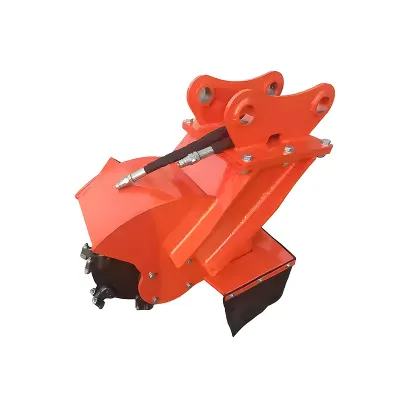
A drum mulcher uses a cylindrical rotor that runs the full working width, with carbide-tipped teeth arranged in a helical pattern along the drum surface. As the drum turns, the teeth strike and shred vegetation continuously across the entire width. The helical setup creates a progressive cutting action that engages material smoothly, reducing shock loads on the carrier. The TGEC skid steer forestry mulcher uses this drum design, with 25 to 56 teeth depending on the model.
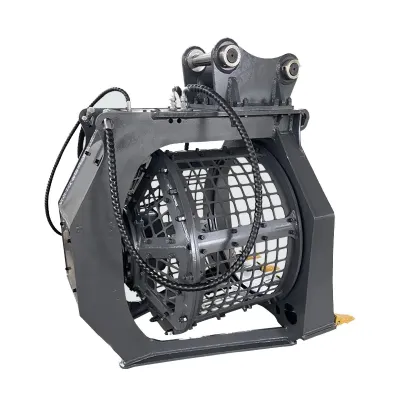
A disc mulcher uses a heavy, flat steel disc that spins in a vertical plane, with cutting teeth mounted around the disc perimeter. The disc's mass acts as a flywheel — once it's up to speed, the stored rotational momentum carries it through thick vegetation without bogging down. The teeth engage material at the disc's outer edge, where cutting speed is highest. The TGEC skid steer disc mulcher uses this rotary disc design with a 1520 mm working width. The core mechanical difference: drum mulchers shred material across a wide cylindrical rotor, while disc mulchers cut with a high-mass spinning disc that uses stored energy for sustained cutting power.
Mulch Finish Quality
Mulch quality is one of the most noticeable differences between the two. A drum mulcher produces a finer, more consistent mulch because the helical tooth pattern shreds material repeatedly as it moves through the drum's cutting zone. Multiple teeth engage the material in sequence, breaking it down into smaller, more uniform chips that decompose faster and cover the soil better. That fine finish is what you want for municipal parks, greenbelts, trail systems, wildfire mitigation, and any job where aesthetics or erosion control are part of the spec.
A disc mulcher leaves a coarser, more variable mulch because the disc teeth cut material in a single pass at the perimeter, rather than shredding it repeatedly. The resulting chips are larger and less uniform — some material gets cut cleanly, while other pieces come off in longer sections. Coarser mulch breaks down more slowly and leaves a rougher surface. For high-production land clearing where the mulch just stays on site to rot, that's fine. For jobs where a neat, finished appearance matters — residential development, public parks, or high-visibility properties — the drum mulcher's finer finish gives you a real advantage.
Production Speed and Throughput
When it comes to speed, the disc mulcher has the edge. The heavy disc's flywheel energy lets it maintain cutting speed through thick brush and standing timber, which means fewer stalls and a steadier pace through dense vegetation. The disc cuts with high momentum at its outer edge, severing tree trunks quickly and cleanly. On open land clearing sites with heavy, continuous cover, a disc mulcher will clear more acres per hour than a drum mulcher of similar size.
A drum mulcher is generally slower on thick standing timber, but it offers advantages in controlled, selective clearing. The full-width drum engages material evenly across the cutting path, producing consistent results without needing to precisely position a disc edge. On sparse to moderate vegetation, brush, and saplings, a drum mulcher keeps up steady production while delivering a superior finish. The speed gap narrows on lighter vegetation — where either mulcher moves quickly — and widens on thick, dense timber where the disc's flywheel advantage really shows. For a broader look at selection factors beyond just speed, see our best skid steer mulcher selection guide.
Maximum Tree Diameter
The disc mulcher's flywheel energy and higher cutting momentum generally let it handle larger trees than a comparably sized drum mulcher. The disc's mass carries it through a cut on a thick trunk, while a drum mulcher may stall or need multiple passes on the same tree. In practical terms, a disc mulcher can typically handle trees up to 200 to 250 mm (8 to 10 in) in diameter, depending on carrier horsepower and hydraulic flow, while a drum mulcher of similar size is more comfortable on trees up to 150 to 200 mm (6 to 8 in).
But maximum diameter isn't everything. A drum mulcher processes smaller material more thoroughly, shredding it into fine mulch in a single pass, while a disc mulcher may leave larger chips that take extra passes to clean up. If your work is mostly brush, saplings, and small trees under 150 mm (6 in), either design will handle the material — the choice comes down to finish quality and cutting style. If you regularly deal with standing timber over 150 mm, the disc mulcher's larger cutting capacity becomes a real advantage.
Hydraulic Requirements
Both drum and disc mulchers need high-flow auxiliary hydraulics, but their specific flow ranges differ. The TGEC drum-style forestry mulchers require 110 to 150 L/min (29 to 40 GPM) at 21 to 25 MPa (3046 to 3626 psi), depending on the model. The TGEC disc mulcher requires 130 to 200 L/min (34 to 53 GPM) at 25 MPa (3626 psi). The disc mulcher's higher minimum flow reflects the power needed to accelerate and keep that heavy disc spinning at speed.
This difference matters when matching the mulcher to your carrier. If your high-flow skid steer delivers 110 to 130 L/min (29 to 34 GPM), the drum mulcher is the practical choice — the disc mulcher's 130 L/min minimum leaves you at the low end of performance, with slower disc acceleration and less flywheel effect. If your machine delivers 150 L/min (40 GPM) or more, either design will perform well, and the disc mulcher will have plenty of flow to reach and maintain optimal cutting speed. Always check your machine's actual high-flow output, not just the spec sheet — real-world flow varies with engine RPM, hydraulic temperature, and system wear.
Weight and Carrier Stability
Weight affects stability, lift capacity, and transport. The TGEC drum mulchers range from 700 to 1235 kg (1543 to 2723 lb) depending on width, with the 1000 mm model being the lightest. The TGEC disc mulcher weighs 1153 kg (2542 lb), which sits in the middle-to-upper range of the drum lineup. Both are heavy front-mounted attachments that need a carrier with adequate operating weight and rated operating capacity.
The disc mulcher's weight is concentrated in the heavy disc, which sits forward on the attachment, potentially shifting the center of gravity farther from the carrier than a drum mulcher of similar total weight. That can affect stability when the attachment is raised or when working on slopes. The drum mulcher's weight is distributed more evenly across the width of the drum, which may give slightly better balance. For operators working on steep terrain or with marginal carrier capacity, the smaller, lighter drum mulcher models (700 to 1000 kg) offer a stability advantage over the disc mulcher. For large, stable carriers with high ROC, the weight difference matters less.
Maintenance and Wear Parts
Both mulcher types share common maintenance: inspecting and replacing cutting teeth, checking hoses and fittings for leaks, greasing bearings and pivot points, and inspecting the rotor or disc for damage. But the wear patterns differ. Drum mulcher teeth are arranged in a helical pattern and wear relatively evenly across the drum, with teeth in certain positions wearing faster depending on cutting style. Individual tooth replacement is straightforward, and teeth can often be rotated to expose a fresh cutting edge before full replacement.
Disc mulcher teeth are mounted around the disc perimeter and take heavy impact loads, especially when cutting thick timber or hitting hidden debris. The disc's high rotational speed means a tooth hitting a rock or metal object can be damaged or broken more violently than a drum tooth. The disc itself should be checked for cracks, warping, or elongated tooth mounting holes after any significant impact. Because the disc stores a lot of rotational energy, maintenance always requires letting it come to a complete stop before inspection. For both designs, genuine replacement teeth and wear parts from the manufacturer ensure proper fit, cutting performance, and safety. The full skid steer mulchers product line is backed by factory-direct parts supply.
Application Matching
The right mulcher type depends on your primary work. For high-production land clearing, site development, and right-of-way work where speed and throughput are the top priorities, the disc mulcher is generally the better choice. Its flywheel energy and high cutting momentum let it power through thick vegetation and standing timber with fewer stalls and more acres per hour.
For municipal vegetation management, park and greenbelt maintenance, selective clearing, wildfire mitigation, and residential development where a fine mulch finish and controlled cutting matter, the drum mulcher is the preferred tool. Its helical tooth pattern produces a consistent, fine mulch that covers the soil neatly and decomposes quickly, and the full-width drum gives even, predictable cutting results.
For farm and ranch clearing, fence-line maintenance, and mixed vegetation work, either design can be effective — the choice depends on whether you value faster cutting on thicker brush (disc) or finer finish and more controlled clearing (drum). Some contractors keep both types on hand, using the disc for large production clearing and the drum for finish work and selective clearing. Look at the application that makes up 70 percent or more of your work and pick the mulcher that excels there.
Making the Right Choice
The drum vs. disc decision comes down to matching the mulcher's strengths to your operation's priorities. If you clear dense, thick vegetation and standing timber on large sites where production speed directly affects profitability, the disc mulcher's flywheel energy and high cutting throughput make it the clear choice. If you manage vegetation in public spaces, need a fine mulch finish for erosion control or aesthetics, or do selective clearing where control and consistency matter, the drum mulcher delivers superior results.
Your carrier's hydraulic output is a hard constraint that may make the decision for you — machines with 110 to 130 L/min high-flow output are better matched to drum mulchers, while machines with 150 L/min or more can run either design effectively. Budget, parts availability, and the specific vegetation on your jobs should all factor into the final decision. By understanding the mechanical differences and real-world performance of each design, you can select the mulcher that maximizes productivity and minimizes downtime for your specific operation.