One of the most frequent missteps in mulcher selection is focusing on cutting width or price while overlooking the host machine's actual size and hydraulic output. Strap an oversized attachment onto your excavator, and you'll overload the hydraulic system, watch the boom droop, compromise stability, and accelerate wear across the carrier. Go too small, and you'll leave productivity on the table—lower throughput, higher cost per acre, and a machine that's capable of more than you're asking of it. Getting the size right means the attachment and excavator work as a balanced system, delivering top production without putting undue stress on either component.
This guide gives you a straightforward method for matching a mulcher to your excavator's size, walking through the key variables: operating weight, hydraulic flow, attachment weight, lift capacity, and cutting capacity. Whether you're running a 3-ton mini for residential jobs or a 25-ton machine for commercial forestry, working through these sizing principles will help you pick a mulcher that performs reliably and protects your equipment investment.
The Four Core Sizing Variables
Proper mulcher sizing comes down to four interconnected factors that have to be evaluated together—you can't look at any one in isolation.
-
Operating weight class: The excavator's rated operating weight sets the appropriate frame size and weight range for the mulcher.
-
Auxiliary hydraulic flow: The continuous flow rate of your auxiliary circuit determines which mulcher models your machine can actually power.
-
Attachment weight: The mulcher's weight has to stay within your excavator's lift capacity at working reach to keep the machine stable and performing.
-
Cutting capacity: The maximum material diameter the mulcher can handle should line up with the vegetation you run into most often.
These variables don't operate in a vacuum. A larger mulcher with a wider cutting width usually weighs more, demands more hydraulic flow, and can process bigger material. Getting all four dialed in to match both your excavator and your work is what delivers optimal performance.
Sizing by Excavator Weight Class
3 to 5 Ton Mini Excavators
Mini excavators in the 3-to-5-ton range are the go-to for residential clearing, fence-line work, pond maintenance, and trail building. Their compact footprint gets them into tight spots, but their limited hydraulic output and lift capacity restrict the size of mulcher they can carry effectively. Attachments in this class typically weigh between 200 and 400 kg, offer a cutting width of 700 to 900 mm, and ask for 30 to 60 L/min of continuous auxiliary flow. Maximum cutting capacity generally lands around 80 to 100 mm for softwood, with smaller diameters for dense hardwoods.
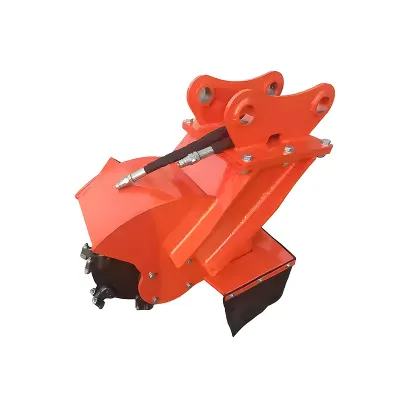
The TG-M02 is a good example of a mulcher built for 3-to-5-ton excavators, coming in at 241 kg with an 800 mm cutting width and a flow requirement of 30 to 60 L/min. For a deeper look at mini excavator mulcher selection, check out our mini excavator mulcher selection guide.
5 to 9 Ton Compact Excavators
The 5-to-9-ton class sits right between mini and mid-size machines, giving you more hydraulic output and lift capacity while keeping maneuverability reasonable. Mulchers in this class usually weigh 350 to 600 kg, have cutting widths from 900 to 1100 mm, and require 50 to 100 L/min of continuous flow. Maximum cutting capacity climbs to 100 to 150 mm, depending on the model and the material. These machines are well-suited for commercial lot clearing, utility easement maintenance, and lighter forestry applications.
The TG-M04 is sized for 5-to-9-ton excavators, weighing 373 kg with a 906 mm cutting width and a 50-to-100 L/min flow requirement.
9 to 15 Ton Mid-Size Excavators
Mid-size excavators from 9 to 15 tons are the backbone of the land-clearing industry, striking a solid balance between power, reach, and maneuverability across a broad range of jobs. Mulchers for this class typically weigh 700 to 1100 kg, run cutting widths of 1000 to 1300 mm, and need 90 to 150 L/min of continuous flow. Maximum cutting capacity falls in the 150-to-200-mm range, making this class suitable for forestry thinning, right-of-way clearing, and site prep on medium-to-large projects.
Both the TG-M06 and TG-MC 120 fit this weight range. The TG-M06 weighs 820 kg with a 1102 mm cutting width and requires 50 to 100 L/min. The TG-MC 120 tips the scales at 1000 kg, demands 150 L/min at 245 bar, and carries 16 carbide cutters for high-volume production.
15 to 25 Ton Large Excavators
Large excavators from 15 to 25 tons bring the hydraulic power and lift capacity needed for the toughest mulching applications—heavy forestry clearing, large-scale site prep, and utility corridor work. Mulchers for this class generally weigh 1200 to 1800 kg, have cutting widths from 1300 to 1800 mm, and require 150 to 250 L/min of continuous flow. Maximum cutting capacity exceeds 200 mm, and the higher tooth count on larger drums or discs delivers rapid material processing. These attachments are built for high-production commercial and industrial clearing.
The TG-M10 and TG-MC 200 are both designed for large excavators. The TG-M10 is fully customizable, with attachment weight ranging from 1200 to 1800 kg, cutting width from 1300 to 1800 mm, and a flow requirement of 100 to 200 L/min. The TG-MC 200 weighs 1500 kg, requires 250 L/min at 245 bar, and carries 24 carbide cutters for maximum production on 20-to-25-ton excavators.
Matching Hydraulic Flow
While operating weight class gives you a good starting point, hydraulic flow is the variable that most directly determines whether a particular mulcher model will actually perform on your machine. Two excavators in the same weight class can have very different auxiliary hydraulic outputs depending on the manufacturer, model year, and whether a high-flow package is installed. Always verify your machine's continuous auxiliary flow rate against the mulcher's required flow range before you make a decision.
The mulcher's required flow range marks the minimum and maximum flow rates the attachment is designed to handle. Run below the minimum, and the drum or disc won't spin fast enough—you'll get stalls, poor cut quality, and accelerated tooth wear. Run above the maximum, and you risk overspinning the motor, building excess heat, and damaging seals and bearings. The sweet spot is when your excavator's continuous flow falls in the middle-to-upper portion of the mulcher's required range, giving you plenty of power without bumping up against the upper limit.
| Excavator Class | Typical Auxiliary Flow | Example Mulcher Model | Required Flow |
|---|---|---|---|
| 3–5 t | 30–60 L/min | TG-M02 | 30–60 L/min |
| 5–9 t | 50–100 L/min | TG-M04 | 50–100 L/min |
| 9–15 t | 90–150 L/min | TG-MC 120 | 150 L/min |
| 15–25 t | 150–250 L/min | TG-MC 200 | 250 L/min |
Attachment Weight and Lift Capacity
Attachment weight is easy to overlook, but it's a critical factor for machine stability and overall performance. A mulcher hanging at the end of the boom creates a significant lever arm, and the dynamic loads from cutting add even more stress. If the mulcher is too heavy for your excavator, you'll see boom sag, reduced stability, accelerated wear on swing bearings and boom components, and—in extreme cases—a tipping hazard.
To assess weight compatibility, pull up your excavator's lift capacity chart, which shows the maximum weight the machine can lift at various boom extensions and heights. The mulcher's weight should sit comfortably within the lift capacity at your typical working reach, with a margin for the dynamic forces generated during cutting. As a rough rule of thumb, the attachment weight shouldn't exceed 20 to 25 percent of the excavator's operating weight, though that varies by machine design and boom configuration. Always check the specific lift chart for your exact excavator model.
Cutting Capacity and Vegetation Matching
The last sizing variable is cutting capacity, which needs to match the vegetation you process day in and day out. A mulcher rated for 100 mm maximum will struggle with regular 150 mm trees—expect stalls, accelerated wear, and operator frustration. On the flip side, a mulcher rated for 300 mm material is overkill if you're mostly dealing with brush and small stems, adding unnecessary weight, fuel consumption, and upfront cost.
Take a close look at your typical vegetation. Measure the diameter of the majority of trees and brush you encounter, and pick a mulcher whose rated cutting capacity comfortably exceeds that figure. If you occasionally run into larger trees beyond the mulcher's rated capacity, drop them first with a chainsaw or tree shear, then mulch the downed sections. That approach is more efficient and kinder to the attachment than trying to force material beyond its design limits.
Common Sizing Mistakes to Avoid
-
Picking by cutting width alone: A wider mulcher might look more productive, but if it exceeds your hydraulic flow or lift capacity, it'll underperform and wear out faster.
-
Ignoring continuous flow rating: Peak or intermittent flow won't cut it—mulchers run under sustained load, so always use the continuous flow figure.
-
Overlooking the case drain requirement: Most mulchers need a case drain line to protect the hydraulic motor. Running without one can cause seal failure and void the warranty.
-
Neglecting lift capacity: Attachment weight at the end of the boom creates a long lever arm. Verify lift capacity at your actual working reach, not just at minimum extension.
-
Matching to maximum vegetation rather than typical vegetation: Size the mulcher for the material you handle most often, not the occasional oversized tree. Handle larger stuff separately.
Size Matching Checklist
Run through these four checks before you commit to a model. Confirm your excavator's operating weight falls within the attachment's rated class, and that the continuous auxiliary flow—not the peak figure—lands inside the mulcher's required range. Pull the lift capacity chart and verify the attachment weight stays under the rated lift at your typical working reach, with margin for dynamic loads. Cross-reference the mulcher's maximum cutting diameter against the stem sizes you encounter on most jobs, and plan to fell anything significantly larger separately rather than forcing it through the attachment.
TGEC mulchers cover carriers from 3 to 30 tons, from the compact TG-M02 for mini excavators to the fixed-tooth drum mulcher in three frame sizes and the fully customizable TG-M10 for large forestry applications. See the complete excavator mulchers lineup or share your excavator make, model, and hydraulic specs with the TGEC team for a size-matched recommendation.
Compatibility Questions
Answers to common questions about sizing mulchers to excavators and hydraulic systems.