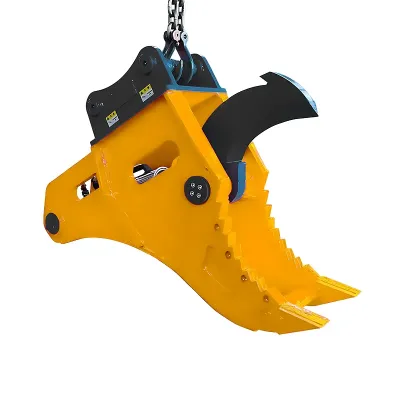
Picking the right ripper isn't just about matching a model number to your excavator's weight. Too big, and you'll struggle to get good penetration while putting unnecessary strain on the arm. Too small, and you'll bounce off hard ground, wasting time and fuel. The right choice balances four things: your machine's weight class, the arm mounting dimensions, the type of ground you're working in (which drives tooth selection), and whether the excavator can handle the added weight at full reach. Nail that balance, and you'll get good penetration, stay within safe limits, and maximize tooth life.
Start with Excavator Weight Class
Your machine's operating weight is the first thing to look at when picking a ripper. Manufacturers group models into weight ranges that match the machine's hydraulic capacity and arm strength. A typical lineup runs from 1‑ton minis all the way up to 100‑ton production machines, with groups like 1–3 t, 3–6 t, 8–12 t, 12–16 t, 18–23 t, 30–40 t, and 60–100 t. Your excavator's weight should fall within the specified range for the ripper you're considering.
That said, weight alone doesn't tell the whole story. Two machines with the same nominal tonnage can have different arm geometry, breakout force, and lift capacity. A long‑reach excavator, for instance, will have less breakout force and lift capacity than a standard machine of the same weight. If you're sitting right on the line between two models — say a 16‑ton machine that could go with either the 12–16 t or 18–23 t model — base the decision on your actual mounting dimensions and the hardness of your material, not just the number on the spec sheet. For hard ground, stepping up to the heavier model gives you more shank mass and a bigger tooth, which can improve penetration even on a smaller carrier.
Verify Mounting Dimensions
Once you've narrowed it down by weight, the next step is making sure the ripper's bracket fits your excavator arm. Three measurements matter: the arm pin diameter, the center‑to‑center distance between the two pins, and the width between the inner faces of the arm plates. These numbers vary between brands and models — even within the same weight class — so a ripper that fits one 15‑ton machine might not fit another without a custom bracket.
Most suppliers offer custom brackets for non‑standard arm dimensions. The bracket gets fabricated to match your exact pin diameter, spacing, and arm width. If you're running a quick coupler, the bracket also has to be compatible with that interface — different couplers have different pin configurations and adapter requirements. Always give your supplier the excavator model, serial number, and arm dimensions when ordering, so the bracket comes out right the first time. A poorly fitting bracket leads to slop, uneven wear, and potential safety issues.
Match the Tooth to the Ground Condition
The tooth does the actual work, so picking the right one is critical for penetration and wear life. Tooth options scale with the excavator size and get matched to the ground you're breaking. Mini excavators (1–8 t) typically use J220 or J250 teeth for landscaping, utility work, and light frost. Mid‑size machines (8–16 t) run 1U3352RC general‑purpose teeth for construction, hard clay, and hardpan. Larger rigs (18–29 t) step up to D8 heavy‑duty teeth for hard clay, moderate rock, and deep frost. Big excavators (30–60 t) use D9 rock teeth for weathered rock and quarry overburden. The biggest machines (60–100 t) go with D11 heavy rock teeth for the toughest rock and severe applications.
The ground condition should guide your tooth choice within the options available for your model. For light work — landscaping, soft frost, loose compacted soil — a general‑purpose tooth does the job. For moderate conditions — hard clay, hardpan, caliche, stump pulling — a heavy‑duty tooth (D8) gives better bite and lasts longer. For heavy work — deep frost, weathered rock, shale, quarry overburden — you need a rock tooth (D9 or D11). Running a tooth that's too light for the ground will wear it out fast and hurt penetration, while one that's too heavy may not cut as well in softer stuff. And keep it sharp — a dull tooth requires a lot more force and puts extra stress on the shank and adapter.
Mini vs. Large Excavator Rippers
Rippers for mini excavators (1–8 t) and large machines (30–100 t) are built differently in more ways than just size. Mini rippers use lightweight frames (45–65 kg) with shorter shanks (320–492 mm) and J‑series teeth. They're made for landscaping, utility work, small construction jobs, and light frost. The frame is typically Q345 steel, which is plenty strong enough for the lower forces these machines put out. Mini rippers are easy to handle, don't need any special mounting beyond the bracket, and are cheap to maintain.
Large excavator rippers (30–100 t) use much heavier frames (850–1970 kg) with longer shanks (950–1120 mm) and D9 or D11 rock teeth. They're designed for quarry work, deep frost, weathered rock, and big site prep jobs. The frame material upgrades to Q345+NM400 wear‑resistant steel to handle the higher forces and more abrasive conditions. With these big rippers, you have to pay close attention to lift capacity — adding 850–1970 kg at the end of the arm cuts into your lifting ability significantly, especially at full reach. Large rippers may also need reinforced arm pins or bushings to handle the extra load. And changing the tooth on a big ripper can take a sledgehammer or hydraulic press, whereas mini ripper teeth usually swap out with hand tools.
Choosing for Frozen or Rocky Ground
Frozen ground and rock are the two toughest applications for a ripper, and the selection approach is different for each. For frozen ground, the priority is a sharp, heavy‑duty tooth and enough machine weight to get through the frost. Mini excavators can handle light frost with J‑series teeth, but deep or hard frost calls for mid‑size or large machines with D8/D9/D11 teeth. Match the ripper model to the frost depth — deeper frost needs a longer shank and heavier tooth. Work in shallow passes, breaking the surface crust first before going deeper. A worn tooth will skate on frozen ground, so keep spares handy.
For rock, the first question is whether it's soft enough to rip at all. Weathered rock — shale, sandstone, decomposed granite, soft limestone — can be ripped with the right machine and tooth. Hard, intact rock — granite, basalt, quartzite — can't be ripped and needs drilling and blasting. If it is rippable, use a large excavator (30‑ton class and up) with a D9 or D11 rock tooth and a wear‑resistant shank. Work along the natural bedding planes — ripping with the grain is much easier than against it. If you see fractures, put the tooth right on the crack to exploit the weakness. Always test with a shallow pass first: if the tooth bites and peels, you're good; if it bounces off, the rock is too hard and you need a breaker or drills.