Welcome to the Official Website of TianGe Attachments.

Orange Peel Grapple

Orange Peel Grapple

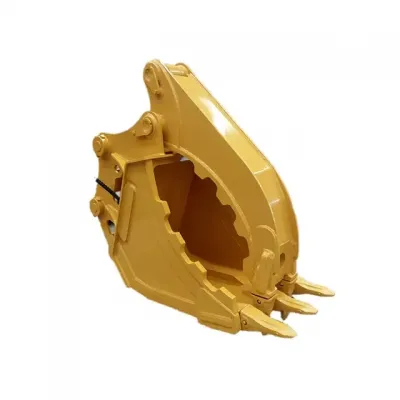
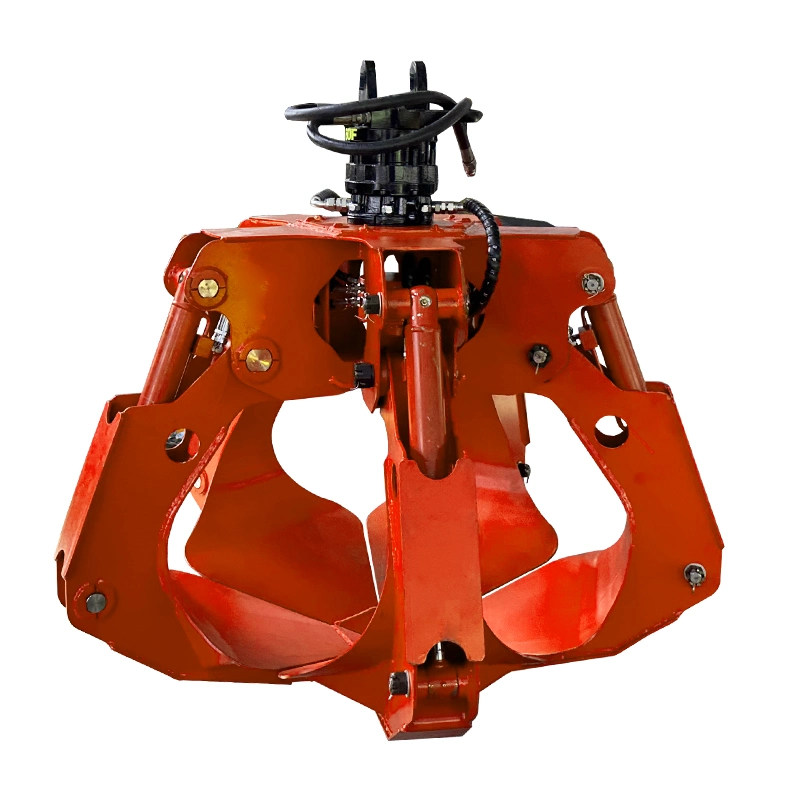
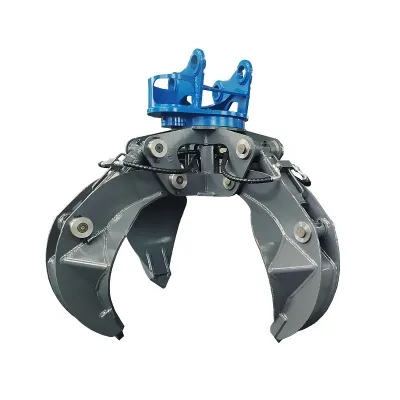
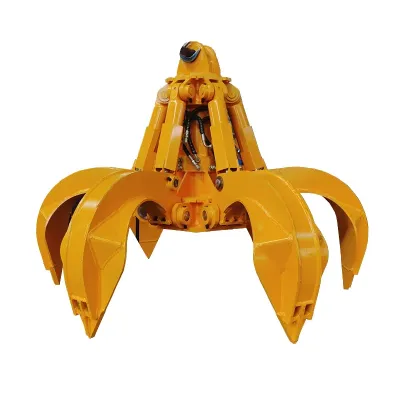
Independent hydraulic tines conform around irregular scrap shapes, providing multiple contact points for handling curved, tangled and uneven loads. Four models cover 4 to 35 ton excavators, with all models specified for 260 bar operating pressure.
Product Name: Multi-finger scrap grapple / Orange peel grapple / Polyp grapple / Scrap handling grapple
Type: Grapples
After-sales Service: Provided
Warranty: 1 Year
Customization: Available
Shipping Cost: Negotiate with us about shipping cost and estimated delivery time.
Get a quote
Overview
FAQ

Product Overview

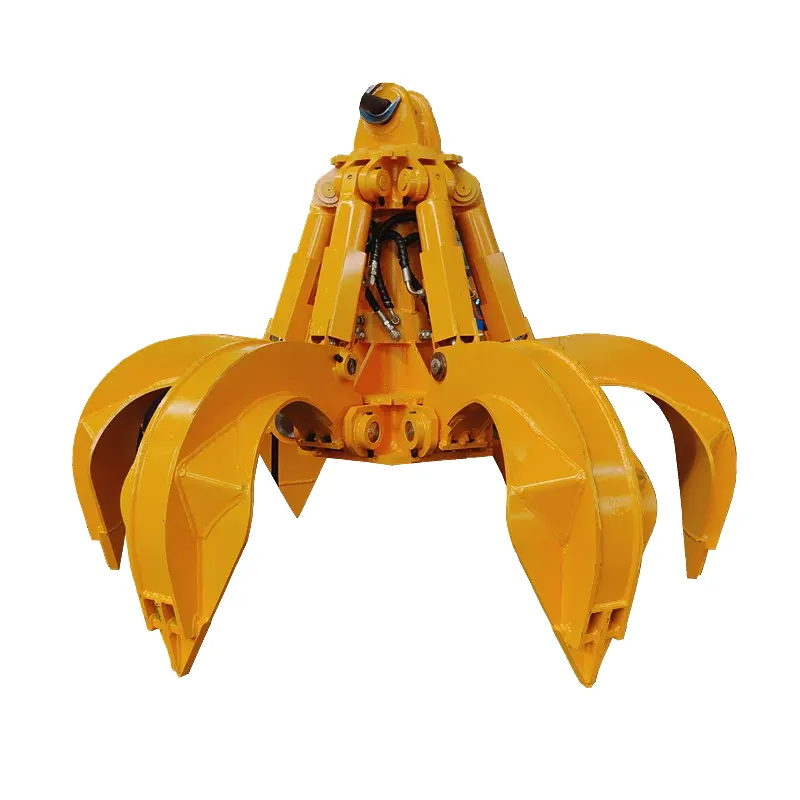
An orange peel grapple (multi‑finger grapple) handles irregular scrap loads differently from a standard two‑jaw clam. Mixed metals, crumpled car panels, and bundled recyclables do not sit flat in a rigid jaw. The multi‑finger design puts a separate cylinder behind each tine, so every finger moves on its own and finds its own grip point, allowing each finger to close independently and conform to irregular load shapes.

This configuration sits squarely within the TGEC excavator grapple family and is built specifically for scrap metal, recycling streams, and mixed waste. Four frame sizes—TG-SG04, TG-SG06, TG-SG08 and TG-SG10—are specified for 4 to 35 ton excavators, and all run on the same 260 bar operating pressure. If you also need precise rotation for sorting into bins, take a look at the single-cylinder rotary scrap grapple.

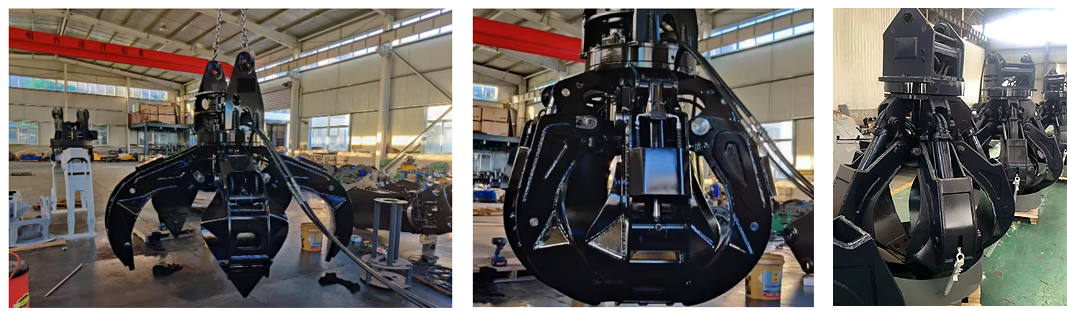
TGEC Multi-Finger Hydraulic Scrap Grapple – Orange Peel Polyp Grapple with Independent Tines for Scrap Handling

Why Independent Tines Matter

What sets this grapple apart isn't the number of tines—it's that each one acts independently. Every tine has its own hydraulic cylinder, fed by a central manifold, so the whole assembly can wrap itself around a load even when one side sits higher or sticks out farther. A two‑jaw grapple drives both halves together; if one side makes contact early, the opposite side may not close as fully around the load.

This independent action really pays off with materials that have no flat surfaces: curved pipe, twisted rebar, tangled wire, and stamped metal scraps. Each finger keeps closing until it hits solid metal, spreading the grip over several points instead of concentrating it on just two. The trade‑off is added hydraulic complexity—multiple cylinders mean more seals, rods, and hoses to look after. For scrap-yard applications, the independent tine design can provide handling advantages with irregular loads, while requiring more hydraulic components to maintain.

Models & Specifications

All four models share the same multi‑tine jaw design and 260 bar operating pressure. Model selection should be based on excavator size, hydraulic requirements, attachment weight and the intended scrap-handling application.

ParameterTG-SG04TG-SG06TG-SG08TG-SG10
Compatible Excavator Class4–8 t (4.4–8.8 ton)9–16 t (9.9–17.6 ton)17–25 t (18.7–27.6 ton)26–35 t (28.7–38.6 ton)
Attachment Weight510 kg (1125 lb)1200 kg (2646 lb)1560 kg (3439 lb)1800 kg (3968 lb)
Max Jaw Opening1750 mm (68.9 in)1780 mm (70.1 in)1950 mm (76.8 in)2180 mm (85.8 in)
Overall Height1440 mm (56.7 in)1540 mm (60.6 in)1650 mm (65.0 in)1860 mm (73.2 in)
Operating Pressure260 bar (3770 psi)260 bar (3770 psi)260 bar (3770 psi)260 bar (3770 psi)
Required Hydraulic Flow20–70 L/min (5.3–18.5 GPM)60–120 L/min (15.9–31.7 GPM)60–120 L/min (15.9–31.7 GPM)60–120 L/min (15.9–31.7 GPM)

Table data is for reference only. Actual specifications may vary based on the final configuration. Please contact the TianGe technical team for details.

Where This Grapple Earns Its Keep

Scrap yards are a primary application for this attachment. The independent tines can handle loose sheet metal, bundled wire, vehicle body sections and other irregular scrap. Typical tasks include loading incoming material, sorting scrap, feeding processing equipment and loading outbound trucks.

Recycling and materials recovery facilities can use the grapple for handling mixed recyclable materials, feeding sorting lines and loading containers. The multi‑finger configuration is suited to bulky plastics, aluminum sections and irregular metal fractions that are difficult to handle with a rigid two-jaw design.

Demolition sites with significant metal content are a third use case. After the building comes down, this grapple separates rebar, beam offcuts, and steel framing from concrete and wood debris. If your demolition work is mostly concrete and masonry, though, a dedicated demolition grapple with solid serrated jaws is more appropriate for concrete and masonry handling.

TGEC Multi-Finger Hydraulic Scrap Grapple in Application – Scrap Yard Sorting and Loading

Excavator Compatibility

Choosing the right model starts with your machine's weight: TG-SG04 is specified for 4 to 8 ton excavators, TG-SG06 for 9 to 16 tons, TG-SG08 for 17 to 25 tons, and TG-SG10 for 26 to 35 tons. The smallest unit needs only 20 to 70 L/min, while the three larger ones all require 60 to 120 L/min. Since all models are specified for 260 bar operating pressure, the excavator's auxiliary circuit should meet the pressure and flow requirements of the selected model. Give us your excavator make, model, and auxiliary specs, and we'll confirm compatibility.

Operating & Service Notes

The central manifold that distributes oil to each tine cylinder is an important inspection point. Check it regularly for leaks at the cylinder feed connections, and check the manifold mounting bolts periodically, following the recommended torque specifications for the final configuration. Inspect each cylinder rod regularly for scoring or chrome damage—sharp scrap can leave marks that ruin seals. Run all hydraulic hoses through protective sleeves wherever they pass near the gripping zone; sharp metal edges can slice exposed hoses, and a hose failure mid‑lift can drop the load. Replace any hose that shows abrasion, cuts, or bulging right away.

Request a Quote — Multi-Finger Hydraulic Scrap Grapple

Tell us your excavator make and model, operating weight, auxiliary flow and pressure, mounting or coupler type, preferred model (TG-SG04 / TG-SG06 / TG-SG08 / TG-SG10), primary application, and the quantity you need. Our team will verify compatibility, check whether a pressure adjustment is needed, and send you a quote based on your specs and delivery terms. Dealers and OEMs are welcome for volume orders, custom configurations, and private‑label options.
Frequently Asked Questions

How do independent tines differ from a two-jaw grapple for scrap?+

A two-jaw grapple drives both halves through a single cylinder or linkage, so if one jaw contacts the load first the opposite jaw may not close completely. A multi-finger grapple gives each tine its own cylinder, allowing every finger to close independently until it contacts the load. This creates a conforming grip with multiple contact points that wraps around irregular scrap — curved pipe, twisted rebar, bundled wire — that would shift in a two-jaw bucket. The trade-off is more cylinders, seals and hose connections to maintain.

What happens if one tine cylinder loses pressure during a lift?+

If one tine cylinder loses pressure because of a seal failure or hose rupture, that tine may stop applying the intended clamping force. The operator should lower the load safely and stop using the grapple until the fault is inspected and repaired. A failed tine changes load distribution, so the grapple should not continue operating with the hydraulic fault.

Four-tine vs five-tine — how does tine count affect scrap retention?+

Tine count affects opening geometry, contact points and hydraulic complexity. Four-tine configurations involve fewer hydraulic components, while five-tine configurations add another contact point for irregular or smaller material. The appropriate configuration depends on the material mix and final grapple design.

Why is operating pressure standardized at 260 bar across all SG models?+

All four models are specified for 260 bar operating pressure, while model size and hydraulic cylinder configuration determine the available clamping force. Always verify the required hydraulic pressure and flow for the selected model.

Can the multi-finger grapple handle baled scrap as well as loose material?+

Baled and bundled scrap has a more regular shape than loose material, and the independent tines can grip around the bundle perimeter at multiple contact points. The grapple can therefore be used for both loose and bundled scrap, subject to the material dimensions and final configuration. For dense bales with sharp protruding wire edges, approach carefully to avoid hose damage.

What wear parts need replacement most often?+

Tine tips, pivot pins, bushings, cylinder seals and hydraulic hoses are typical components to inspect for wear or damage. Wear rates depend on the material being handled and operating conditions. Depending on the final tine construction, worn areas may be replaceable or repairable. Confirm the recommended repair method with TGEC before welding or rebuilding wear areas. Hydraulic hoses should be inspected regularly for abrasion and replaced at the first sign of damage.

How should hydraulic hoses be routed to avoid sharp scrap damage?+

Hoses should be routed along the grapple frame and through protective sleeves or spiral wraps where they pass near the grasping area. Hose sections near the gripping area should be routed and protected to minimize contact with sharp scrap and moving components. Hose lengths need enough slack for full tine movement without tension at maximum opening, but not so much that hoses droop into the load path. After installation, cycle through full open and close while observing hose movement to identify rubbing points, and add abrasion protection there. A hose failure mid-lift can cause the load to drop, so proactive inspection is critical in scrap applications.

What grapple size fits a 12-ton excavator for scrap handling?+

A 12-ton excavator falls within the TG-SG06 compatible range of 9 to 16 tons. Final selection should also be confirmed against auxiliary hydraulic flow and pressure, attachment weight, mounting dimensions and the excavator's rated lifting capacity at the intended working reach. Contact the TGEC team for model-specific confirmation.

Can the orange-peel grapple be used for demolition sorting?+

The multi-finger grapple can sort demolition debris when metal is a significant fraction, but it is not optimized for concrete and masonry. The independent tines grasp rebar, metal framing and beam offcuts well, and the conforming grip handles mixed debris loads. However, the tines are not designed for crushing concrete like a demolition grapple with solid serrated jaws, and fine material like crushed concrete falls through tine gaps. If your demolition work is primarily structural teardown with concrete, a dedicated demolition grapple is better. If you are separating metal from an already-demolished pile, the multi-finger scrap grapple works well.

What mounting bracket options exist for quick-coupler systems?+

The grapple can be configured for direct pin-on mounting or a quick-coupler interface, subject to the required bracket dimensions. The bracket must match your excavator pin spacing, pin diameter and coupler interface. When ordering with a quick-coupler bracket, provide your coupler manufacturer and model, or the pin-on dimensions if using a mechanical coupler. Some couplers require an additional adapter plate between the grapple top bracket and the coupler, adding height and weight. Verify the added height does not interfere with the boom or stick at full curl, and confirm the coupler lock mechanism is compatible with the grapple bracket geometry.
Please make sure to include your phone number with the country code (e.g., 86 for China, 1 for USA).