Welcome to the Official Website of TianGe Attachments.

Manual Mechanical Grapple

Manual Mechanical Grapple

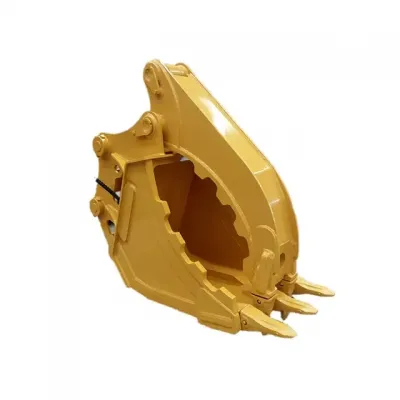
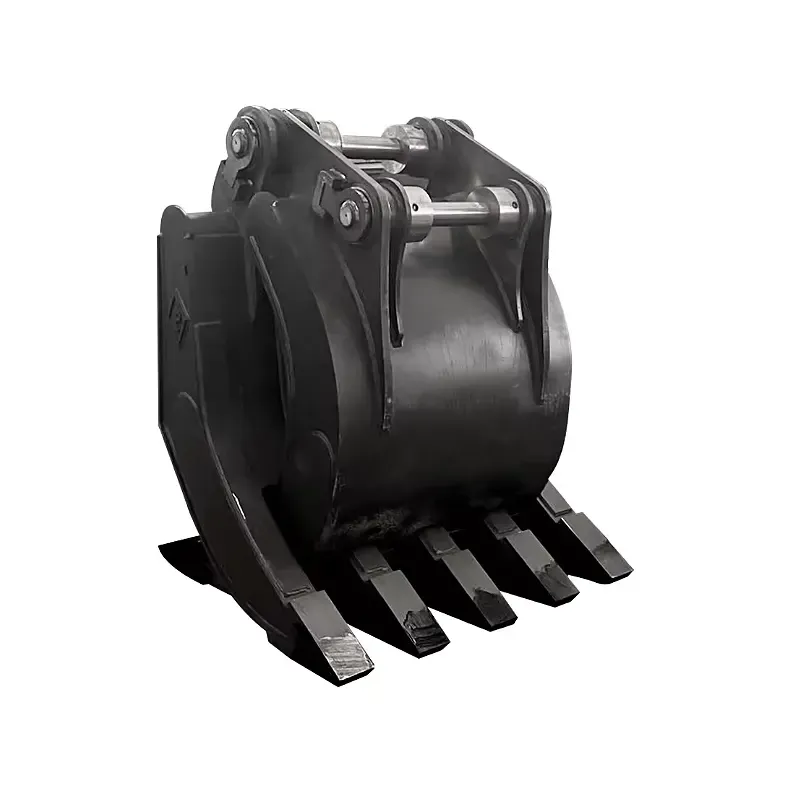
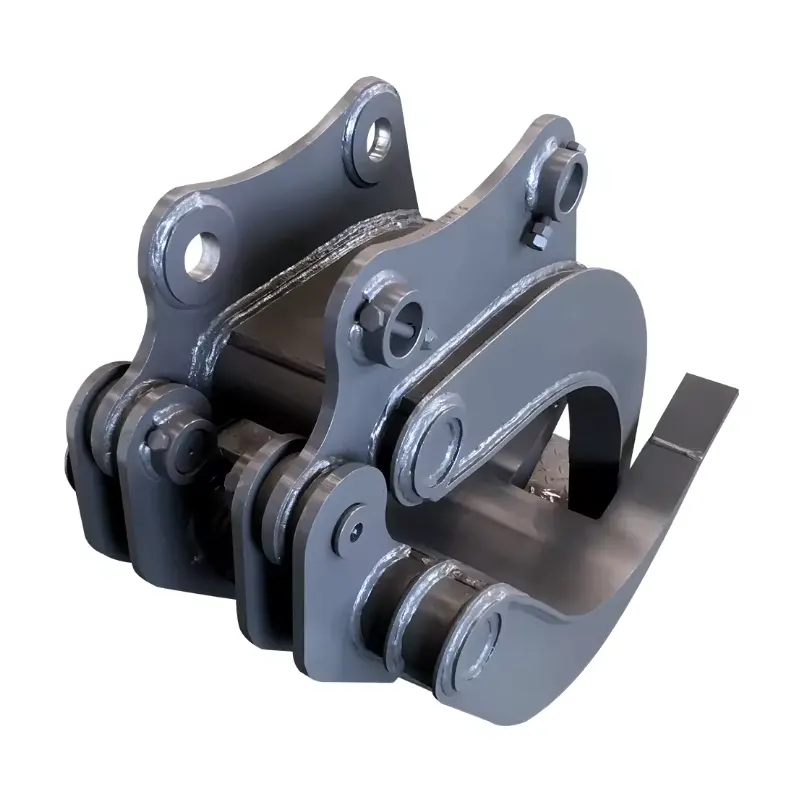
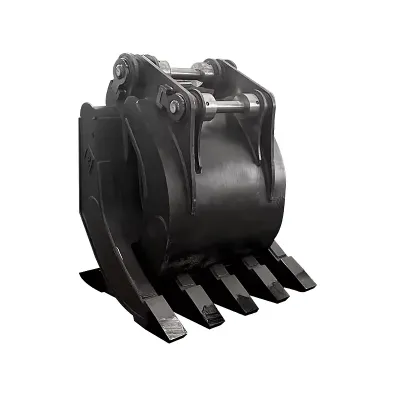
Curved rake tines cradle round and irregular material without auxiliary hydraulics, operating through the excavator bucket curl function. Five models cover 3 to 23 ton excavators with opening widths from 1050 to 2200 mm.
Product Name: Mechanical Grapple / Manual Grapple / Curved-Tine Mechanical Grapple / Excavator Manual Grab
Type: Grapples
After-sales Service: Provided
Warranty: 1 Year
Customization: Available
Shipping Cost: Negotiate with us about shipping cost and estimated delivery time.
Get a quote
Overview
FAQ

Product Overview

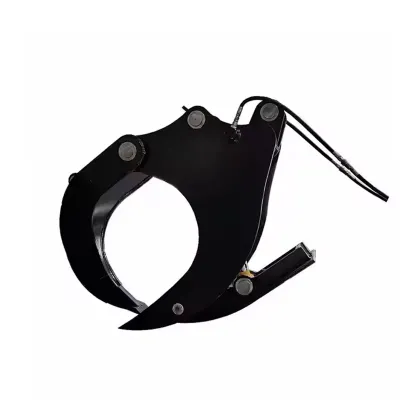
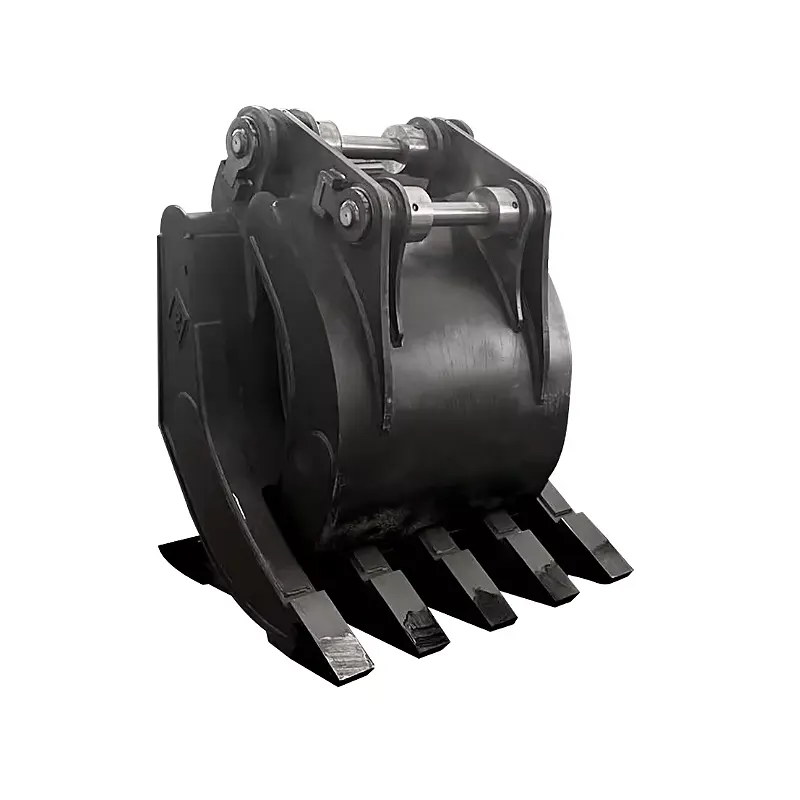
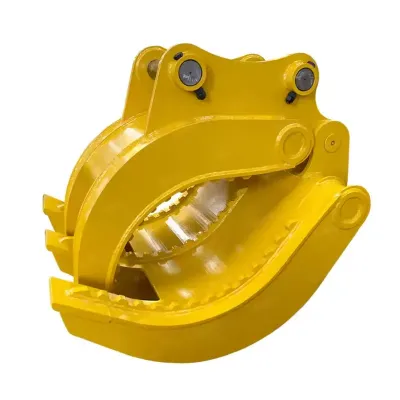
A mechanical grapple is a fixed, non-rotating attachment that runs off the excavator's standard bucket curl circuit—no auxiliary hydraulics needed. The curved tines arc inward to cradle cylindrical loads, helping reduce roll-off during handling without requiring high clamping force. It mounts in place of the bucket, uses the existing linkage, and works on excavators with or without auxiliary hydraulics, provided the mounting and bucket linkage are correctly matched. For land clearing, landscaping, utility work, and general material handling where rotation isn't critical, this is a simple, low-maintenance option.

Part of the TGEC excavator grapple lineup, this model comes in five sizes—TG-HMG30 through TG-HMG200—for 3‑ to 23‑ton excavators. If you need 360° rotation, compare the rotary log grapple; for rock and demolition debris, consider the heavy-duty mechanical grapple.
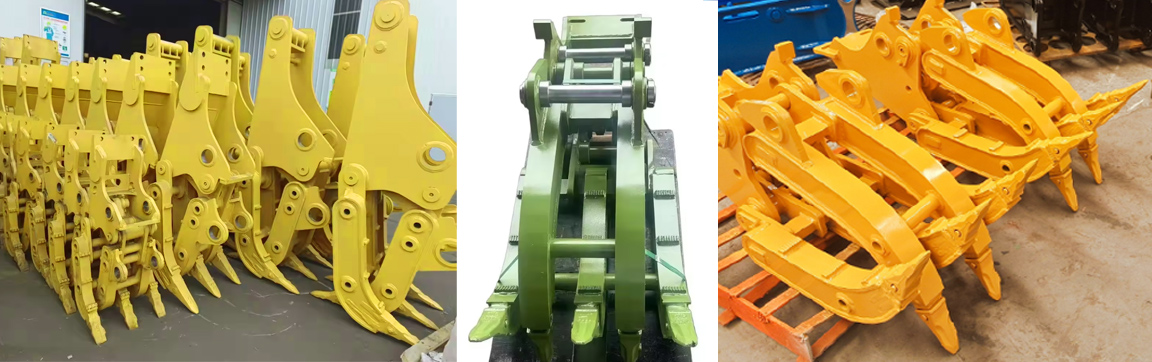
TGEC Mechanical Grapple – Curved Rake Tines for General-Purpose Material Handling, No Auxiliary Hydraulics Required

Curved Tine Design

The curved tine is the key differentiator. Straight jaws pinch cylindrical material at two points, allowing it to roll. A curved tine wraps around the circumference, creating a geometric cradle that stops rotation. This means the grapple holds logs, poles, and pipes securely with less force—critical because a mechanical design generates less clamping power than a hydraulic one.

Tine profile affects performance: a deeper curve cradles medium‑to‑large loads better but may not close fully on small items; a shallower curve grips small material tighter but relies more on friction for large loads. The TGEC grapple uses a curved tine profile intended for mixed handling of logs, poles, brush, and similar materials. Custom profiles are available, and the wear‑resistant steel tines can be refurbished by welding or grinding. Operation is identical to bucket curl—no new controls to learn.

Models & Specifications

Five models span 3 to 23 tons, with opening width and weight scaling accordingly.

ParameterTG-HMG30TG-HMG50TG-HMG70TG-HMG120TG-HMG200
Compatible Excavator Class3–4 t (3.3–4.4 ton)4–6 t (4.4–6.6 ton)6–8 t (6.6–8.8 ton)12–16 t (13.2–17.6 ton)18–23 t (19.8–25.4 ton)
Opening Width1050 mm (41.3 in)1500 mm (59.1 in)1600 mm (63.0 in)1900 mm (74.8 in)2200 mm (86.6 in)
Attachment Weight125 kg (276 lb)200 kg (441 lb)310 kg (683 lb)510 kg (1124 lb)970 kg (2138 lb)

Table data is for reference only. Actual specifications may vary based on the final configuration. Please contact the TianGe technical team for details.

Where the Mechanical Grapple Performs

Land Clearing & Site Prep

Excels at removing and stacking brush, small trees, stumps, and woody debris. The curved tines bundle material securely for transport to a chipper or pile. Since it needs no auxiliary hydraulics, it works on older or rental machines. Lightweight—125 to 970 kg—preserves lift capacity, and the fixed design is sufficient for general placement.

Landscaping & Tree Service

Ideal for moving logs, branches, and stumps after tree removal. The curved tines provide broader contact around cylindrical loads and help keep logs contained during handling, and wide openings (up to 2200 mm) handle large trunks. Mechanical operation means no auxiliary upgrades, low maintenance, and minimal ground disturbance—great for residential work.

Utility & Pole Handling

Utility crews use it to move poles, posts, and long cylinders. The curved tines cradle securely during lifting and transport. While a rotary grapple offers more precision for setting poles, the mechanical version is adequate for general handling and fencing, and it works on excavators with or without auxiliary hydraulics—ideal for multi‑machine or rental fleets.
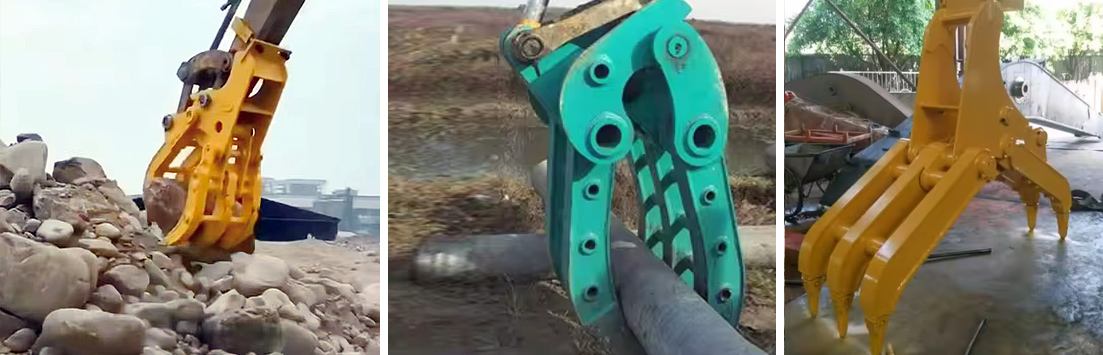
TGEC Mechanical Grapple in Application – Landscaping, Utility Work and General Material Handling

Mounting & Compatibility

Mounts in place of the bucket, connecting to the boom pin and bucket curl linkage. No auxiliary circuits are needed—it runs off the standard bucket lever. The bracket must match your excavator's pin spacing, pin diameter, and linkage geometry; provide make, model, and pin dimensions when ordering. Quick‑coupler compatibility is available. Installation is straightforward: remove the bucket, align the bracket, install pins, and secure. Operation is immediate with no training. Five models cover 3 to 23 tons; for 8‑ to 12‑ton machines, contact us for the best fit. Always verify lift capacity at working reach.

Operation Tips

Approach with tines fully open and centered, close gradually to wrap the curve around the load. For large logs, open/close once or twice to settle. Brush and small material can be closed faster. Lift smoothly, keep loads low during transport, and open fully to release—avoid partial opening. For bundles, center the grapple over the middle. For long logs, grasp at the center of gravity. After each shift, cycle open/close to clear debris, and inspect pivots and tines for wear.

Request a Quote — Mechanical Grapple

Share your excavator make, model, operating weight, mounting/coupler type, pin spacing and diameter, preferred model (TG-HMG30 / 50 / 70 / 120 / 200), primary application, typical log diameter, and quantity. Our team will confirm the correct bracket and opening width, and provide a quote. Dealer and OEM inquiries welcome for volume, custom tines, and private label.
Frequently Asked Questions

How do curved tines prevent log roll-off during transport?+

Curved tines prevent roll-off through geometric containment rather than friction alone. A straight-jaw grapple holds a round log by pressing two flat surfaces against opposite sides — the log is held by friction at two contact points. When the boom moves, the log can rotate between contacts and roll out. A curved tine wraps around the log circumference in an arc, creating a cradle. When the log tries to roll, it contacts the inner curve, which acts as a physical barrier preventing further rotation. This means the curved-tine grapple holds logs securely with less clamping force than a straight-jaw grapple — important for mechanical grapples that generate less force than hydraulic models. The curve also distributes contact pressure over a larger area, reducing damage to high-value timber surfaces.

How does opening width affect log diameter selection?+

Opening width is the maximum distance between tine tips when fully open, and it sets the upper limit for what can fit between the tines. A log must be smaller than the opening to fit, but the practical log diameter also depends on tine geometry, material shape, and how the grapple closes around the load. A log near maximum opening may not be held securely if the tines cannot close sufficiently to create the curved cradle effect. When selecting a model, choose an opening that comfortably exceeds the typical material diameter rather than barely fitting the largest piece. Select a model based on the typical material size and contact geometry rather than opening width alone.

What is the weight difference between TG-HMG30 and TG-HMG200?+

TG-HMG30 weighs 125 kg and TG-HMG200 weighs 970 kg — a difference of 845 kg. The largest model is approximately 7.8 times heavier than the smallest, reflecting thicker steel plate, larger and stronger tines, heavier pivot pins and linkage arms, and a more robust mounting bracket for 18 to 23 ton excavators. TG-HMG30 at 125 kg is light enough for 3 to 4 ton mini excavators — the grapple consumes a small fraction of the carrier's lift capacity, leaving room for logs. TG-HMG200 at 970 kg requires a larger excavator, and even on 18 to 23 ton machines, the 970 kg grapple plus a heavy log can approach the lift limit at extended reach. For operators choosing between adjacent models, weight is an important factor — a heavier grapple reduces effective log load capacity, so if your excavator is at the lower end of a model's range, the next smaller model may be safer despite having a smaller opening.

Can the grapple handle brush and small trees in addition to cut logs?+

Yes — brush, small trees, saplings and woody vegetation are common applications in land clearing and landscaping. The curved tines wrap around bundles of brush and small diameter material, creating a secure cradle that holds the bundle together during transport. The curved tines can gather brush bundles by closing around the material and lifting it to a staging pile, chipper or haul truck. The wide opening on larger models (up to 2200 mm on TG-HMG200) accommodates bulky brush bundles, while smaller models handle smaller bundles for compact excavator work. For dense, tangled brush, opening and closing once or twice may be needed to settle and compress the bundle. The mechanical operation through bucket curl provides adequate force for compressing brush, which is lighter and more conformable than solid logs. For land clearing contractors, handling both cut logs and brush with one attachment can be a practical benefit — no need to switch between a log grapple and a brush rake. For very dense, heavy brush with thick woody stems, a dedicated brush rake or forestry mulcher may be more appropriate.

How does tine curvature affect retention of different material types?+

Tine curvature directly determines how securely different materials are held. For cylindrical loads like logs, poles, and pipes, a curved tine wraps around the circumference to create a geometric cradle — the material cannot roll out because the inner curve acts as a physical barrier. This is why curved tines require less clamping force than straight jaws for round material. For irregular material like brush bundles and stumps, the curve helps compress and contain the bundle as the tines close. For flat or angular material, curved tines have fewer contact points than straight jaws, so very flat or smooth slabs may be less secure — in those cases, a grapple with straight or rake-style jaws may be more appropriate. The TGEC mechanical grapple uses a curved tine profile that performs well across logs, poles, brush, and general landscaping material.

What tine profile is best for large single logs vs small diameter bundles?+

Optimal tine profile depends on dominant material type. For large single logs, a deeper curve provides better geometric containment because tines wrap further around the circumference, creating a more secure cradle that prevents roll-off. A deeper curve also distributes contact pressure over a larger area, reducing damage to high-value timber. However, a very deep curve may not close fully on very small diameter material. For small diameter bundles (brush, saplings, pulpwood, thinning cuts), a shallower curve with more closely spaced tines provides better retention because tines close more tightly on small material and closer spacing prevents small pieces from slipping through. A shallower curve also allows more effective bundle compression. The TGEC mechanical grapple uses a general-purpose tine profile balancing performance across a range of diameters, from small brush to medium and large logs. This is suitable for most contractors handling mixed material. For specialized operations, tine profile can be configured for the intended material and application where customization is available. Changing the profile affects performance across the full range — optimizing for one size may reduce performance at the other extreme.

How does the mechanical grapple compare to a rotary log grapple for truck loading?+

A rotary log grapple provides independent 360-degree orientation, which can make log positioning easier during truck loading. A fixed mechanical grapple relies on excavator boom and arm positioning to control load orientation, so the operator may need to reposition the machine to align logs with the truck bed. For high-volume loading at sawmills, timber yards or logging operations, the rotary grapple's ability to rotate without repositioning the carrier can improve operational efficiency. However, the mechanical grapple remains practical for smaller-scale operations, occasional loading, or sites where the excavator can position itself to lower logs directly. It also costs less and requires no auxiliary hydraulics, case drain, or rotator maintenance. For landscapers, tree services and small land clearing contractors who load occasionally, the mechanical grapple is often the more practical choice. For contractors focused on high-volume timber loading, the rotary grapple's orientation capability may justify the additional investment.
Please make sure to include your phone number with the country code (e.g., 86 for China, 1 for USA).