Product Overview
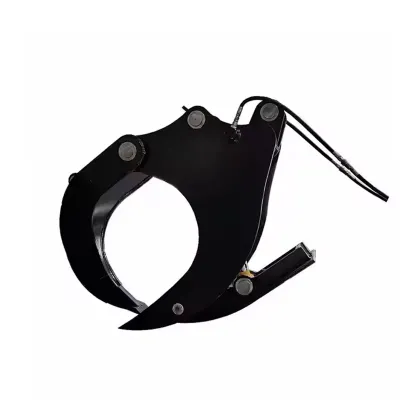
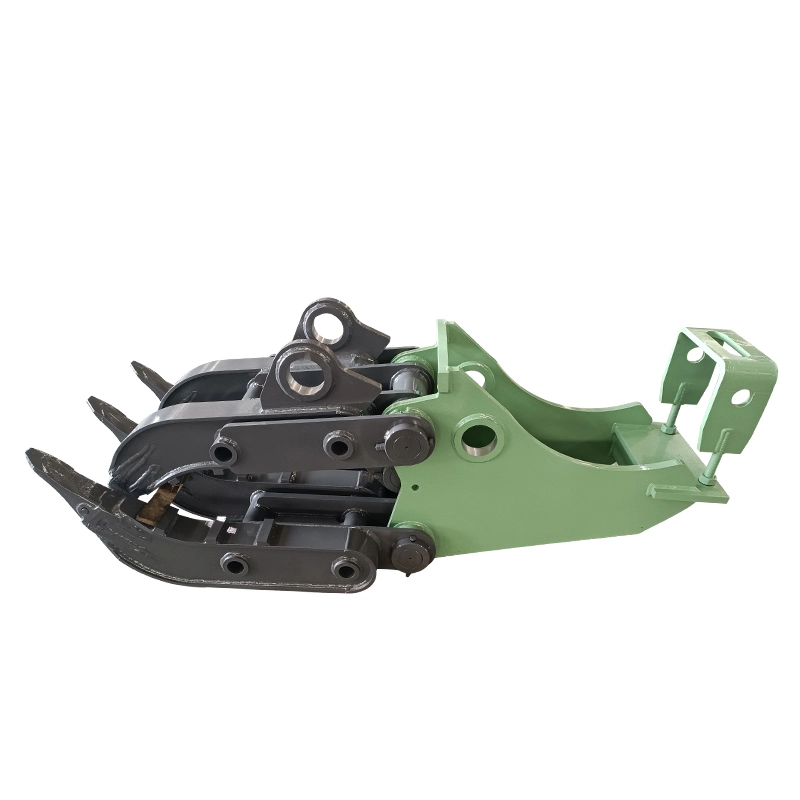
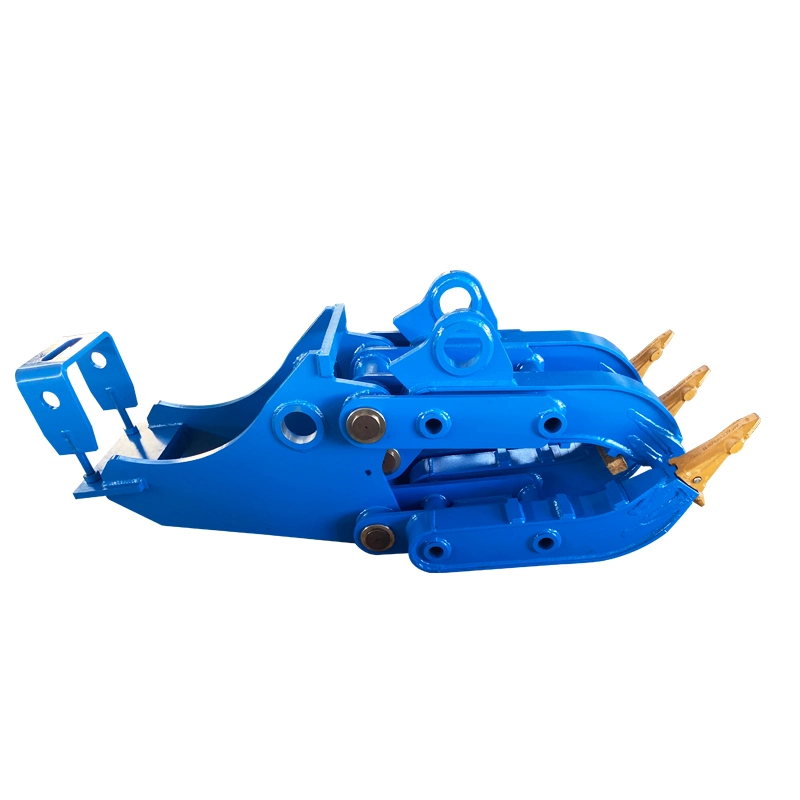
Hydraulic grapples demand auxiliary circuits, extra hoses, cylinder seals, and—on rotating models—rotators with case drains. A mechanical grapple sidesteps all of that. It runs purely off the excavator's standard bucket curl function. You mount it to the boom in place of the bucket, tie into the existing bucket linkage, and the curl motion opens and closes the jaws through a simple mechanical linkage. No auxiliary hydraulic plumbing and fewer hydraulic components to service. It can be used on excavators with or without auxiliary hydraulics, provided the mounting bracket and bucket linkage are correctly matched to the carrier. For contractors moving rock, demolition rubble, or general materials on machines without auxiliary hydraulics—or for anyone who just wants a rugged, low‑fuss attachment—this is a practical, low-maintenance choice.
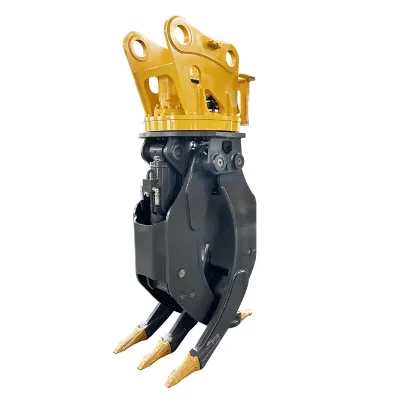
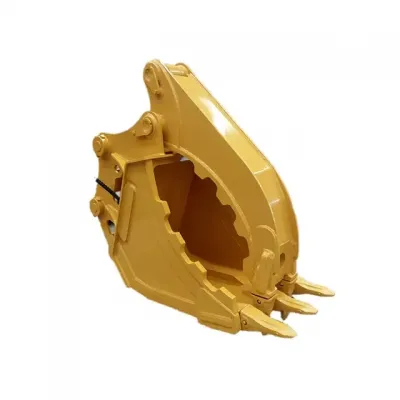
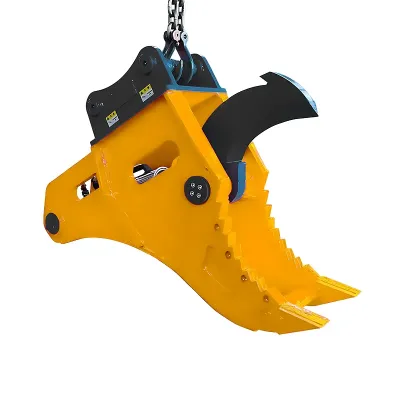
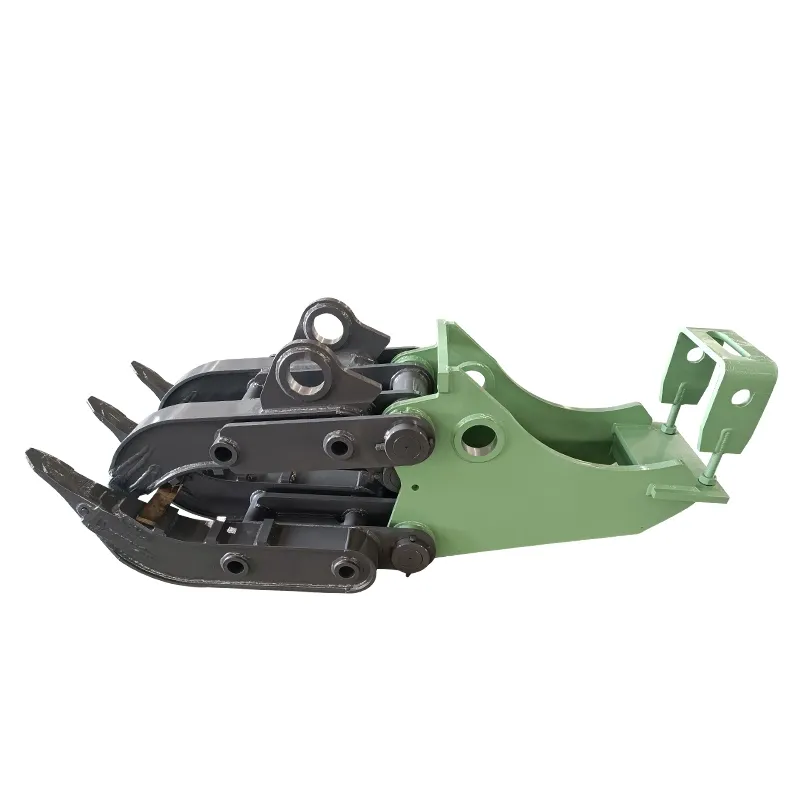
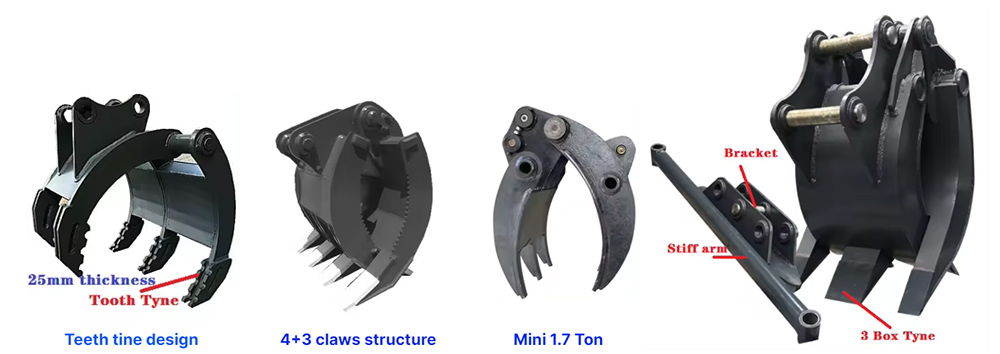
Part of the TGEC excavator grapple lineup, this heavy‑duty mechanical version comes in eight frame sizes—TG-MG01 through TG-MG20—covering excavators from 1.7 to 50 tons. This is the broadest excavator size range in the TGEC mechanical grapple lineup. The rake‑style jaw design, with generous spacing between teeth, lets fines and small debris sift through while holding onto larger rock and demolition material. If you need rotation for precise placement or more clamping force for heavy timber, take a look at the demolition grapple for hydraulic sorting, or the mechanical grapple with curved tines for cylindrical loads.
Mechanical Operation Principle
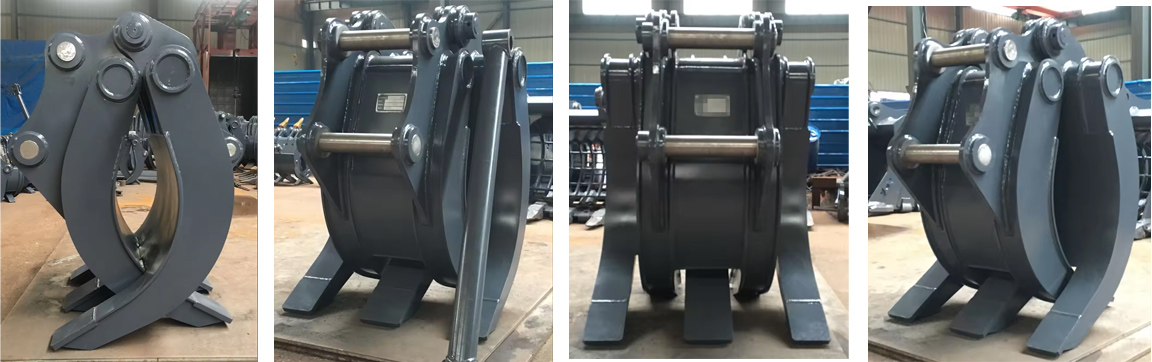
The mechanical grapple pins directly to the excavator boom in place of the bucket, connecting to both the boom linkage and the bucket curl cylinder. A built‑in mechanical linkage converts the curl motion into jaw movement. Curl the bucket in using the standard control lever, and the linkage pulls the two rake‑style jaws shut to grip your load. Dump the bucket out, and the linkage opens the jaws to release. Since it taps into the machine's existing bucket curl circuit, there are no auxiliary lines, valves, or extra controls to rig up—you run it with the same bucket curl control.
The clamping force you get comes from the excavator's bucket curl cylinder transferred through the grapple's mechanical linkage. Actual force at the jaw tips depends on the carrier's curl cylinder output, the linkage geometry, and the condition of pivot points and bushings. For rock and general demolition debris, this configuration is suited to applications where independent hydraulic clamping is not required—the material is relatively uniform in shape and doesn't need the conforming grip of a multi‑finger grapple or the high clamping pressure of a dual‑cylinder hydraulic unit. The rake‑style jaws, with their wide tooth spacing, let soil, sand, and small debris fall through while keeping the larger rocks and chunks contained.
The fixed, non‑rotating design means orientation is controlled by the excavator boom—you swing the machine to point the load. For rock handling, demolition debris, and bulk material movement, precise orientation is rarely critical. The fixed design has no rotator bearing or seal assembly, simplifying the structure and reducing hydraulic components.
Models & Specifications
Eight models cover excavators from 1.7 to 50 tons. Dimensions W1, W2, and W3 represent jaw width, tooth spacing, and maximum opening, respectively.
| Parameter | TG-MG01 | TG-MG02 | TG-MG04 | TG-MG06 | TG-MG06-A | TG-MG08 | TG-MG10 | TG-MG20 |
|---|---|---|---|---|---|---|---|---|
| Compatible Excavator Class | 1.7–3 t (1.9–3.3 ton) | 3–5 t (3.3–5.5 ton) | 6–10 t (6.6–11.0 ton) | 12–16 t (13.2–17.6 ton) | 15–20 t (16.5–22.0 ton) | 20–25 t (22.0–27.6 ton) | 24–35 t (26.5–38.6 ton) | 35–50 t (38.6–55.1 ton) |
| Overall Height | 580 mm (22.8 in) | 700 mm (27.6 in) | 940 mm (37.0 in) | 1140 mm (44.9 in) | 1200 mm (47.2 in) | 1327 mm (52.2 in) | 1532 mm (60.3 in) | 1868 mm (73.5 in) |
| Width W1 (Jaw Width) | 400 mm (15.7 in) | 550 mm (21.7 in) | 590 mm (23.2 in) | 680 mm (26.8 in) | 820 mm (32.3 in) | 1120 mm (44.1 in) | 1180 mm (46.5 in) | 1250 mm (49.2 in) |
| Width W2 (Tooth Spacing) | 220 mm (8.7 in) | 290 mm (11.4 in) | 330 mm (13.0 in) | 380 mm (15.0 in) | 550 mm (21.7 in) | 680 mm (26.8 in) | 720 mm (28.3 in) | 790 mm (31.1 in) |
| Width W3 (Max Opening) | 720 mm (28.3 in) | 880 mm (34.6 in) | 1020 mm (40.2 in) | 1310 mm (51.6 in) | 1645 mm (64.8 in) | 1670 mm (65.7 in) | 1900 mm (74.8 in) | 2230 mm (87.8 in) |
| Attachment Weight | 85 kg (187 lb) | 175 kg (386 lb) | 320 kg (705 lb) | 790 kg (1742 lb) | 1200 kg (2646 lb) | 1400 kg (3086 lb) | 1750 kg (3858 lb) | 3082 kg (6795 lb) |
Table data is for reference only. Actual specifications may vary based on the final configuration. Please contact the TianGe technical team for details.
Size Range & Application Matching
Compact Excavators (1.7 to 10 Tons)
The TG-MG01, TG-MG02, and TG-MG04 are built for compact and small excavators from 1.7 up to 10 tons. These lightweight units—85 kg, 175 kg, and 320 kg respectively—are tailored for mini excavators and small carriers where lift capacity is tight and auxiliary hydraulics are often absent. They're ideal for landscaping rock picking, light land clearing, utility trench cleanup, and general property maintenance. The narrow jaw widths (400 to 590 mm) and compact overall size make them well suited for confined spaces like backyards, utility corridors, and residential job sites. The wide tooth spacing (220 to 330 mm) lets soil sift through while retaining rocks and debris.
Mid-Size Excavators (12 to 25 Tons)
The TG-MG06, TG-MG06-A, and TG-MG08 are built for mid‑size excavators from 12 to 25 tons. These are the most versatile models in the line, fitting general construction, site prep, demolition debris handling, and medium‑scale rock work. TG-MG06 (12–16 tons, 790 kg) and TG-MG06-A (15–20 tons, 1200 kg) overlap in the 15‑ to 16‑ton range but offer different jaw widths and weights—TG-MG06 has a 680 mm jaw with 380 mm tooth spacing, while TG-MG06-A steps up to an 820 mm jaw and 550 mm spacing for larger material. TG-MG08 (20–25 tons, 1400 kg) jumps to a 1120 mm jaw width and 680 mm tooth spacing, handling bigger rocks and heavier demolition debris.
Large Excavators (24 to 50 Tons)
The TG-MG10 and TG-MG20 are built for large excavators from 24 to 50 tons. These heavyweights—1750 kg and 3082 kg respectively—are meant for large‑scale rock handling, major demolition projects, quarry work, and heavy civil construction. TG-MG10 (24–35 tons) offers a 1180 mm jaw width, 720 mm tooth spacing, and a 1900 mm maximum opening, handling big rocks and heavy debris on mid‑large machines. TG-MG20 (35–50 tons) is the biggest of the bunch, with a 1250 mm jaw, 790 mm tooth spacing, and 2230 mm maximum opening for the largest rocks and bulkiest materials. The substantial weight means the excavator's lift capacity at working reach becomes the main limiting factor—operators should verify that their carrier can handle the combined grapple‑plus‑load weight at the typical reach and height they'll be working at.
Installation & Mounting
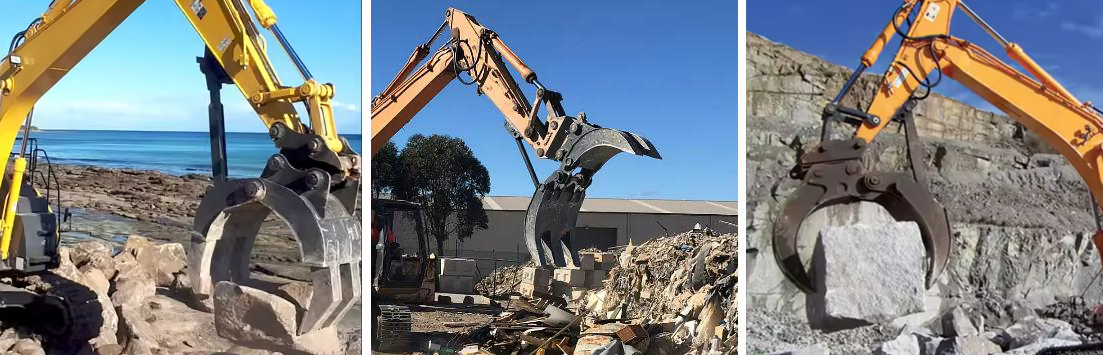
The heavy-duty mechanical grapple mounts in place of the bucket using the same boom pin and bucket linkage connections. The bracket must match your excavator's pin spacing, pin diameter, and linkage geometry—provide make, model, and pin dimensions when ordering. Quick‑coupler compatibility is available. Since there are no hydraulic lines to connect, installation is faster than with a hydraulic grapple. For large models (TG-MG10, TG-MG20), verify the carrier's lift capacity at working reach before mounting, as the combined grapple‑plus‑load weight can approach the machine's limit at extended reach.
Wear & Service
The mechanical grapple has fewer service points than a hydraulic one, because there are no cylinders, hoses, or rotators to maintain. The main wear items are the pivot pins and bushings at the jaw hinges and linkage connections—they see oscillating motion under load with every open‑close cycle. These should be greased daily during heavy use and checked periodically for excessive play. A worn pivot lets the jaw shift, reducing clamping force and causing uneven wear on the jaw edges and teeth. If you spot play, replace the worn pins and bushings before the wear damages the grapple frame or linkage arms. The rake teeth are the second major wear point—the tooth tips take a beating every time you grab material, especially in abrasive conditions, and can wear down over time. Replacement teeth can be welded onto the jaw frame by a qualified fabricator. The jaw frame and linkage arms should be inspected periodically for cracks, bending, or stress marks, especially after heavy loads or hard impacts. Because there's no hydraulic system, there are no cylinder seals to change, no hoses to leak‑check, and no rotator bearings to grease. The mechanical design eliminates cylinder, hose and rotator maintenance associated with hydraulic or rotating grapples.
Request a Quote — Heavy-Duty Mechanical Grapple
Tell us your excavator make and model, operating weight, mounting or coupler type, pin spacing and pin diameter, preferred model (TG-MG01 through TG-MG20), primary application (rock / demolition / land clearing / landscaping), typical material size, and the quantity you need. Our team will confirm the right model and mounting bracket, verify the jaw width and tooth spacing for your material, and send you a quote based on your specs and delivery terms. Dealers and OEMs are welcome for volume orders, custom jaw configurations, and private‑label options.