Skid steer forks are among the most versatile attachments for material handling, but not all forks are the same. The right choice depends on the type of material you handle, the working environment, and the machine's capacity. Pallet forks excel at moving uniform palletized loads, grapple forks secure irregular debris, and manure grapple forks handle loose agricultural materials. Selecting the wrong type leads to inefficient operation, damaged material, and potential safety hazards.
This guide compares the three primary fork types in the skid steer forks category, explains their strengths and limitations, and helps you match the right attachment to your operation. Whether you run a construction yard, a rental fleet, a farm, or a recycling facility, understanding these differences ensures you invest in a fork attachment that delivers productivity and safety.
Pallet Forks: For Uniform and Palletized Loads
Pallet forks are the standard fork attachment, designed with two long, flat tines that slide under pallets, skids, and uniform loads. They are the most efficient choice for warehouse work, construction material handling, and any application where loads are palletized or uniformly shaped. Hydraulic side-shift pallet forks add the ability to slide the carriage left or right from the cab, improving alignment in tight spaces without repositioning the machine.
The TGEC hydraulic pallet forks offer a 2000 kg (4409 lb) rated capacity, 1200 mm (48 in) tines, and hydraulic side-shift positioning on a universal quick-attach frame. They are ideal for loading and unloading trucks, moving building materials, and warehouse logistics. Pallet forks are lighter than grapple-equipped alternatives, preserving more of the machine's lifting capacity. Their main limitation is that they cannot secure irregular or loose loads — material can shift or fall off during transport.
Grapple Forks: For Irregular and Mixed Loads
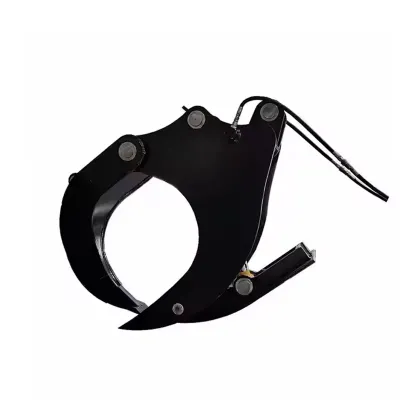
Grapple forks combine standard fork tines with a hydraulic upper clamp that secures irregular, bulky, or slippery loads. The grapple arm opens and closes independently, allowing the operator to clamp down on brush, debris, rocks, and mixed materials while the tines support the load from below. This makes grapple forks the most versatile option for landscaping, construction cleanup, recycling, and any application where loads are not palletized.
The TGEC skid steer forks with grapple are available in two sizes — 1070 mm (42 in) and 1220 mm (48 in) — with 1500 to 2000 kg (3307 to 4409 lb) lift capacity and adjustable tine spacing. They can also carry standard pallets when the grapple is open, making them a good choice for operations that handle both palletized and irregular loads. The trade-off is added weight from the grapple mechanism, which reduces effective machine capacity compared to standard pallet forks.
Manure and Silage Grapple Forks: For Agricultural Materials
Manure and silage grapple forks are purpose-built for agricultural material handling. They use multiple curved tines — typically 11 or more — with an open-bottom design that allows liquid to drain while retaining solid material. A hydraulic grapple clamps large volumes of loose material, and the wide tine spacing prevents clogging with fibrous or semi-liquid loads. These attachments are essential for dairy operations, feedlots, composting facilities, and large farms.
The TGEC manure and silage grapple fork features 11 tines at φ36 × 880 mm (1.4 × 34.6 in), 206 mm (8.1 in) spacing, dual hydraulic cylinders, and a 1778 mm (70 in) maximum grapple opening. Its open-bottom design is specifically engineered for manure, silage, bedding, and compost — materials that would fall through a bucket or slide off standard forks. The main trade-off is weight: at 498 kg (1099 lb), this attachment requires a mid-to-large frame skid steer with sufficient rated operating capacity.
Key Decision Factors
The first factor is load type. If 80 percent or more of your work involves palletized or uniform loads, pallet forks are the most efficient and cost-effective choice. If you regularly handle irregular debris, brush, or mixed materials, a grapple fork provides the clamping force needed to secure those loads. If your primary work is agricultural — manure, silage, bedding, or compost — a dedicated manure grapple fork with an open-bottom design is the only option that handles these materials effectively.
The second factor is machine capacity. Each fork type has a different weight, and attachment weight directly reduces the machine's effective lifting capacity. Pallet forks are the lightest, grapple forks add moderate weight, and manure grapple forks are the heaviest. Always calculate the combined attachment and load weight against your skid steer's rated operating capacity at the actual load center. A machine that handles pallet forks easily may be overloaded with a heavy manure grapple fork.
The third factor is working environment. In tight warehouses and loading docks, hydraulic side-shift pallet forks save significant time. In open construction and landscaping sites, grapple forks' versatility outweighs the side-shift advantage. On farms and feedlots, the open-bottom design of a manure fork is non-negotiable for handling wet, fibrous materials. Consider where and how the attachment will be used most of the time, rather than for occasional tasks.
When to Consider Multiple Attachments
For operations with diverse material handling needs, owning more than one fork type may be justified. A construction company might use pallet forks for material delivery and a grapple fork for site cleanup. A large farm might use a manure grapple fork for daily waste management and pallet forks for feed and supply handling. The universal quick-attach system makes switching between attachments fast, so multiple forks can share one machine without significant downtime.
When evaluating multiple attachments, calculate the utilization rate of each. If an attachment is used less than 10 percent of the time, it may be more cost-effective to rent it occasionally or use a more versatile alternative. If two fork types are each used 30 to 40 percent of the time, owning both is usually justified by the productivity gains and reduced wear on the primary attachment.
Common Selection Mistakes
The most common mistake is buying a grapple fork when pallet forks would suffice, paying extra for weight and complexity that reduce productivity for palletized work. Conversely, buying standard pallet forks for irregular load handling leads to spilled material, damaged goods, and safety risks. Another frequent error is ignoring attachment weight and overloading the machine, especially with heavy manure grapple forks. Always verify capacity before purchasing.
Some operators also choose forks based solely on the attachment's rated capacity without checking the machine's effective lifting capacity at the actual load center. A fork rated for 2500 kg is meaningless if the skid steer can only lift 1200 kg with that attachment. The lower of the two ratings always governs safe operation.
Final Recommendations
Choose pallet forks for primarily palletized and uniform loads, especially in tight spaces where hydraulic side-shift adds value. Choose grapple forks for mixed operations involving both palletized and irregular loads, where versatility is prioritized over maximum capacity. Choose manure and silage grapple forks for dedicated agricultural material handling where the open-bottom design and wide tine spacing are essential. Always match attachment weight and capacity to your skid steer's rated operating capacity, and use the shortest fork length that handles your standard loads. For a deeper dive into pallet-fork-specific selection factors, see our pallet fork selection guide, which covers fork length, duty class, and frame type in detail.