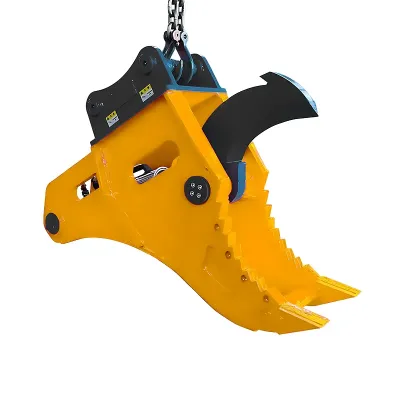
Picking the right excavator shear isn't just about grabbing the one that looks tough—it's about matching the attachment to your machine, your job, and the materials you're cutting. Get it wrong, and you could end up with a shear that's too heavy for your boom, strains your hydraulics, or simply can't handle the workload. Go too small, and you'll waste time making extra passes. The trick is to walk through a few key considerations: what you're cutting, what your excavator can handle, whether you need rotation, and how the thing mounts up. Run through these steps, and you'll land on a shear that cuts clean, lasts long, and keeps your operation safe and productive.
Start With the Primary Application
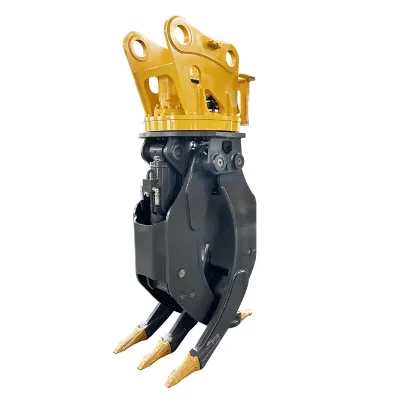
The very first thing to nail down is what you're actually going to be doing with the shear, because that dictates which type makes sense. If you're into building demolition and structural renovation—cutting concrete slabs, columns, beams, and the rebar inside them—you're looking at a multi-purpose demolition shear with swappable blades for concrete and light metal. These are the Swiss Army knives of the shear world; they save you from switching attachments on a mixed site, which keeps productivity up.
If your thing is scrap yards and metal recycling—processing steel, structural sections, plate, and rebar day in and day out—you'll get better results from a dedicated scrap metal shear with jaw geometry and blades that are all about metal. For yards that handle bulky, odd-shaped scrap where you need even force across the jaw width, a double-cylinder scrap shear with twin synchronized cylinders keeps things from twisting and gives you clean cuts on wide materials. Auto wreckers and vehicle recyclers should lean toward a specialized vehicle dismantling shear with a narrow jaw that can reach into tight spots and blades tuned for automotive sheet metal and frame sections. If you wear a few different hats, a multi-purpose shear might be your best bet; if you stick to one lane, a specialized shear will give you higher throughput.
Match the Shear to the Excavator Operating Weight
Once you've settled on the type, the next move is sizing it to your excavator's operating weight. Shear manufacturers put a recommended carrier weight range on each model, and staying within that window ensures your machine has the stability, lift capacity, and structural backbone to handle the attachment safely. The shear's own weight is a big deal here—the combined weight of the shear plus whatever you're cutting can't exceed what your excavator can lift at the reach and height you're working at. Push past that limit, and you're asking for trouble: tip-overs, boom damage, and hazardous situations for everyone on site.
Compact and mini excavators in the lower weight classes have smaller shear options with lighter weight and lower cutting force—fine for light demo and small-scale metal work. Mid-size machines in the common construction range can handle medium shears with moderate cutting power for general demo and scrap. Large production excavators need heavy-duty shears with serious cutting force for thick steel and big structural members. Also keep in mind that lift capacity drops the farther you reach out, so a shear that's manageable at close range might be too much at full extension. Always check the excavator's lift chart for the reach and height you'll actually be using.
Verify Hydraulic Flow and Pressure Compatibility
Hydraulic matching is where a lot of people stumble, but it's critical. The excavator's auxiliary hydraulic flow needs to line up with what the shear's cylinders and optional rotation motor require. Too little flow and the jaws crawl; too much and you generate heat, over-speed the cylinders, and wear out seals and internals faster. Operating pressure also has to be within the shear's specified range, and the auxiliary circuit relief valve should be set to the manufacturer's recommended max to avoid overpressure damage. If you're looking at a rotating shear, you'll need a second auxiliary circuit or a diverter valve to run the rotation motor separately from the jaw cylinders—make sure your excavator has that capability or can be modified to support it.
When your excavator's hydraulic specs fall between two shear models, it's generally safer to go with the one that wants a little less flow and pressure than your machine can deliver. It'll still work fine, though cycle times might be a touch longer. Going the other way—a shear that needs more than your excavator can give—means poor performance and potential damage to your hydraulic system. Also think about cooling: continuous shear work generates a lot of heat, so make sure your excavator's hydraulic cooling system is up to the task. For operations that run the shear hard for long stretches, you might need to add extra cooling capacity.
Evaluate Rotation and Mounting Requirements
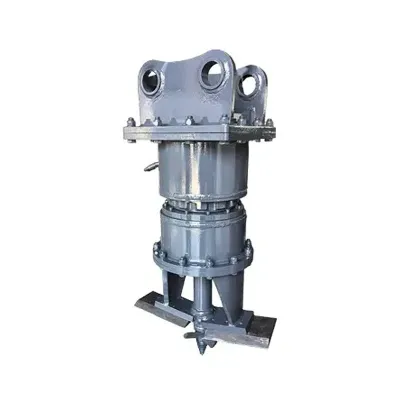
Whether you need rotation depends on the job. Rotating shears with 360-degree continuous rotation let you angle the jaws any way you want without moving the excavator—huge advantage in tight demolition sites, indoor work, vehicle dismantling, and any time you need precise alignment. Rotation also helps you keep the jaws square to the material for maximum cutting force, cuts down on machine repositioning, and saves wear on the undercarriage. Non-rotating shears are simpler, lighter, and cheaper, and they work fine when you can easily reposition the excavator and don't need fine-tuned angles.
Mounting is the other half of the equation. Direct pin-on mounting needs a custom bracket with the right pin-to-pin spacing, pin diameter, and stick width for your specific excavator model. If your machine has a mechanical or hydraulic quick coupler, the bracket has to match that coupler interface so you can swap attachments without leaving the cab. Most shear makers have bracket data for all the major excavator brands and can set you up with the right configuration. When you order, give them the excavator make, model, pin dimensions, and coupler type to make sure the bracket fits like it should.
Consider Total Cost of Ownership
Don't just look at the sticker price—total cost of ownership is where the real math happens. That includes wear parts, maintenance, downtime, and how long the shear is expected to last. Cutting blades are the big consumable, and how often you replace them depends on what you're cutting; abrasive concrete and high-strength steel eat blades faster than mild steel and sheet metal. Pivot pins and bushings need regular greasing and occasional replacement, and hydraulic seals, hoses, and the rotation motor (if you have one) are additional maintenance items. Going with a manufacturer that offers readily available wear parts at reasonable prices, and backs it up with solid technical support, keeps your long-term costs down and minimizes downtime.
For dealers, rental outfits, and contractors running multiple machines, standardizing on one shear brand and model line simplifies parts inventory, operator training, and maintenance routines. OEM and private-label programs can also make sense for volume buyers, with custom branding and marketing support thrown in. When you're weighing total cost, factor in expected annual usage hours, the materials you typically process, local parts availability, and the manufacturer's warranty and support. A better-built shear with a longer service life and easy parts access often ends up cheaper in the long run than a bargain unit that needs more frequent replacement and leaves you waiting on parts.